

217
Ionic interactions are actually salt bridges between ionizable groups of a protein
that has negative and positive charge. Damodaran (2008), Li-Chan (2012) proposed
that electrostatic interactions between oppositely charged ion pairs are strong, and
certainly have an influence on protein folding patterns, therefore they contribute
little to the stability of a protein since these charged groups can also interact
with water.
Covalent Bonds
Disulfide bonds (S–S) are the only covalent cross linkages found in protein molecules and are formed between sulfhydryl (thiol) groups of two cysteine molecules
in the presence of oxidizing environment. Disulfide bonds can be inter or intramolecular and help in the stabilization of folded protein structure.
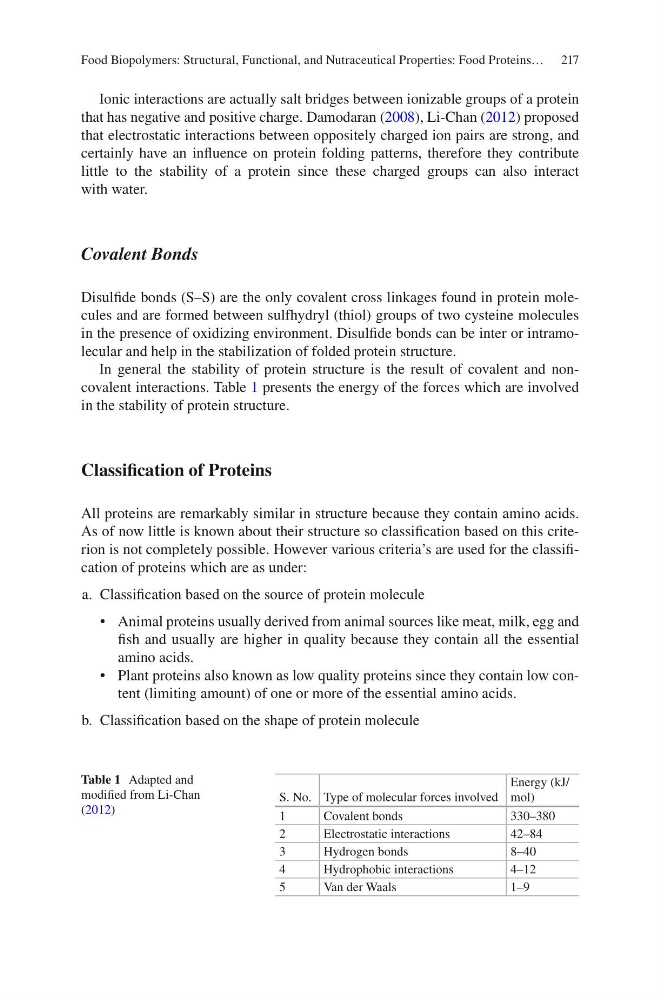
In general the stability of protein structure is the result of covalent and noncovalent interactions. Table 1 presents the energy of the forces which are involved
in the stability of protein structure.
Classification of Proteins
All proteins are remarkably similar in structure because they contain amino acids.
As of now little is known about their structure so classification based on this criterion is not completely possible. However various criteria’s are used for the classification of proteins which are as under:
a. Classification based on the source of protein molecule
• Animal proteins usually derived from animal sources like meat, milk, egg and
fish and usually are higher in quality because they contain all the essential
amino acids.
• Plant proteins also known as low quality proteins since they contain low content (limiting amount) of one or more of the essential amino acids.
b. Classification based on the shape of protein molecule
Table 1 Adapted and
modified from Li-Chan
(2012)
S. No. Type of molecular forces involved
Energy (kJ/
mol)
1
Covalent bonds
330–380
2
Electrostatic interactions
42–84
3
Hydrogen bonds
8–40
4
Hydrophobic interactions
4–12
5
Van der Waals
1–9
Food Biopolymers: Structural, Functional, and Nutraceutical Properties: Food Proteins…
Ionic interactions are actually salt bridges between ionizable groups of a protein
that has negative and positive charge. Damodaran (2008), Li-Chan (2012) proposed
that electrostatic interactions between oppositely charged ion pairs are strong, and
certainly have an influence on protein folding patterns, therefore they contribute
little to the stability of a protein since these charged groups can also interact
with water.
Covalent Bonds
Disulfide bonds (S–S) are the only covalent cross linkages found in protein molecules and are formed between sulfhydryl (thiol) groups of two cysteine molecules
in the presence of oxidizing environment. Disulfide bonds can be inter or intramolecular and help in the stabilization of folded protein structure.
In general the stability of protein structure is the result of covalent and noncovalent interactions. Table 1 presents the energy of the forces which are involved
in the stability of protein structure.
Classification of Proteins
All proteins are remarkably similar in structure because they contain amino acids.
As of now little is known about their structure so classification based on this criterion is not completely possible. However various criteria’s are used for the classification of proteins which are as under:
a. Classification based on the source of protein molecule
• Animal proteins usually derived from animal sources like meat, milk, egg and
fish and usually are higher in quality because they contain all the essential
amino acids.
• Plant proteins also known as low quality proteins since they contain low content (limiting amount) of one or more of the essential amino acids.
b. Classification based on the shape of protein molecule
Table 1 Adapted and
modified from Li-Chan
(2012)
S. No. Type of molecular forces involved
Energy (kJ/
mol)
1
Covalent bonds
330–380
2
Electrostatic interactions
42–84
3
Hydrogen bonds
8–40
4
Hydrophobic interactions
4–12
5
Van der Waals
1–9
Food Biopolymers: Structural, Functional, and Nutraceutical Properties: Food Proteins…