

212
into the alimentary canal. In addition to this the effectiveness of use of proteins
largely depends upon the functional characteristics which can be tailored to meet
the needs of food products and manufacturers. The functional attributes of the food
proteins depend primarily on their molecular size, charge distribution and three
dimensional structures. Among functional properties the most important ones
include hydration, water/oil combination, gelling, emulsification, foam formation
and rheological behaviors. Therefore, proteins in the form of isolates or concentrates can be used in a wide variety of bakery, meat, dairy and other food products
in order to impart desirable sensorial and textural characteristics and to produce
some novel functionalities.
Protein Structure
Protein structure sets the foundation for its interaction with other molecules in the
body and therefore determines its function. Protein molecules are usually single,
unbranched chains of amino acids and monomers. In general protein molecules are
made up of 20 different amino acids (Fig. 2). The amino acid side chains in a peptide can become modified and in turn extend the functional repertoire of amino
acids to more than hundred different amino acids. In addition to this the amino acid
sequence of proteins determine its three dimensional structure (confirmation) which
in turn determines the functionality of the protein.
In general a protein structure is divided into four different types depending upon
the sequence of amino acids present in the structure. These four levels of structure
determines the shape of proteins, the four types of structure are:
1. Primary structure
The primary structure of proteins consists of a sequence of amino acids linked
together by peptide bonds and includes any disulfide bonds. It is also characterized by genetic code and post translational covalent modifications and it ultimately determines the physicochemical and functional properties of food.
However the secondary, tertiary and quaternary structure determines the biological functions of proteins.
2. Secondary structure
SIDE CHAIN
CARBOXYLIC GROUP
AMINOGROUP
ALPHA CARBON
H
H
N
H
O
C
C α
R
O
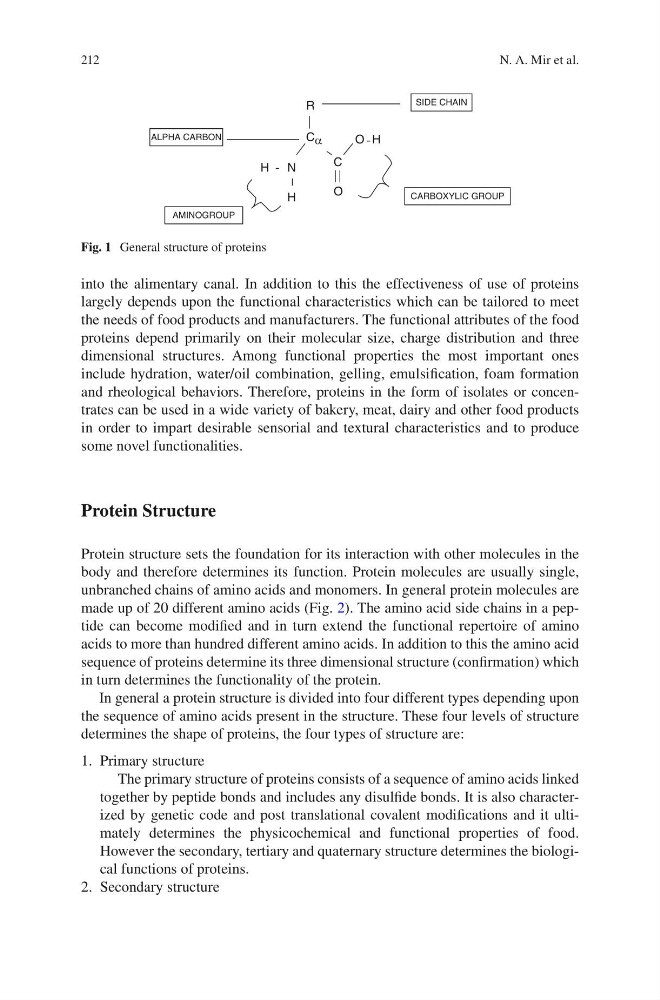
Fig. 1 General structure of proteins
N. A. Mir et al.
into the alimentary canal. In addition to this the effectiveness of use of proteins
largely depends upon the functional characteristics which can be tailored to meet
the needs of food products and manufacturers. The functional attributes of the food
proteins depend primarily on their molecular size, charge distribution and three
dimensional structures. Among functional properties the most important ones
include hydration, water/oil combination, gelling, emulsification, foam formation
and rheological behaviors. Therefore, proteins in the form of isolates or concentrates can be used in a wide variety of bakery, meat, dairy and other food products
in order to impart desirable sensorial and textural characteristics and to produce
some novel functionalities.
Protein Structure
Protein structure sets the foundation for its interaction with other molecules in the
body and therefore determines its function. Protein molecules are usually single,
unbranched chains of amino acids and monomers. In general protein molecules are
made up of 20 different amino acids (Fig. 2). The amino acid side chains in a peptide can become modified and in turn extend the functional repertoire of amino
acids to more than hundred different amino acids. In addition to this the amino acid
sequence of proteins determine its three dimensional structure (confirmation) which
in turn determines the functionality of the protein.
In general a protein structure is divided into four different types depending upon
the sequence of amino acids present in the structure. These four levels of structure
determines the shape of proteins, the four types of structure are:
1. Primary structure
The primary structure of proteins consists of a sequence of amino acids linked
together by peptide bonds and includes any disulfide bonds. It is also characterized by genetic code and post translational covalent modifications and it ultimately determines the physicochemical and functional properties of food.
However the secondary, tertiary and quaternary structure determines the biological functions of proteins.
2. Secondary structure
SIDE CHAIN
CARBOXYLIC GROUP
AMINOGROUP
ALPHA CARBON
H
H
N
H
O
C
C α
R
O
Fig. 1 General structure of proteins
N. A. Mir et al.