

202
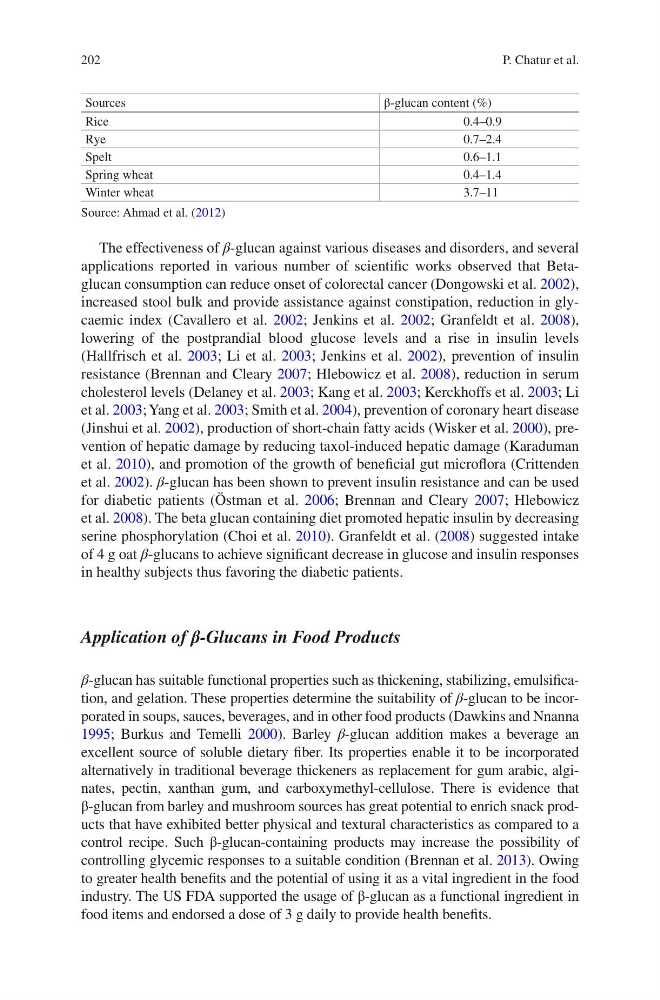
Sources
β-glucan content (%)
Rice
0.4–0.9
Rye
0.7–2.4
Spelt
0.6–1.1
Spring wheat
0.4–1.4
Winter wheat
3.7–11
Source: Ahmad et al. (2012)
The effectiveness of β-glucan against various diseases and disorders, and several
applications reported in various number of scientific works observed that Betaglucan consumption can reduce onset of colorectal cancer (Dongowski et al. 2002),
increased stool bulk and provide assistance against constipation, reduction in glycaemic index (Cavallero et al. 2002; Jenkins et al. 2002; Granfeldt et al. 2008),
lowering of the postprandial blood glucose levels and a rise in insulin levels
(Hallfrisch et al. 2003; Li et al. 2003; Jenkins et al. 2002), prevention of insulin
resistance (Brennan and Cleary 2007; Hlebowicz et al. 2008), reduction in serum
cholesterol levels (Delaney et al. 2003; Kang et al. 2003; Kerckhoffs et al. 2003; Li
et al. 2003; Yang et al. 2003; Smith et al. 2004), prevention of coronary heart disease
(Jinshui et al. 2002), production of short-chain fatty acids (Wisker et al. 2000), prevention of hepatic damage by reducing taxol-induced hepatic damage (Karaduman
et al. 2010), and promotion of the growth of beneficial gut microflora (Crittenden
et al. 2002). β-glucan has been shown to prevent insulin resistance and can be used
for diabetic patients (Östman et al. 2006; Brennan and Cleary 2007; Hlebowicz
et al. 2008). The beta glucan containing diet promoted hepatic insulin by decreasing
serine phosphorylation (Choi et al. 2010). Granfeldt et al. (2008) suggested intake
of 4 g oat β-glucans to achieve significant decrease in glucose and insulin responses
in healthy subjects thus favoring the diabetic patients.
Application of β-Glucans in Food Products
β-glucan has suitable functional properties such as thickening, stabilizing, emulsification, and gelation. These properties determine the suitability of β-glucan to be incorporated in soups, sauces, beverages, and in other food products (Dawkins and Nnanna
1995; Burkus and Temelli 2000). Barley β-glucan addition makes a beverage an
excellent source of soluble dietary fiber. Its properties enable it to be incorporated
alternatively in traditional beverage thickeners as replacement for gum arabic, alginates, pectin, xanthan gum, and carboxymethyl-cellulose. There is evidence that
β-glucan from barley and mushroom sources has great potential to enrich snack products that have exhibited better physical and textural characteristics as compared to a
control recipe. Such β-glucan-containing products may increase the possibility of
controlling glycemic responses to a suitable condition (Brennan et al. 2013). Owing
to greater health benefits and the potential of using it as a vital ingredient in the food
industry. The US FDA supported the usage of β-glucan as a functional ingredient in
food items and endorsed a dose of 3 g daily to provide health benefits.
P. Chatur et al.
Sources
β-glucan content (%)
Rice
0.4–0.9
Rye
0.7–2.4
Spelt
0.6–1.1
Spring wheat
0.4–1.4
Winter wheat
3.7–11
Source: Ahmad et al. (2012)
The effectiveness of β-glucan against various diseases and disorders, and several
applications reported in various number of scientific works observed that Betaglucan consumption can reduce onset of colorectal cancer (Dongowski et al. 2002),
increased stool bulk and provide assistance against constipation, reduction in glycaemic index (Cavallero et al. 2002; Jenkins et al. 2002; Granfeldt et al. 2008),
lowering of the postprandial blood glucose levels and a rise in insulin levels
(Hallfrisch et al. 2003; Li et al. 2003; Jenkins et al. 2002), prevention of insulin
resistance (Brennan and Cleary 2007; Hlebowicz et al. 2008), reduction in serum
cholesterol levels (Delaney et al. 2003; Kang et al. 2003; Kerckhoffs et al. 2003; Li
et al. 2003; Yang et al. 2003; Smith et al. 2004), prevention of coronary heart disease
(Jinshui et al. 2002), production of short-chain fatty acids (Wisker et al. 2000), prevention of hepatic damage by reducing taxol-induced hepatic damage (Karaduman
et al. 2010), and promotion of the growth of beneficial gut microflora (Crittenden
et al. 2002). β-glucan has been shown to prevent insulin resistance and can be used
for diabetic patients (Östman et al. 2006; Brennan and Cleary 2007; Hlebowicz
et al. 2008). The beta glucan containing diet promoted hepatic insulin by decreasing
serine phosphorylation (Choi et al. 2010). Granfeldt et al. (2008) suggested intake
of 4 g oat β-glucans to achieve significant decrease in glucose and insulin responses
in healthy subjects thus favoring the diabetic patients.
Application of β-Glucans in Food Products
β-glucan has suitable functional properties such as thickening, stabilizing, emulsification, and gelation. These properties determine the suitability of β-glucan to be incorporated in soups, sauces, beverages, and in other food products (Dawkins and Nnanna
1995; Burkus and Temelli 2000). Barley β-glucan addition makes a beverage an
excellent source of soluble dietary fiber. Its properties enable it to be incorporated
alternatively in traditional beverage thickeners as replacement for gum arabic, alginates, pectin, xanthan gum, and carboxymethyl-cellulose. There is evidence that
β-glucan from barley and mushroom sources has great potential to enrich snack products that have exhibited better physical and textural characteristics as compared to a
control recipe. Such β-glucan-containing products may increase the possibility of
controlling glycemic responses to a suitable condition (Brennan et al. 2013). Owing
to greater health benefits and the potential of using it as a vital ingredient in the food
industry. The US FDA supported the usage of β-glucan as a functional ingredient in
food items and endorsed a dose of 3 g daily to provide health benefits.
P. Chatur et al.