

130
commercial pectin has another variant called amidated low methoxy pectin (ALMP).
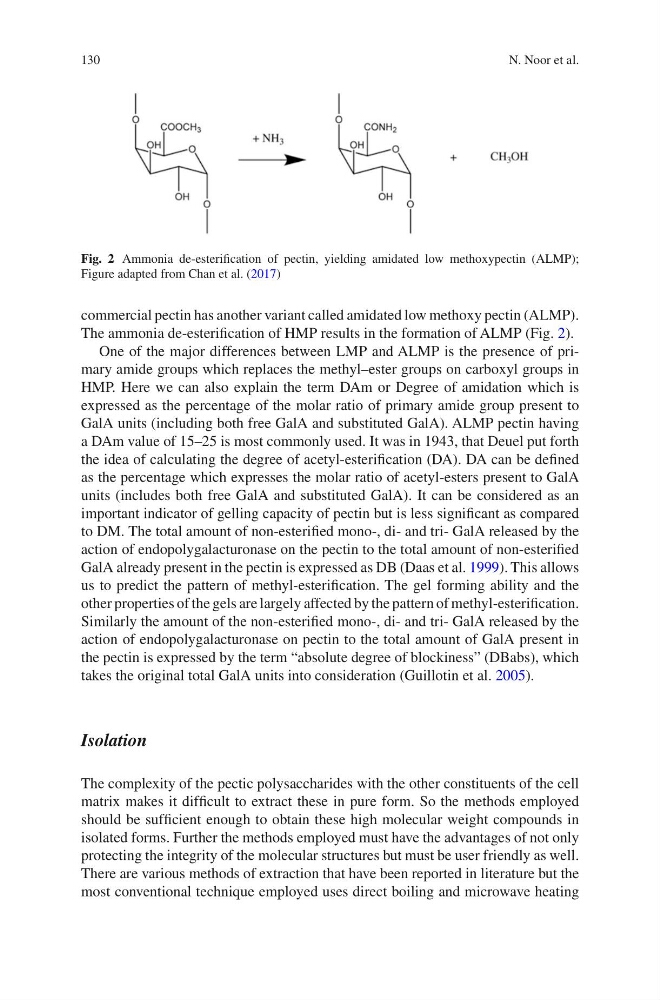
The ammonia de-esterification of HMP results in the formation of ALMP (Fig. 2).
One of the major differences between LMP and ALMP is the presence of primary amide groups which replaces the methyl–ester groups on carboxyl groups in
HMP. Here we can also explain the term DAm or Degree of amidation which is
expressed as the percentage of the molar ratio of primary amide group present to
GalA units (including both free GalA and substituted GalA). ALMP pectin having
a DAm value of 15–25 is most commonly used. It was in 1943, that Deuel put forth
the idea of calculating the degree of acetyl-esterification (DA). DA can be defined
as the percentage which expresses the molar ratio of acetyl-esters present to GalA
units (includes both free GalA and substituted GalA). It can be considered as an
important indicator of gelling capacity of pectin but is less significant as compared
to DM. The total amount of non-esterified mono-, di- and tri- GalA released by the
action of endopolygalacturonase on the pectin to the total amount of non-esterified
GalA already present in the pectin is expressed as DB (Daas et al. 1999). This allows
us to predict the pattern of methyl-esterification. The gel forming ability and the
other properties of the gels are largely affected by the pattern of methyl- esterification.
Similarly the amount of the non-esterified mono-, di- and tri- GalA released by the
action of endopolygalacturonase on pectin to the total amount of GalA present in
the pectin is expressed by the term “absolute degree of blockiness” (DBabs), which
takes the original total GalA units into consideration (Guillotin et al. 2005).
Isolation
The complexity of the pectic polysaccharides with the other constituents of the cell
matrix makes it difficult to extract these in pure form. So the methods employed
should be sufficient enough to obtain these high molecular weight compounds in
isolated forms. Further the methods employed must have the advantages of not only
protecting the integrity of the molecular structures but must be user friendly as well.
There are various methods of extraction that have been reported in literature but the
most conventional technique employed uses direct boiling and microwave heating
Fig. 2 Ammonia de-esterification of pectin, yielding amidated low methoxypectin (ALMP);
Figure adapted from Chan et al. (2017)
N. Noor et al.
commercial pectin has another variant called amidated low methoxy pectin (ALMP).
The ammonia de-esterification of HMP results in the formation of ALMP (Fig. 2).
One of the major differences between LMP and ALMP is the presence of primary amide groups which replaces the methyl–ester groups on carboxyl groups in
HMP. Here we can also explain the term DAm or Degree of amidation which is
expressed as the percentage of the molar ratio of primary amide group present to
GalA units (including both free GalA and substituted GalA). ALMP pectin having
a DAm value of 15–25 is most commonly used. It was in 1943, that Deuel put forth
the idea of calculating the degree of acetyl-esterification (DA). DA can be defined
as the percentage which expresses the molar ratio of acetyl-esters present to GalA
units (includes both free GalA and substituted GalA). It can be considered as an
important indicator of gelling capacity of pectin but is less significant as compared
to DM. The total amount of non-esterified mono-, di- and tri- GalA released by the
action of endopolygalacturonase on the pectin to the total amount of non-esterified
GalA already present in the pectin is expressed as DB (Daas et al. 1999). This allows
us to predict the pattern of methyl-esterification. The gel forming ability and the
other properties of the gels are largely affected by the pattern of methyl- esterification.
Similarly the amount of the non-esterified mono-, di- and tri- GalA released by the
action of endopolygalacturonase on pectin to the total amount of GalA present in
the pectin is expressed by the term “absolute degree of blockiness” (DBabs), which
takes the original total GalA units into consideration (Guillotin et al. 2005).
Isolation
The complexity of the pectic polysaccharides with the other constituents of the cell
matrix makes it difficult to extract these in pure form. So the methods employed
should be sufficient enough to obtain these high molecular weight compounds in
isolated forms. Further the methods employed must have the advantages of not only
protecting the integrity of the molecular structures but must be user friendly as well.
There are various methods of extraction that have been reported in literature but the
most conventional technique employed uses direct boiling and microwave heating
Fig. 2 Ammonia de-esterification of pectin, yielding amidated low methoxypectin (ALMP);
Figure adapted from Chan et al. (2017)
N. Noor et al.