

person does not mean getting infected, so masked mode and distance in transport
and other public places must remain mandatory. Workers in transport, trade,
pharmacies, police (all of whom are forced to have many contacts) must be provided with enhanced protection. People at risk should continue to refrain from
traveling, visiting indoors and minimizing visits to medical facilities. Where it is
possible, distant work and study should be maintained. For ordinary citizens
working in small groups, the risk of meeting an infected person depends on the
transport situation. If cars and metro stations, land transport will be regularly
decontaminated, then the values of M and P for passengers will be small. Everyone
can assess their own level of risk (allowable probability) using formula (4.22).
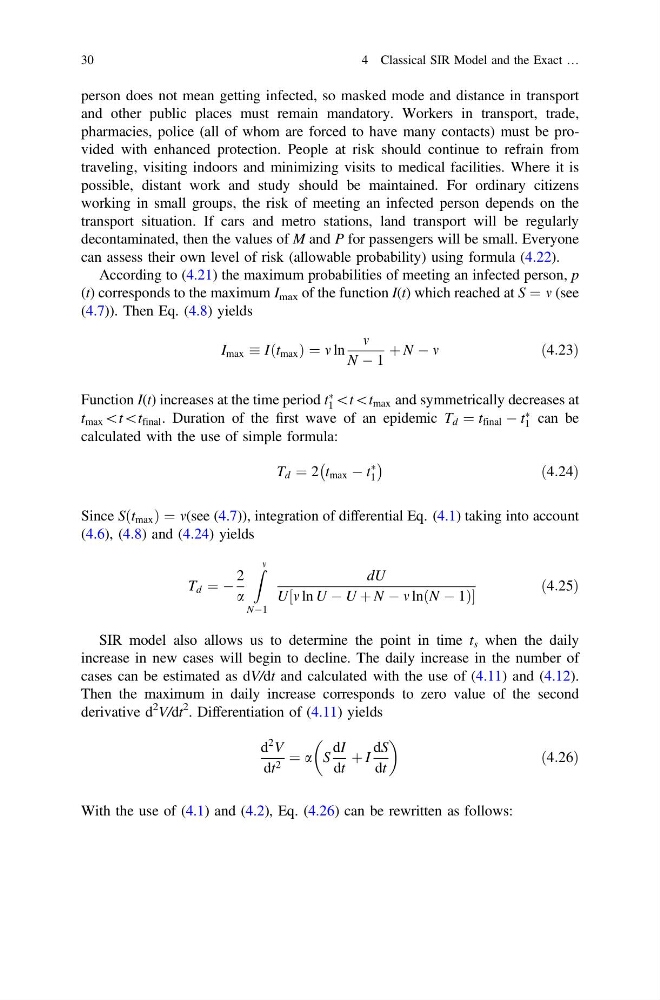
According to (4.21) the maximum probabilities of meeting an infected person, p
(t) corresponds to the maximum I max of the function I(t) which reached at S ¼ m (see
(4.7)). Then Eq. (4.8) yields
I max I t max
ð
Þ ¼ m ln
m
N À 1
þ N À m
ð4:23Þ
Function I(t) increases at the time period t
Ã
1 \t\t max and symmetrically decreases at
t max \t\t final . Duration of the first wave of an epidemic T d ¼ t final À t
Ã
1 can be
calculated with the use of simple formula:
T d ¼ 2 t max À t
Ã
1
À
Á
ð4:24Þ
Since S t max
ð
Þ ¼ m(see (4.7)), integration of differential Eq. (4.1) taking into account
(4.6), (4.8) and (4.24) yields
T d ¼ À
2
a
Z m
NÀ1
dU
U m ln U À U þ N À m lnðN À 1Þ
½
ð4:25Þ
SIR model also allows us to determine the point in time t s when the daily
increase in new cases will begin to decline. The daily increase in the number of
cases can be estimated as dV/dt and calculated with the use of (4.11) and (4.12).
Then the maximum in daily increase corresponds to zero value of the second
derivative d
2 V/dt
2 . Differentiation of (4.11) yields
d
2 V
dt 2 ¼ a S
dI
dt
þ I
dS
dt
ð4:26Þ
With the use of (4.1) and (4.2), Eq. (4.26) can be rewritten as follows:
30
4 Classical SIR Model and the Exact …
and other public places must remain mandatory. Workers in transport, trade,
pharmacies, police (all of whom are forced to have many contacts) must be provided with enhanced protection. People at risk should continue to refrain from
traveling, visiting indoors and minimizing visits to medical facilities. Where it is
possible, distant work and study should be maintained. For ordinary citizens
working in small groups, the risk of meeting an infected person depends on the
transport situation. If cars and metro stations, land transport will be regularly
decontaminated, then the values of M and P for passengers will be small. Everyone
can assess their own level of risk (allowable probability) using formula (4.22).
According to (4.21) the maximum probabilities of meeting an infected person, p
(t) corresponds to the maximum I max of the function I(t) which reached at S ¼ m (see
(4.7)). Then Eq. (4.8) yields
I max I t max
ð
Þ ¼ m ln
m
N À 1
þ N À m
ð4:23Þ
Function I(t) increases at the time period t
Ã
1 \t\t max and symmetrically decreases at
t max \t\t final . Duration of the first wave of an epidemic T d ¼ t final À t
Ã
1 can be
calculated with the use of simple formula:
T d ¼ 2 t max À t
Ã
1
À
Á
ð4:24Þ
Since S t max
ð
Þ ¼ m(see (4.7)), integration of differential Eq. (4.1) taking into account
(4.6), (4.8) and (4.24) yields
T d ¼ À
2
a
Z m
NÀ1
dU
U m ln U À U þ N À m lnðN À 1Þ
½
ð4:25Þ
SIR model also allows us to determine the point in time t s when the daily
increase in new cases will begin to decline. The daily increase in the number of
cases can be estimated as dV/dt and calculated with the use of (4.11) and (4.12).
Then the maximum in daily increase corresponds to zero value of the second
derivative d
2 V/dt
2 . Differentiation of (4.11) yields
d
2 V
dt 2 ¼ a S
dI
dt
þ I
dS
dt
ð4:26Þ
With the use of (4.1) and (4.2), Eq. (4.26) can be rewritten as follows:
30
4 Classical SIR Model and the Exact …