

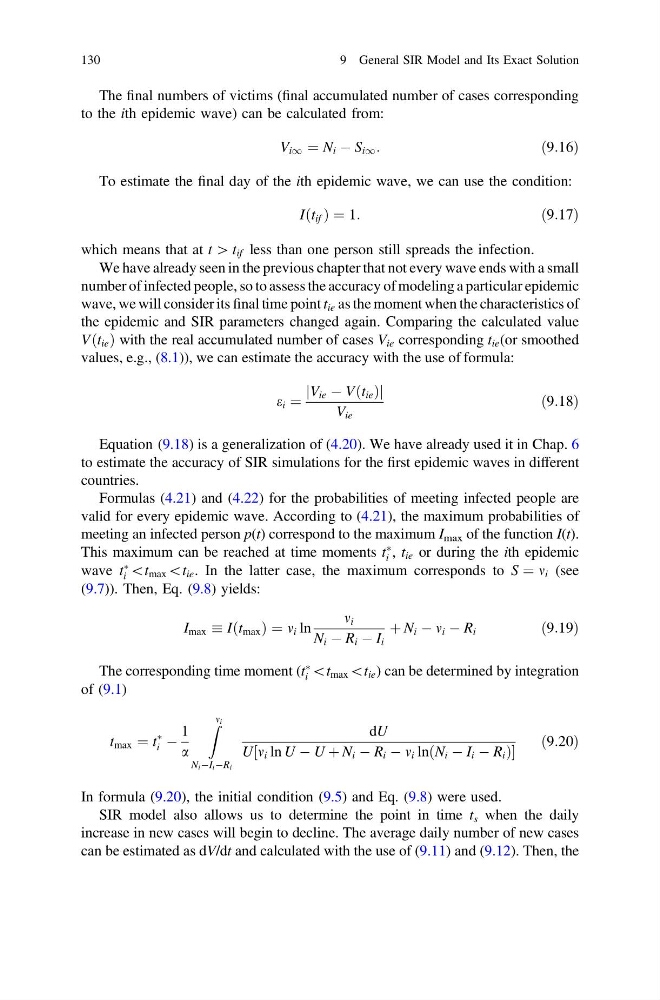
The final numbers of victims (final accumulated number of cases corresponding
to the ith epidemic wave) can be calculated from:
V i1 ¼ N i À S i1 :
ð9:16Þ
To estimate the final day of the ith epidemic wave, we can use the condition:
Iðt if Þ ¼ 1:
ð9:17Þ
which means that at t [ t if less than one person still spreads the infection.
We have already seen in the previous chapter that not every wave ends with a small
number of infected people, so to assess the accuracy of modeling a particular epidemic
wave, we will consider its final time point t ie as the moment when the characteristics of
the epidemic and SIR parameters changed again. Comparing the calculated value
Vðt ie Þ with the real accumulated number of cases V ie corresponding t ie (or smoothed
values, e.g., (8.1)), we can estimate the accuracy with the use of formula:
e i ¼
V ie À Vðt ie Þ
j
j
V ie
ð9:18Þ
Equation (9.18) is a generalization of (4.20). We have already used it in Chap. 6
to estimate the accuracy of SIR simulations for the first epidemic waves in different
countries.
Formulas (4.21) and (4.22) for the probabilities of meeting infected people are
valid for every epidemic wave. According to (4.21), the maximum probabilities of
meeting an infected person p(t) correspond to the maximum I max of the function I(t).
This maximum can be reached at time moments t
Ã
i , t ie or during the ith epidemic
wave t
Ã
i \t max \t ie . In the latter case, the maximum corresponds to S ¼ m i (see
(9.7)). Then, Eq. (9.8) yields:
I max Iðt max Þ ¼ m i ln
m i
N i À R i À I i
þ N i À m i À R i
ð9:19Þ
The corresponding time moment (t
Ã
i \t max \t ie ) can be determined by integration
of (9.1)
t max ¼ t
Ã
i À
1
a
Z m i
N i ÀI i ÀR i
dU
U m i ln U À U þ N i À R i À m i lnðN i À I i À R i Þ
½
ð9:20Þ
In formula (9.20), the initial condition (9.5) and Eq. (9.8) were used.
SIR model also allows us to determine the point in time t s when the daily
increase in new cases will begin to decline. The average daily number of new cases
can be estimated as dV/dt and calculated with the use of (9.11) and (9.12). Then, the
130
9 General SIR Model and Its Exact Solution
to the ith epidemic wave) can be calculated from:
V i1 ¼ N i À S i1 :
ð9:16Þ
To estimate the final day of the ith epidemic wave, we can use the condition:
Iðt if Þ ¼ 1:
ð9:17Þ
which means that at t [ t if less than one person still spreads the infection.
We have already seen in the previous chapter that not every wave ends with a small
number of infected people, so to assess the accuracy of modeling a particular epidemic
wave, we will consider its final time point t ie as the moment when the characteristics of
the epidemic and SIR parameters changed again. Comparing the calculated value
Vðt ie Þ with the real accumulated number of cases V ie corresponding t ie (or smoothed
values, e.g., (8.1)), we can estimate the accuracy with the use of formula:
e i ¼
V ie À Vðt ie Þ
j
j
V ie
ð9:18Þ
Equation (9.18) is a generalization of (4.20). We have already used it in Chap. 6
to estimate the accuracy of SIR simulations for the first epidemic waves in different
countries.
Formulas (4.21) and (4.22) for the probabilities of meeting infected people are
valid for every epidemic wave. According to (4.21), the maximum probabilities of
meeting an infected person p(t) correspond to the maximum I max of the function I(t).
This maximum can be reached at time moments t
Ã
i , t ie or during the ith epidemic
wave t
Ã
i \t max \t ie . In the latter case, the maximum corresponds to S ¼ m i (see
(9.7)). Then, Eq. (9.8) yields:
I max Iðt max Þ ¼ m i ln
m i
N i À R i À I i
þ N i À m i À R i
ð9:19Þ
The corresponding time moment (t
Ã
i \t max \t ie ) can be determined by integration
of (9.1)
t max ¼ t
Ã
i À
1
a
Z m i
N i ÀI i ÀR i
dU
U m i ln U À U þ N i À R i À m i lnðN i À I i À R i Þ
½
ð9:20Þ
In formula (9.20), the initial condition (9.5) and Eq. (9.8) were used.
SIR model also allows us to determine the point in time t s when the daily
increase in new cases will begin to decline. The average daily number of new cases
can be estimated as dV/dt and calculated with the use of (9.11) and (9.12). Then, the
130
9 General SIR Model and Its Exact Solution