

218
C. Nabukalu and R. Giere
2018) and its low price. For example, a standard 3-kilogram (kg) bag
of charcoal costs as little as e1.99 in Germany (WWF, 2018). Even
when prices fall, producers continue to export depending on marginal
profits and contractual terms imposed by exporters to sustain supply.
Conversely, price increases by exporters make the trade attractive, thus
increasing the number of local producers, and adding pressure to existing
vegetation (Zimmermann & Joubert, 2002). The influence of foreign
exchange rates on charcoal prices was briefly discussed by Asfaw and
Demissie (2012) in their study of Ethiopia.
Our comparison of the most recent export data for the same years
within the past decade showing the valuation of ‘wood charcoal’ from
Africa revealed that there are enormous discrepancies in the estimated
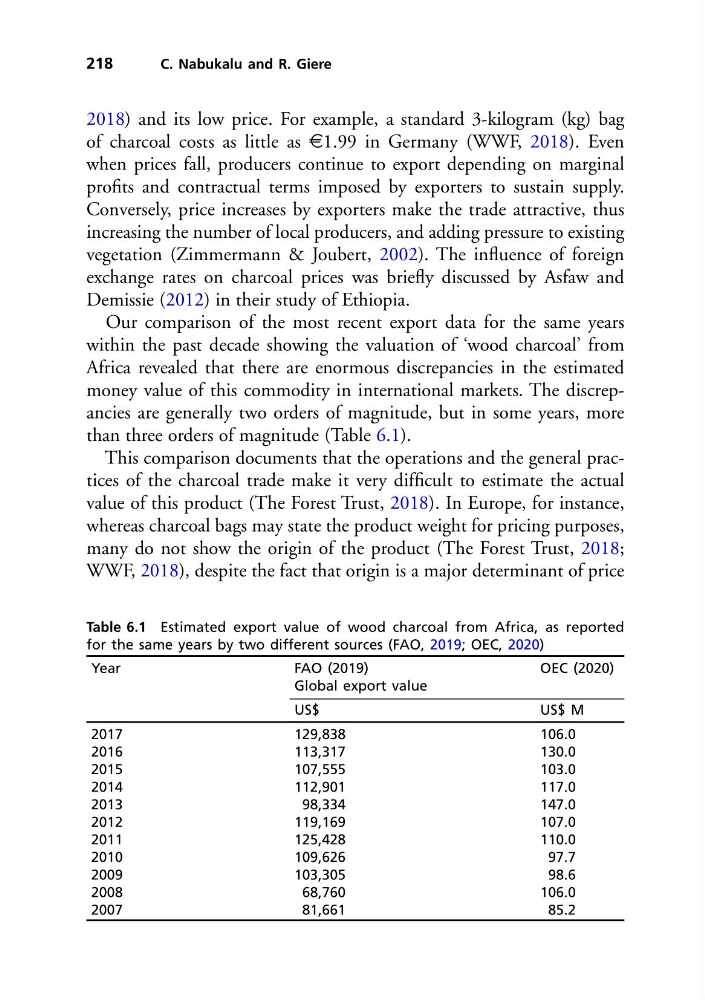
money value of this commodity in international markets. The discrepancies are generally two orders of magnitude, but in some years, more
than three orders of magnitude (Table 6.1).
This comparison documents that the operations and the general practices of the charcoal trade make it very difficult to estimate the actual
value of this product (The Forest Trust, 2018). In Europe, for instance,
whereas charcoal bags may state the product weight for pricing purposes,
many do not show the origin of the product (The Forest Trust, 2018;
WWF, 2018), despite the fact that origin is a major determinant of price
Table 6.1 Estimated export value of wood charcoal from Africa, as reported
for the same years by two different sources (FAO, 2019; OEC, 2020)
Year
FAO (2019)
OEC (2020)
Global export value
US$
US$ M
2017
129,838
106.0
2016
113,317
130.0
2015
107,555
103.0
2014
112,901
117.0
2013
98,334
147.0
2012
119,169
107.0
2011
125,428
110.0
2010
109,626
97.7
2009
103,305
98.6
2008
68,760
106.0
2007
81,661
85.2
C. Nabukalu and R. Giere
2018) and its low price. For example, a standard 3-kilogram (kg) bag
of charcoal costs as little as e1.99 in Germany (WWF, 2018). Even
when prices fall, producers continue to export depending on marginal
profits and contractual terms imposed by exporters to sustain supply.
Conversely, price increases by exporters make the trade attractive, thus
increasing the number of local producers, and adding pressure to existing
vegetation (Zimmermann & Joubert, 2002). The influence of foreign
exchange rates on charcoal prices was briefly discussed by Asfaw and
Demissie (2012) in their study of Ethiopia.
Our comparison of the most recent export data for the same years
within the past decade showing the valuation of ‘wood charcoal’ from
Africa revealed that there are enormous discrepancies in the estimated
money value of this commodity in international markets. The discrepancies are generally two orders of magnitude, but in some years, more
than three orders of magnitude (Table 6.1).
This comparison documents that the operations and the general practices of the charcoal trade make it very difficult to estimate the actual
value of this product (The Forest Trust, 2018). In Europe, for instance,
whereas charcoal bags may state the product weight for pricing purposes,
many do not show the origin of the product (The Forest Trust, 2018;
WWF, 2018), despite the fact that origin is a major determinant of price
Table 6.1 Estimated export value of wood charcoal from Africa, as reported
for the same years by two different sources (FAO, 2019; OEC, 2020)
Year
FAO (2019)
OEC (2020)
Global export value
US$
US$ M
2017
129,838
106.0
2016
113,317
130.0
2015
107,555
103.0
2014
112,901
117.0
2013
98,334
147.0
2012
119,169
107.0
2011
125,428
110.0
2010
109,626
97.7
2009
103,305
98.6
2008
68,760
106.0
2007
81,661
85.2