

6 The Status and Future of Charcoal in the Energy …
211
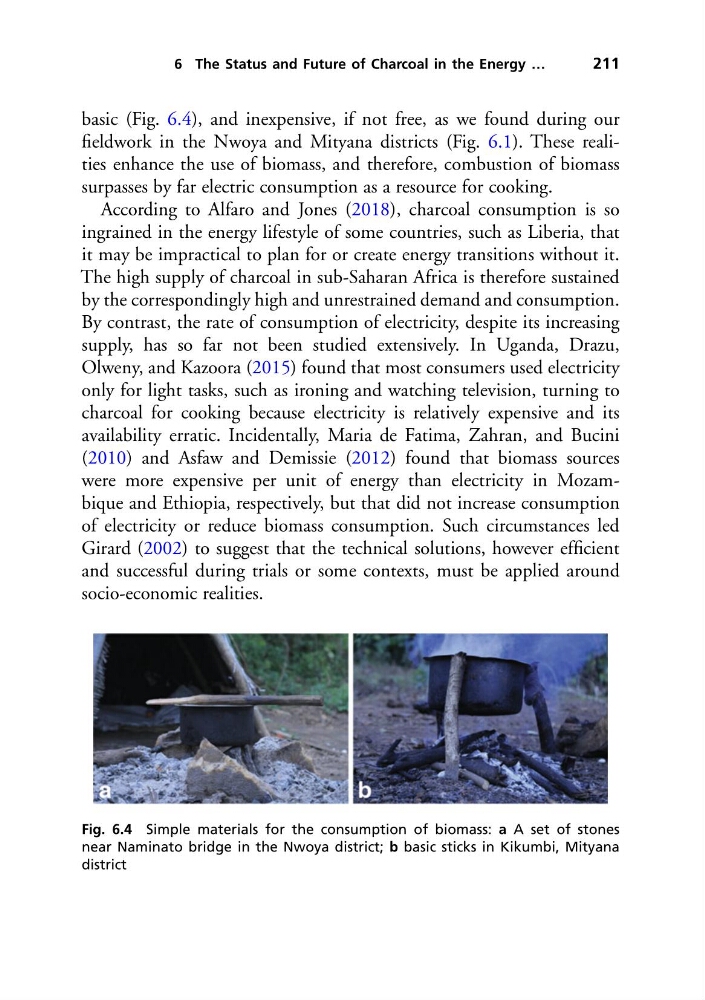
basic (Fig. 6.4), and inexpensive, if not free, as we found during our
fieldwork in the Nwoya and Mityana districts (Fig. 6.1). These realities enhance the use of biomass, and therefore, combustion of biomass
surpasses by far electric consumption as a resource for cooking.
According to Alfaro and Jones (2018), charcoal consumption is so
ingrained in the energy lifestyle of some countries, such as Liberia, that
it may be impractical to plan for or create energy transitions without it.
The high supply of charcoal in sub-Saharan Africa is therefore sustained
by the correspondingly high and unrestrained demand and consumption.
By contrast, the rate of consumption of electricity, despite its increasing
supply, has so far not been studied extensively. In Uganda, Drazu,
Olweny, and Kazoora (2015) found that most consumers used electricity
only for light tasks, such as ironing and watching television, turning to
charcoal for cooking because electricity is relatively expensive and its
availability erratic. Incidentally, Maria de Fatima, Zahran, and Bucini
(2010) and Asfaw and Demissie (2012) found that biomass sources
were more expensive per unit of energy than electricity in Mozambique and Ethiopia, respectively, but that did not increase consumption
of electricity or reduce biomass consumption. Such circumstances led
Girard (2002) to suggest that the technical solutions, however efficient
and successful during trials or some contexts, must be applied around
socio-economic realities.
Fig. 6.4 Simple materials for the consumption of biomass: a A set of stones
near Naminato bridge in the Nwoya district; b basic sticks in Kikumbi, Mityana
district
211
basic (Fig. 6.4), and inexpensive, if not free, as we found during our
fieldwork in the Nwoya and Mityana districts (Fig. 6.1). These realities enhance the use of biomass, and therefore, combustion of biomass
surpasses by far electric consumption as a resource for cooking.
According to Alfaro and Jones (2018), charcoal consumption is so
ingrained in the energy lifestyle of some countries, such as Liberia, that
it may be impractical to plan for or create energy transitions without it.
The high supply of charcoal in sub-Saharan Africa is therefore sustained
by the correspondingly high and unrestrained demand and consumption.
By contrast, the rate of consumption of electricity, despite its increasing
supply, has so far not been studied extensively. In Uganda, Drazu,
Olweny, and Kazoora (2015) found that most consumers used electricity
only for light tasks, such as ironing and watching television, turning to
charcoal for cooking because electricity is relatively expensive and its
availability erratic. Incidentally, Maria de Fatima, Zahran, and Bucini
(2010) and Asfaw and Demissie (2012) found that biomass sources
were more expensive per unit of energy than electricity in Mozambique and Ethiopia, respectively, but that did not increase consumption
of electricity or reduce biomass consumption. Such circumstances led
Girard (2002) to suggest that the technical solutions, however efficient
and successful during trials or some contexts, must be applied around
socio-economic realities.
Fig. 6.4 Simple materials for the consumption of biomass: a A set of stones
near Naminato bridge in the Nwoya district; b basic sticks in Kikumbi, Mityana
district