

78
5 Flux Pinning Phenomena
This is called the penetration field. The distributions of the magnetic flux and current
in the region of d < x < 2d are symmetric and antisymmetric to those shown in
above with respect to x = d , respectively.
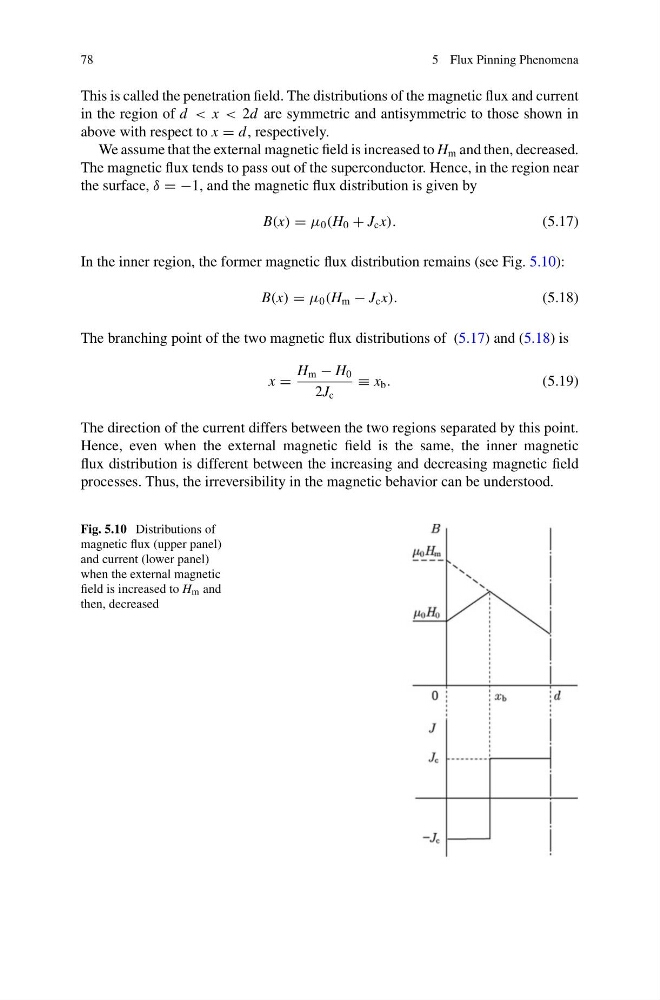
We assume that the external magnetic field is increased to H m and then, decreased.
The magnetic flux tends to pass out of the superconductor. Hence, in the region near
the surface, δ = −1, and the magnetic flux distribution is given by
B(x) = μ 0 (H 0 + J c x).
(5.17)
In the inner region, the former magnetic flux distribution remains (see Fig. 5.10):
B(x) = μ 0 (H m − J c x).
(5.18)
The branching point of the two magnetic flux distributions of (5.17) and (5.18) is
x =
H m − H 0
2J c
≡ x b .
(5.19)
The direction of the current differs between the two regions separated by this point.
Hence, even when the external magnetic field is the same, the inner magnetic
flux distribution is different between the increasing and decreasing magnetic field
processes. Thus, the irreversibility in the magnetic behavior can be understood.
Fig. 5.10 Distributions of
magnetic flux (upper panel)
and current (lower panel)
when the external magnetic
field is increased to H m and
then, decreased
5 Flux Pinning Phenomena
This is called the penetration field. The distributions of the magnetic flux and current
in the region of d < x < 2d are symmetric and antisymmetric to those shown in
above with respect to x = d , respectively.
We assume that the external magnetic field is increased to H m and then, decreased.
The magnetic flux tends to pass out of the superconductor. Hence, in the region near
the surface, δ = −1, and the magnetic flux distribution is given by
B(x) = μ 0 (H 0 + J c x).
(5.17)
In the inner region, the former magnetic flux distribution remains (see Fig. 5.10):
B(x) = μ 0 (H m − J c x).
(5.18)
The branching point of the two magnetic flux distributions of (5.17) and (5.18) is
x =
H m − H 0
2J c
≡ x b .
(5.19)
The direction of the current differs between the two regions separated by this point.
Hence, even when the external magnetic field is the same, the inner magnetic
flux distribution is different between the increasing and decreasing magnetic field
processes. Thus, the irreversibility in the magnetic behavior can be understood.
Fig. 5.10 Distributions of
magnetic flux (upper panel)
and current (lower panel)
when the external magnetic
field is increased to H m and
then, decreased