

56
4 Fundamental Electromagnetic Properties of Superconductors
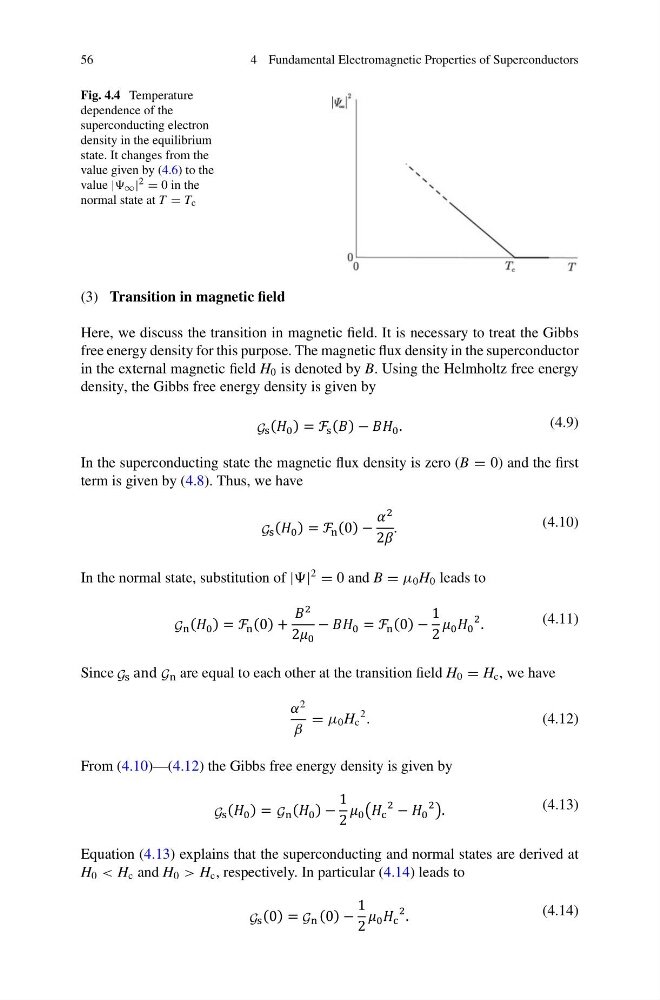
Fig. 4.4 Temperature
dependence of the
superconducting electron
density in the equilibrium
state. It changes from the
value given by (4.6) to the
value | ∞ | 2 = 0 in the
normal state at T = T c
(3) Transition in magnetic field
Here, we discuss the transition in magnetic field. It is necessary to treat the Gibbs
free energy density for this purpose. The magnetic flux density in the superconductor
in the external magnetic field H 0 is denoted by B. Using the Helmholtz free energy
density, the Gibbs free energy density is given by
(4.9)
In the superconducting state the magnetic flux density is zero (B = 0) and the first
term is given by (4.8). Thus, we have
(4.10)
In the normal state, substitution of |
2
= 0 and B = μ 0 H 0 leads to
(4.11)
Since
are equal to each other at the transition field H 0 = H c , we have
α
2
β
= μ 0 H c
2
.
(4.12)
From (4.10)—(4.12) the Gibbs free energy density is given by
(4.13)
Equation (4.13) explains that the superconducting and normal states are derived at
H 0 < H c and H 0 > H c , respectively. In particular (4.14) leads to
(4.14)
4 Fundamental Electromagnetic Properties of Superconductors
Fig. 4.4 Temperature
dependence of the
superconducting electron
density in the equilibrium
state. It changes from the
value given by (4.6) to the
value | ∞ | 2 = 0 in the
normal state at T = T c
(3) Transition in magnetic field
Here, we discuss the transition in magnetic field. It is necessary to treat the Gibbs
free energy density for this purpose. The magnetic flux density in the superconductor
in the external magnetic field H 0 is denoted by B. Using the Helmholtz free energy
density, the Gibbs free energy density is given by
(4.9)
In the superconducting state the magnetic flux density is zero (B = 0) and the first
term is given by (4.8). Thus, we have
(4.10)
In the normal state, substitution of |
2
= 0 and B = μ 0 H 0 leads to
(4.11)
Since
are equal to each other at the transition field H 0 = H c , we have
α
2
β
= μ 0 H c
2
.
(4.12)
From (4.10)—(4.12) the Gibbs free energy density is given by
(4.13)
Equation (4.13) explains that the superconducting and normal states are derived at
H 0 < H c and H 0 > H c , respectively. In particular (4.14) leads to
(4.14)