

4.2 Ginzburg–Landau Theory
53
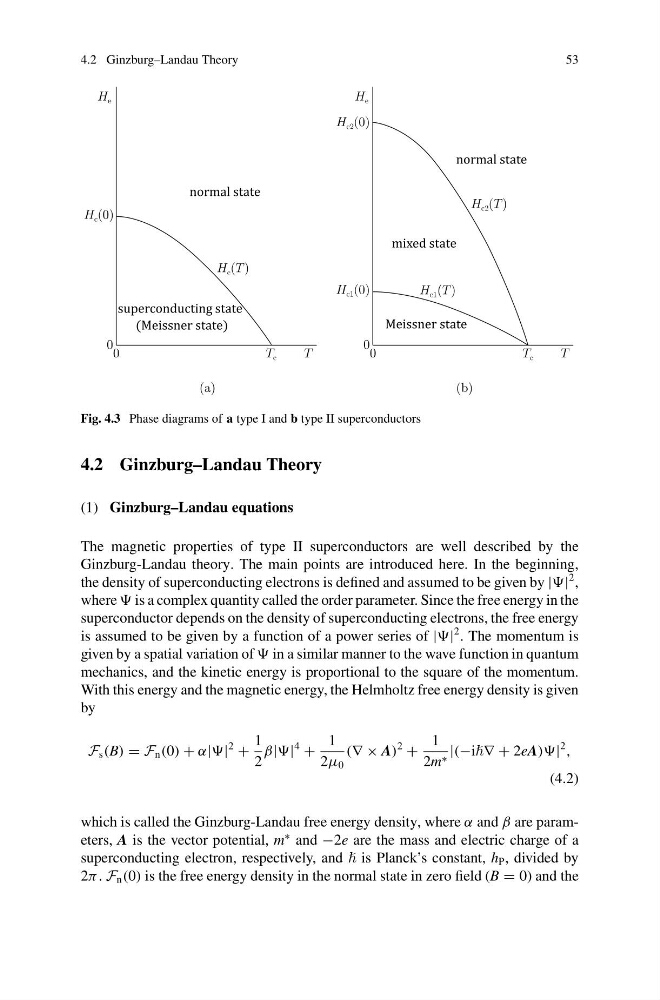
Fig. 4.3 Phase diagrams of a type I and b type II superconductors
4.2 Ginzburg–Landau Theory
(1) Ginzburg–Landau equations
The magnetic properties of type II superconductors are well described by the
Ginzburg-Landau theory. The main points are introduced here. In the beginning,
the density of superconducting electrons is defined and assumed to be given by ||
2 ,
where is a complex quantity called the order parameter. Since the free energy in the
superconductor depends on the density of superconducting electrons, the free energy
is assumed to be given by a function of a power series of ||
2 . The momentum is
given by a spatial variation of in a similar manner to the wave function in quantum
mechanics, and the kinetic energy is proportional to the square of the momentum.
With this energy and the magnetic energy, the Helmholtz free energy density is given
by
F s (B) = F n (0) + α||
2
+
1
2
β||
4
+
1
2μ 0
(∇ × A)
2
+
1
2m ∗ |(−i∇ + 2eA)|
2
,
(4.2)
which is called the Ginzburg-Landau free energy density, where α and β are parameters, A is the vector potential, m
∗ and −2e are the mass and electric charge of a
superconducting electron, respectively, and is Planck’s constant, h P , divided by
2π . F n (0) is the free energy density in the normal state in zero field (B = 0) and the
53
Fig. 4.3 Phase diagrams of a type I and b type II superconductors
4.2 Ginzburg–Landau Theory
(1) Ginzburg–Landau equations
The magnetic properties of type II superconductors are well described by the
Ginzburg-Landau theory. The main points are introduced here. In the beginning,
the density of superconducting electrons is defined and assumed to be given by ||
2 ,
where is a complex quantity called the order parameter. Since the free energy in the
superconductor depends on the density of superconducting electrons, the free energy
is assumed to be given by a function of a power series of ||
2 . The momentum is
given by a spatial variation of in a similar manner to the wave function in quantum
mechanics, and the kinetic energy is proportional to the square of the momentum.
With this energy and the magnetic energy, the Helmholtz free energy density is given
by
F s (B) = F n (0) + α||
2
+
1
2
β||
4
+
1
2μ 0
(∇ × A)
2
+
1
2m ∗ |(−i∇ + 2eA)|
2
,
(4.2)
which is called the Ginzburg-Landau free energy density, where α and β are parameters, A is the vector potential, m
∗ and −2e are the mass and electric charge of a
superconducting electron, respectively, and is Planck’s constant, h P , divided by
2π . F n (0) is the free energy density in the normal state in zero field (B = 0) and the