

3.3 Merits of Introducing Superconductivity
49
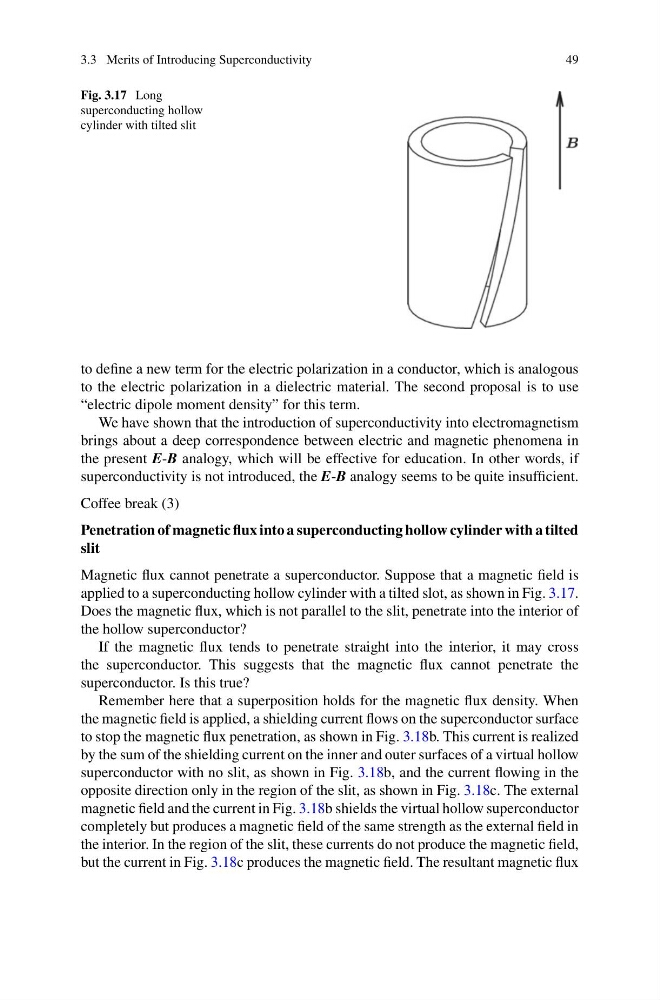
Fig. 3.17 Long
superconducting hollow
cylinder with tilted slit
to define a new term for the electric polarization in a conductor, which is analogous
to the electric polarization in a dielectric material. The second proposal is to use
“electric dipole moment density” for this term.
We have shown that the introduction of superconductivity into electromagnetism
brings about a deep correspondence between electric and magnetic phenomena in
the present E-B analogy, which will be effective for education. In other words, if
superconductivity is not introduced, the E-B analogy seems to be quite insufficient.
Coffee break (3)
Penetration of magnetic flux into a superconducting hollow cylinder with a tilted
slit
Magnetic flux cannot penetrate a superconductor. Suppose that a magnetic field is
applied to a superconducting hollow cylinder with a tilted slot, as shown in Fig. 3.17.
Does the magnetic flux, which is not parallel to the slit, penetrate into the interior of
the hollow superconductor?
If the magnetic flux tends to penetrate straight into the interior, it may cross
the superconductor. This suggests that the magnetic flux cannot penetrate the
superconductor. Is this true?
Remember here that a superposition holds for the magnetic flux density. When
the magnetic field is applied, a shielding current flows on the superconductor surface
to stop the magnetic flux penetration, as shown in Fig. 3.18b. This current is realized
by the sum of the shielding current on the inner and outer surfaces of a virtual hollow
superconductor with no slit, as shown in Fig. 3.18b, and the current flowing in the
opposite direction only in the region of the slit, as shown in Fig. 3.18c. The external
magnetic field and the current in Fig. 3.18b shields the virtual hollow superconductor
completely but produces a magnetic field of the same strength as the external field in
the interior. In the region of the slit, these currents do not produce the magnetic field,
but the current in Fig. 3.18c produces the magnetic field. The resultant magnetic flux
49
Fig. 3.17 Long
superconducting hollow
cylinder with tilted slit
to define a new term for the electric polarization in a conductor, which is analogous
to the electric polarization in a dielectric material. The second proposal is to use
“electric dipole moment density” for this term.
We have shown that the introduction of superconductivity into electromagnetism
brings about a deep correspondence between electric and magnetic phenomena in
the present E-B analogy, which will be effective for education. In other words, if
superconductivity is not introduced, the E-B analogy seems to be quite insufficient.
Coffee break (3)
Penetration of magnetic flux into a superconducting hollow cylinder with a tilted
slit
Magnetic flux cannot penetrate a superconductor. Suppose that a magnetic field is
applied to a superconducting hollow cylinder with a tilted slot, as shown in Fig. 3.17.
Does the magnetic flux, which is not parallel to the slit, penetrate into the interior of
the hollow superconductor?
If the magnetic flux tends to penetrate straight into the interior, it may cross
the superconductor. This suggests that the magnetic flux cannot penetrate the
superconductor. Is this true?
Remember here that a superposition holds for the magnetic flux density. When
the magnetic field is applied, a shielding current flows on the superconductor surface
to stop the magnetic flux penetration, as shown in Fig. 3.18b. This current is realized
by the sum of the shielding current on the inner and outer surfaces of a virtual hollow
superconductor with no slit, as shown in Fig. 3.18b, and the current flowing in the
opposite direction only in the region of the slit, as shown in Fig. 3.18c. The external
magnetic field and the current in Fig. 3.18b shields the virtual hollow superconductor
completely but produces a magnetic field of the same strength as the external field in
the interior. In the region of the slit, these currents do not produce the magnetic field,
but the current in Fig. 3.18c produces the magnetic field. The resultant magnetic flux