

Appendix
201
A.16 Derivation of (6.62) and (6.63)
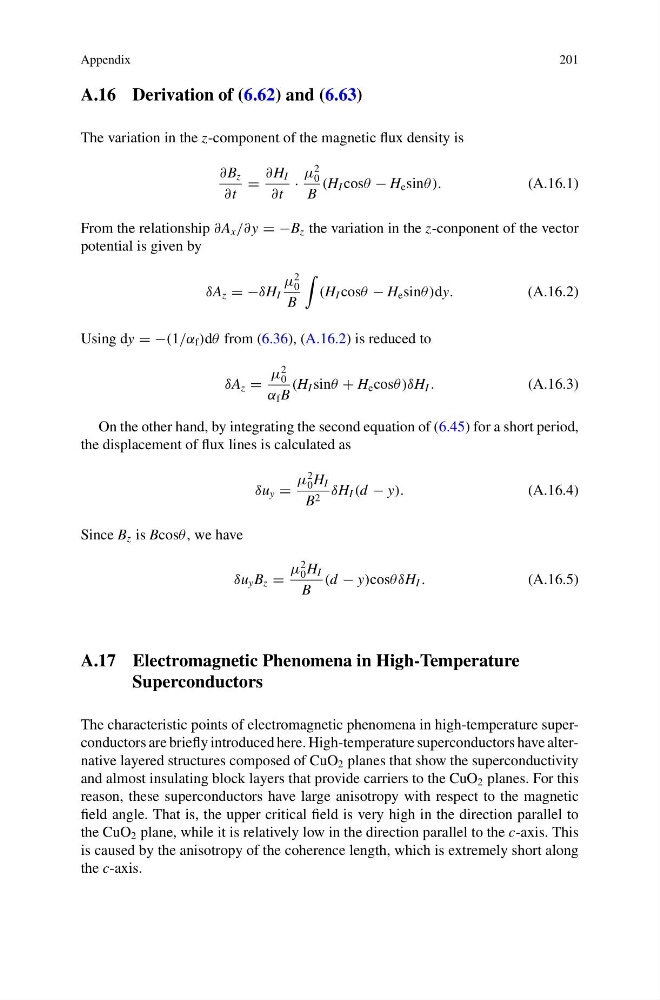
The variation in the z-component of the magnetic flux density is
∂B z
∂t
=
∂H I
∂t
·
μ
2
0
B
(H I cosθ − H e sinθ).
(A.16.1)
From the relationship ∂A x /∂y = −B z the variation in the z-conponent of the vector
potential is given by
δA z = −δH I
μ
2
0
B
(H I cosθ − H e sinθ )dy.
(A.16.2)
Using dy = −(1/α f )dθ from (6.36), (A.16.2) is reduced to
δA z =
μ
2
0
α f B
(H I sinθ + H e cosθ )δH I .
(A.16.3)
On the other hand, by integrating the second equation of (6.45) for a short period,
the displacement of flux lines is calculated as
δu y =
μ
2
0 H I
B 2 δH I (d − y).
(A.16.4)
Since B z is Bcosθ , we have
δu y B z =
μ
2
0 H I
B
(d − y)cosθδH I .
(A.16.5)
A.17 Electromagnetic Phenomena in High-Temperature
Superconductors
The characteristic points of electromagnetic phenomena in high-temperature superconductors are briefly introduced here. High-temperature superconductors have alternative layered structures composed of CuO 2 planes that show the superconductivity
and almost insulating block layers that provide carriers to the CuO 2 planes. For this
reason, these superconductors have large anisotropy with respect to the magnetic
field angle. That is, the upper critical field is very high in the direction parallel to
the CuO 2 plane, while it is relatively low in the direction parallel to the c-axis. This
is caused by the anisotropy of the coherence length, which is extremely short along
the c-axis.
201
A.16 Derivation of (6.62) and (6.63)
The variation in the z-component of the magnetic flux density is
∂B z
∂t
=
∂H I
∂t
·
μ
2
0
B
(H I cosθ − H e sinθ).
(A.16.1)
From the relationship ∂A x /∂y = −B z the variation in the z-conponent of the vector
potential is given by
δA z = −δH I
μ
2
0
B
(H I cosθ − H e sinθ )dy.
(A.16.2)
Using dy = −(1/α f )dθ from (6.36), (A.16.2) is reduced to
δA z =
μ
2
0
α f B
(H I sinθ + H e cosθ )δH I .
(A.16.3)
On the other hand, by integrating the second equation of (6.45) for a short period,
the displacement of flux lines is calculated as
δu y =
μ
2
0 H I
B 2 δH I (d − y).
(A.16.4)
Since B z is Bcosθ , we have
δu y B z =
μ
2
0 H I
B
(d − y)cosθδH I .
(A.16.5)
A.17 Electromagnetic Phenomena in High-Temperature
Superconductors
The characteristic points of electromagnetic phenomena in high-temperature superconductors are briefly introduced here. High-temperature superconductors have alternative layered structures composed of CuO 2 planes that show the superconductivity
and almost insulating block layers that provide carriers to the CuO 2 planes. For this
reason, these superconductors have large anisotropy with respect to the magnetic
field angle. That is, the upper critical field is very high in the direction parallel to
the CuO 2 plane, while it is relatively low in the direction parallel to the c-axis. This
is caused by the anisotropy of the coherence length, which is extremely short along
the c-axis.