

198
Appendix
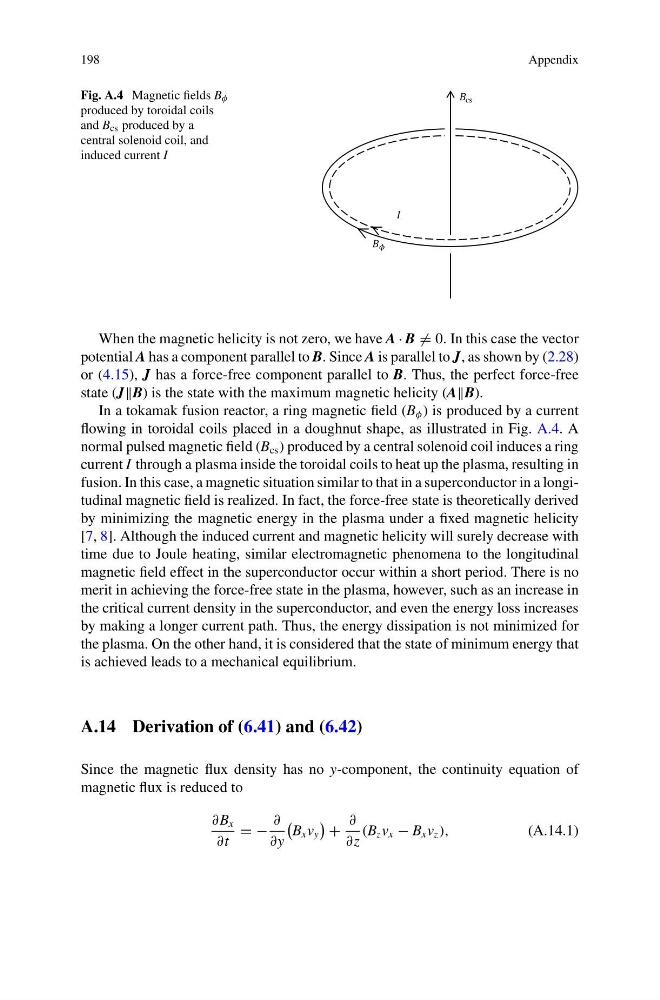
Fig. A.4 Magnetic fields B φ
produced by toroidal coils
and B cs produced by a
central solenoid coil, and
induced current I
When the magnetic helicity is not zero, we have A · B = 0. In this case the vector
potential A has a component parallel to B. Since A is parallel to J, as shown by (2.28)
or (4.15), J has a force-free component parallel to B. Thus, the perfect force-free
state (J is the state with the maximum magnetic helicity (A
In a tokamak fusion reactor, a ring magnetic field (B φ ) is produced by a current
flowing in toroidal coils placed in a doughnut shape, as illustrated in Fig. A.4. A
normal pulsed magnetic field (B cs ) produced by a central solenoid coil induces a ring
current I through a plasma inside the toroidal coils to heat up the plasma, resulting in
fusion. In this case, a magnetic situation similar to that in a superconductor in a longitudinal magnetic field is realized. In fact, the force-free state is theoretically derived
by minimizing the magnetic energy in the plasma under a fixed magnetic helicity
[7, 8]. Although the induced current and magnetic helicity will surely decrease with
time due to Joule heating, similar electromagnetic phenomena to the longitudinal
magnetic field effect in the superconductor occur within a short period. There is no
merit in achieving the force-free state in the plasma, however, such as an increase in
the critical current density in the superconductor, and even the energy loss increases
by making a longer current path. Thus, the energy dissipation is not minimized for
the plasma. On the other hand, it is considered that the state of minimum energy that
is achieved leads to a mechanical equilibrium.
A.14 Derivation of (6.41) and (6.42)
Since the magnetic flux density has no y-component, the continuity equation of
magnetic flux is reduced to
∂B x
∂t
= −
∂
∂y
B x v y
+
∂
∂z
(B z v x − B x v z ),
(A.14.1)
Appendix
Fig. A.4 Magnetic fields B φ
produced by toroidal coils
and B cs produced by a
central solenoid coil, and
induced current I
When the magnetic helicity is not zero, we have A · B = 0. In this case the vector
potential A has a component parallel to B. Since A is parallel to J, as shown by (2.28)
or (4.15), J has a force-free component parallel to B. Thus, the perfect force-free
state (J is the state with the maximum magnetic helicity (A
In a tokamak fusion reactor, a ring magnetic field (B φ ) is produced by a current
flowing in toroidal coils placed in a doughnut shape, as illustrated in Fig. A.4. A
normal pulsed magnetic field (B cs ) produced by a central solenoid coil induces a ring
current I through a plasma inside the toroidal coils to heat up the plasma, resulting in
fusion. In this case, a magnetic situation similar to that in a superconductor in a longitudinal magnetic field is realized. In fact, the force-free state is theoretically derived
by minimizing the magnetic energy in the plasma under a fixed magnetic helicity
[7, 8]. Although the induced current and magnetic helicity will surely decrease with
time due to Joule heating, similar electromagnetic phenomena to the longitudinal
magnetic field effect in the superconductor occur within a short period. There is no
merit in achieving the force-free state in the plasma, however, such as an increase in
the critical current density in the superconductor, and even the energy loss increases
by making a longer current path. Thus, the energy dissipation is not minimized for
the plasma. On the other hand, it is considered that the state of minimum energy that
is achieved leads to a mechanical equilibrium.
A.14 Derivation of (6.41) and (6.42)
Since the magnetic flux density has no y-component, the continuity equation of
magnetic flux is reduced to
∂B x
∂t
= −
∂
∂y
B x v y
+
∂
∂z
(B z v x − B x v z ),
(A.14.1)