

7.3 Scientific Significance of Flux Pinning Phenomena
171
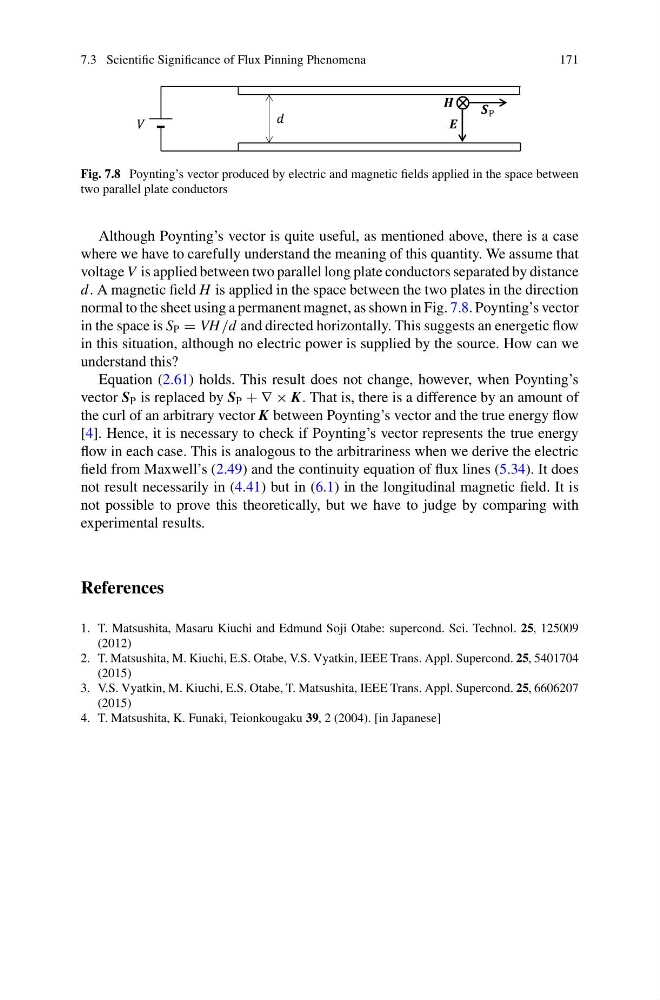
Fig. 7.8 Poynting’s vector produced by electric and magnetic fields applied in the space between
two parallel plate conductors
Although Poynting’s vector is quite useful, as mentioned above, there is a case
where we have to carefully understand the meaning of this quantity. We assume that
voltage V is applied between two parallel long plate conductors separated by distance
d . A magnetic field H is applied in the space between the two plates in the direction
normal to the sheet using a permanent magnet, as shown in Fig. 7.8. Poynting’s vector
in the space is S P = VH /d and directed horizontally. This suggests an energetic flow
in this situation, although no electric power is supplied by the source. How can we
understand this?
Equation (2.61) holds. This result does not change, however, when Poynting’s
vector S P is replaced by S P + ∇ × K. That is, there is a difference by an amount of
the curl of an arbitrary vector K between Poynting’s vector and the true energy flow
[4]. Hence, it is necessary to check if Poynting’s vector represents the true energy
flow in each case. This is analogous to the arbitrariness when we derive the electric
field from Maxwell’s (2.49) and the continuity equation of flux lines (5.34). It does
not result necessarily in (4.41) but in (6.1) in the longitudinal magnetic field. It is
not possible to prove this theoretically, but we have to judge by comparing with
experimental results.
References
1. T. Matsushita, Masaru Kiuchi and Edmund Soji Otabe: supercond. Sci. Technol. 25, 125009
(2012)
2. T. Matsushita, M. Kiuchi, E.S. Otabe, V.S. Vyatkin, IEEE Trans. Appl. Supercond. 25, 5401704
(2015)
3. V.S. Vyatkin, M. Kiuchi, E.S. Otabe, T. Matsushita, IEEE Trans. Appl. Supercond. 25, 6606207
(2015)
4. T. Matsushita, K. Funaki, Teionkougaku 39, 2 (2004). [in Japanese]
171
Fig. 7.8 Poynting’s vector produced by electric and magnetic fields applied in the space between
two parallel plate conductors
Although Poynting’s vector is quite useful, as mentioned above, there is a case
where we have to carefully understand the meaning of this quantity. We assume that
voltage V is applied between two parallel long plate conductors separated by distance
d . A magnetic field H is applied in the space between the two plates in the direction
normal to the sheet using a permanent magnet, as shown in Fig. 7.8. Poynting’s vector
in the space is S P = VH /d and directed horizontally. This suggests an energetic flow
in this situation, although no electric power is supplied by the source. How can we
understand this?
Equation (2.61) holds. This result does not change, however, when Poynting’s
vector S P is replaced by S P + ∇ × K. That is, there is a difference by an amount of
the curl of an arbitrary vector K between Poynting’s vector and the true energy flow
[4]. Hence, it is necessary to check if Poynting’s vector represents the true energy
flow in each case. This is analogous to the arbitrariness when we derive the electric
field from Maxwell’s (2.49) and the continuity equation of flux lines (5.34). It does
not result necessarily in (4.41) but in (6.1) in the longitudinal magnetic field. It is
not possible to prove this theoretically, but we have to judge by comparing with
experimental results.
References
1. T. Matsushita, Masaru Kiuchi and Edmund Soji Otabe: supercond. Sci. Technol. 25, 125009
(2012)
2. T. Matsushita, M. Kiuchi, E.S. Otabe, V.S. Vyatkin, IEEE Trans. Appl. Supercond. 25, 5401704
(2015)
3. V.S. Vyatkin, M. Kiuchi, E.S. Otabe, T. Matsushita, IEEE Trans. Appl. Supercond. 25, 6606207
(2015)
4. T. Matsushita, K. Funaki, Teionkougaku 39, 2 (2004). [in Japanese]