

168
7 Concluding Remarks
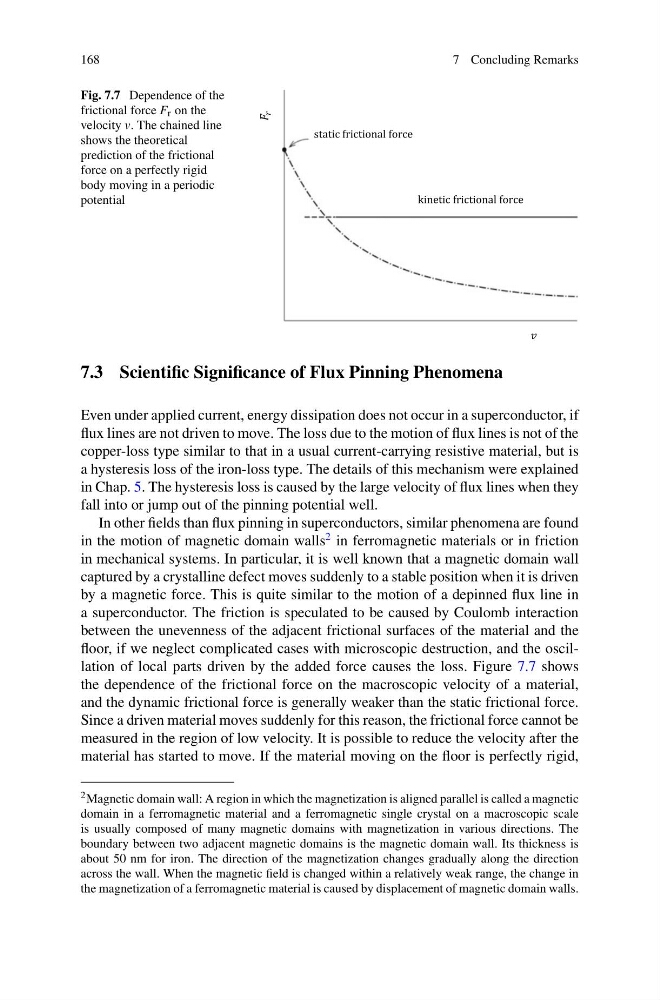
Fig. 7.7 Dependence of the
frictional force F r on the
velocity v. The chained line
shows the theoretical
prediction of the frictional
force on a perfectly rigid
body moving in a periodic
potential
7.3 Scientific Significance of Flux Pinning Phenomena
Even under applied current, energy dissipation does not occur in a superconductor, if
flux lines are not driven to move. The loss due to the motion of flux lines is not of the
copper-loss type similar to that in a usual current-carrying resistive material, but is
a hysteresis loss of the iron-loss type. The details of this mechanism were explained
in Chap. 5. The hysteresis loss is caused by the large velocity of flux lines when they
fall into or jump out of the pinning potential well.
In other fields than flux pinning in superconductors, similar phenomena are found
in the motion of magnetic domain walls
2 in ferromagnetic materials or in friction
in mechanical systems. In particular, it is well known that a magnetic domain wall
captured by a crystalline defect moves suddenly to a stable position when it is driven
by a magnetic force. This is quite similar to the motion of a depinned flux line in
a superconductor. The friction is speculated to be caused by Coulomb interaction
between the unevenness of the adjacent frictional surfaces of the material and the
floor, if we neglect complicated cases with microscopic destruction, and the oscillation of local parts driven by the added force causes the loss. Figure 7.7 shows
the dependence of the frictional force on the macroscopic velocity of a material,
and the dynamic frictional force is generally weaker than the static frictional force.
Since a driven material moves suddenly for this reason, the frictional force cannot be
measured in the region of low velocity. It is possible to reduce the velocity after the
material has started to move. If the material moving on the floor is perfectly rigid,
2 Magnetic domain wall: A region in which the magnetization is aligned parallel is called a magnetic
domain in a ferromagnetic material and a ferromagnetic single crystal on a macroscopic scale
is usually composed of many magnetic domains with magnetization in various directions. The
boundary between two adjacent magnetic domains is the magnetic domain wall. Its thickness is
about 50 nm for iron. The direction of the magnetization changes gradually along the direction
across the wall. When the magnetic field is changed within a relatively weak range, the change in
the magnetization of a ferromagnetic material is caused by displacement of magnetic domain walls.
7 Concluding Remarks
Fig. 7.7 Dependence of the
frictional force F r on the
velocity v. The chained line
shows the theoretical
prediction of the frictional
force on a perfectly rigid
body moving in a periodic
potential
7.3 Scientific Significance of Flux Pinning Phenomena
Even under applied current, energy dissipation does not occur in a superconductor, if
flux lines are not driven to move. The loss due to the motion of flux lines is not of the
copper-loss type similar to that in a usual current-carrying resistive material, but is
a hysteresis loss of the iron-loss type. The details of this mechanism were explained
in Chap. 5. The hysteresis loss is caused by the large velocity of flux lines when they
fall into or jump out of the pinning potential well.
In other fields than flux pinning in superconductors, similar phenomena are found
in the motion of magnetic domain walls
2 in ferromagnetic materials or in friction
in mechanical systems. In particular, it is well known that a magnetic domain wall
captured by a crystalline defect moves suddenly to a stable position when it is driven
by a magnetic force. This is quite similar to the motion of a depinned flux line in
a superconductor. The friction is speculated to be caused by Coulomb interaction
between the unevenness of the adjacent frictional surfaces of the material and the
floor, if we neglect complicated cases with microscopic destruction, and the oscillation of local parts driven by the added force causes the loss. Figure 7.7 shows
the dependence of the frictional force on the macroscopic velocity of a material,
and the dynamic frictional force is generally weaker than the static frictional force.
Since a driven material moves suddenly for this reason, the frictional force cannot be
measured in the region of low velocity. It is possible to reduce the velocity after the
material has started to move. If the material moving on the floor is perfectly rigid,
2 Magnetic domain wall: A region in which the magnetization is aligned parallel is called a magnetic
domain in a ferromagnetic material and a ferromagnetic single crystal on a macroscopic scale
is usually composed of many magnetic domains with magnetization in various directions. The
boundary between two adjacent magnetic domains is the magnetic domain wall. Its thickness is
about 50 nm for iron. The direction of the magnetization changes gradually along the direction
across the wall. When the magnetic field is changed within a relatively weak range, the change in
the magnetization of a ferromagnetic material is caused by displacement of magnetic domain walls.