

166
7 Concluding Remarks
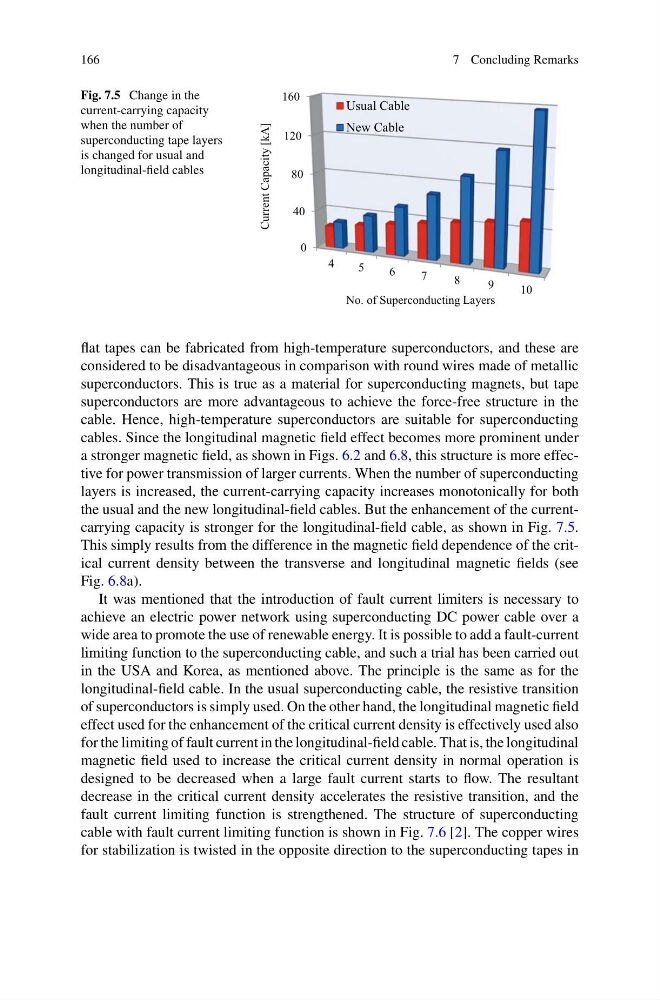
Fig. 7.5 Change in the
current-carrying capacity
when the number of
superconducting tape layers
is changed for usual and
longitudinal-field cables
0
40
80
120
160
4
5
6
7
8
9
10
Usual Cable
New Cable
No. of Superconducting Layers
Current Capacity [kA]
flat tapes can be fabricated from high-temperature superconductors, and these are
considered to be disadvantageous in comparison with round wires made of metallic
superconductors. This is true as a material for superconducting magnets, but tape
superconductors are more advantageous to achieve the force-free structure in the
cable. Hence, high-temperature superconductors are suitable for superconducting
cables. Since the longitudinal magnetic field effect becomes more prominent under
a stronger magnetic field, as shown in Figs. 6.2 and 6.8, this structure is more effective for power transmission of larger currents. When the number of superconducting
layers is increased, the current-carrying capacity increases monotonically for both
the usual and the new longitudinal-field cables. But the enhancement of the currentcarrying capacity is stronger for the longitudinal-field cable, as shown in Fig. 7.5.
This simply results from the difference in the magnetic field dependence of the critical current density between the transverse and longitudinal magnetic fields (see
Fig. 6.8a).
It was mentioned that the introduction of fault current limiters is necessary to
achieve an electric power network using superconducting DC power cable over a
wide area to promote the use of renewable energy. It is possible to add a fault-current
limiting function to the superconducting cable, and such a trial has been carried out
in the USA and Korea, as mentioned above. The principle is the same as for the
longitudinal-field cable. In the usual superconducting cable, the resistive transition
of superconductors is simply used. On the other hand, the longitudinal magnetic field
effect used for the enhancement of the critical current density is effectively used also
for the limiting of fault current in the longitudinal-field cable. That is, the longitudinal
magnetic field used to increase the critical current density in normal operation is
designed to be decreased when a large fault current starts to flow. The resultant
decrease in the critical current density accelerates the resistive transition, and the
fault current limiting function is strengthened. The structure of superconducting
cable with fault current limiting function is shown in Fig. 7.6 [2]. The copper wires
for stabilization is twisted in the opposite direction to the superconducting tapes in
7 Concluding Remarks
Fig. 7.5 Change in the
current-carrying capacity
when the number of
superconducting tape layers
is changed for usual and
longitudinal-field cables
0
40
80
120
160
4
5
6
7
8
9
10
Usual Cable
New Cable
No. of Superconducting Layers
Current Capacity [kA]
flat tapes can be fabricated from high-temperature superconductors, and these are
considered to be disadvantageous in comparison with round wires made of metallic
superconductors. This is true as a material for superconducting magnets, but tape
superconductors are more advantageous to achieve the force-free structure in the
cable. Hence, high-temperature superconductors are suitable for superconducting
cables. Since the longitudinal magnetic field effect becomes more prominent under
a stronger magnetic field, as shown in Figs. 6.2 and 6.8, this structure is more effective for power transmission of larger currents. When the number of superconducting
layers is increased, the current-carrying capacity increases monotonically for both
the usual and the new longitudinal-field cables. But the enhancement of the currentcarrying capacity is stronger for the longitudinal-field cable, as shown in Fig. 7.5.
This simply results from the difference in the magnetic field dependence of the critical current density between the transverse and longitudinal magnetic fields (see
Fig. 6.8a).
It was mentioned that the introduction of fault current limiters is necessary to
achieve an electric power network using superconducting DC power cable over a
wide area to promote the use of renewable energy. It is possible to add a fault-current
limiting function to the superconducting cable, and such a trial has been carried out
in the USA and Korea, as mentioned above. The principle is the same as for the
longitudinal-field cable. In the usual superconducting cable, the resistive transition
of superconductors is simply used. On the other hand, the longitudinal magnetic field
effect used for the enhancement of the critical current density is effectively used also
for the limiting of fault current in the longitudinal-field cable. That is, the longitudinal
magnetic field used to increase the critical current density in normal operation is
designed to be decreased when a large fault current starts to flow. The resultant
decrease in the critical current density accelerates the resistive transition, and the
fault current limiting function is strengthened. The structure of superconducting
cable with fault current limiting function is shown in Fig. 7.6 [2]. The copper wires
for stabilization is twisted in the opposite direction to the superconducting tapes in