

1.2 Zero Electrical Resistance
5
I (t) = I (0)exp
−
t
t 0
,
(1.2)
where t 0 is the time constant given by
t 0 =
L
R
.
(1.3)
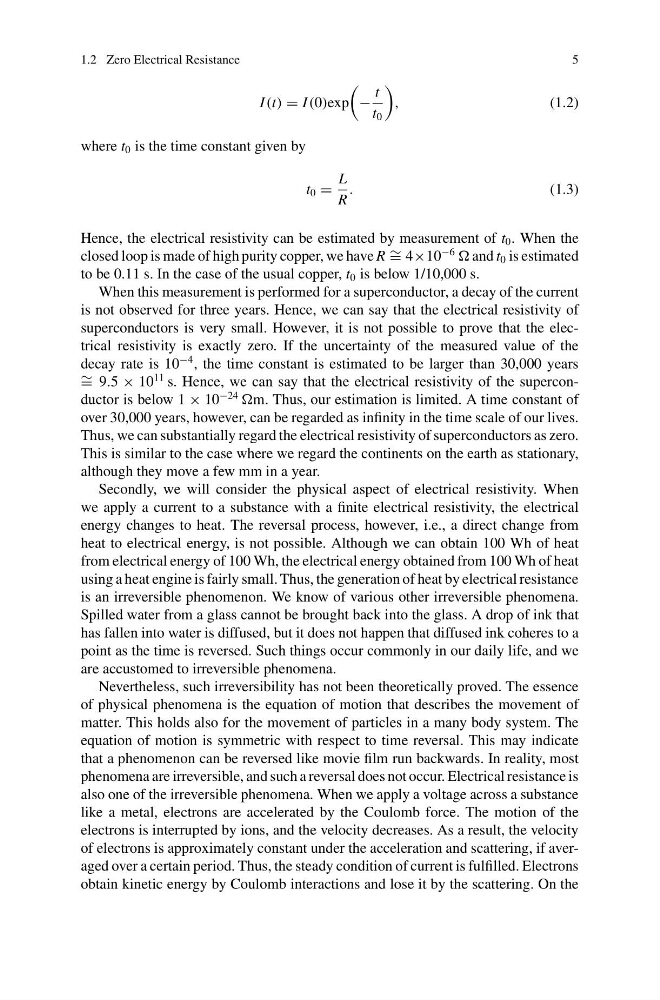
Hence, the electrical resistivity can be estimated by measurement of t 0 . When the
closed loop is made of high purity copper, we have R ∼ = 4×10
−6
and t 0 is estimated
to be 0.11 s. In the case of the usual copper, t 0 is below 1/10,000 s.
When this measurement is performed for a superconductor, a decay of the current
is not observed for three years. Hence, we can say that the electrical resistivity of
superconductors is very small. However, it is not possible to prove that the electrical resistivity is exactly zero. If the uncertainty of the measured value of the
decay rate is 10
−4 , the time constant is estimated to be larger than 30,000 years
∼ = 9.5 × 10
11 s. Hence, we can say that the electrical resistivity of the superconductor is below 1 × 10
−24
m. Thus, our estimation is limited. A time constant of
over 30,000 years, however, can be regarded as infinity in the time scale of our lives.
Thus, we can substantially regard the electrical resistivity of superconductors as zero.
This is similar to the case where we regard the continents on the earth as stationary,
although they move a few mm in a year.
Secondly, we will consider the physical aspect of electrical resistivity. When
we apply a current to a substance with a finite electrical resistivity, the electrical
energy changes to heat. The reversal process, however, i.e., a direct change from
heat to electrical energy, is not possible. Although we can obtain 100 Wh of heat
from electrical energy of 100 Wh, the electrical energy obtained from 100 Wh of heat
using a heat engine is fairly small. Thus, the generation of heat by electrical resistance
is an irreversible phenomenon. We know of various other irreversible phenomena.
Spilled water from a glass cannot be brought back into the glass. A drop of ink that
has fallen into water is diffused, but it does not happen that diffused ink coheres to a
point as the time is reversed. Such things occur commonly in our daily life, and we
are accustomed to irreversible phenomena.
Nevertheless, such irreversibility has not been theoretically proved. The essence
of physical phenomena is the equation of motion that describes the movement of
matter. This holds also for the movement of particles in a many body system. The
equation of motion is symmetric with respect to time reversal. This may indicate
that a phenomenon can be reversed like movie film run backwards. In reality, most
phenomena are irreversible, and such a reversal does not occur. Electrical resistance is
also one of the irreversible phenomena. When we apply a voltage across a substance
like a metal, electrons are accelerated by the Coulomb force. The motion of the
electrons is interrupted by ions, and the velocity decreases. As a result, the velocity
of electrons is approximately constant under the acceleration and scattering, if averaged over a certain period. Thus, the steady condition of current is fulfilled. Electrons
obtain kinetic energy by Coulomb interactions and lose it by the scattering. On the
5
I (t) = I (0)exp
−
t
t 0
,
(1.2)
where t 0 is the time constant given by
t 0 =
L
R
.
(1.3)
Hence, the electrical resistivity can be estimated by measurement of t 0 . When the
closed loop is made of high purity copper, we have R ∼ = 4×10
−6
and t 0 is estimated
to be 0.11 s. In the case of the usual copper, t 0 is below 1/10,000 s.
When this measurement is performed for a superconductor, a decay of the current
is not observed for three years. Hence, we can say that the electrical resistivity of
superconductors is very small. However, it is not possible to prove that the electrical resistivity is exactly zero. If the uncertainty of the measured value of the
decay rate is 10
−4 , the time constant is estimated to be larger than 30,000 years
∼ = 9.5 × 10
11 s. Hence, we can say that the electrical resistivity of the superconductor is below 1 × 10
−24
m. Thus, our estimation is limited. A time constant of
over 30,000 years, however, can be regarded as infinity in the time scale of our lives.
Thus, we can substantially regard the electrical resistivity of superconductors as zero.
This is similar to the case where we regard the continents on the earth as stationary,
although they move a few mm in a year.
Secondly, we will consider the physical aspect of electrical resistivity. When
we apply a current to a substance with a finite electrical resistivity, the electrical
energy changes to heat. The reversal process, however, i.e., a direct change from
heat to electrical energy, is not possible. Although we can obtain 100 Wh of heat
from electrical energy of 100 Wh, the electrical energy obtained from 100 Wh of heat
using a heat engine is fairly small. Thus, the generation of heat by electrical resistance
is an irreversible phenomenon. We know of various other irreversible phenomena.
Spilled water from a glass cannot be brought back into the glass. A drop of ink that
has fallen into water is diffused, but it does not happen that diffused ink coheres to a
point as the time is reversed. Such things occur commonly in our daily life, and we
are accustomed to irreversible phenomena.
Nevertheless, such irreversibility has not been theoretically proved. The essence
of physical phenomena is the equation of motion that describes the movement of
matter. This holds also for the movement of particles in a many body system. The
equation of motion is symmetric with respect to time reversal. This may indicate
that a phenomenon can be reversed like movie film run backwards. In reality, most
phenomena are irreversible, and such a reversal does not occur. Electrical resistance is
also one of the irreversible phenomena. When we apply a voltage across a substance
like a metal, electrons are accelerated by the Coulomb force. The motion of the
electrons is interrupted by ions, and the velocity decreases. As a result, the velocity
of electrons is approximately constant under the acceleration and scattering, if averaged over a certain period. Thus, the steady condition of current is fulfilled. Electrons
obtain kinetic energy by Coulomb interactions and lose it by the scattering. On the