

1.1 Superconductor
3
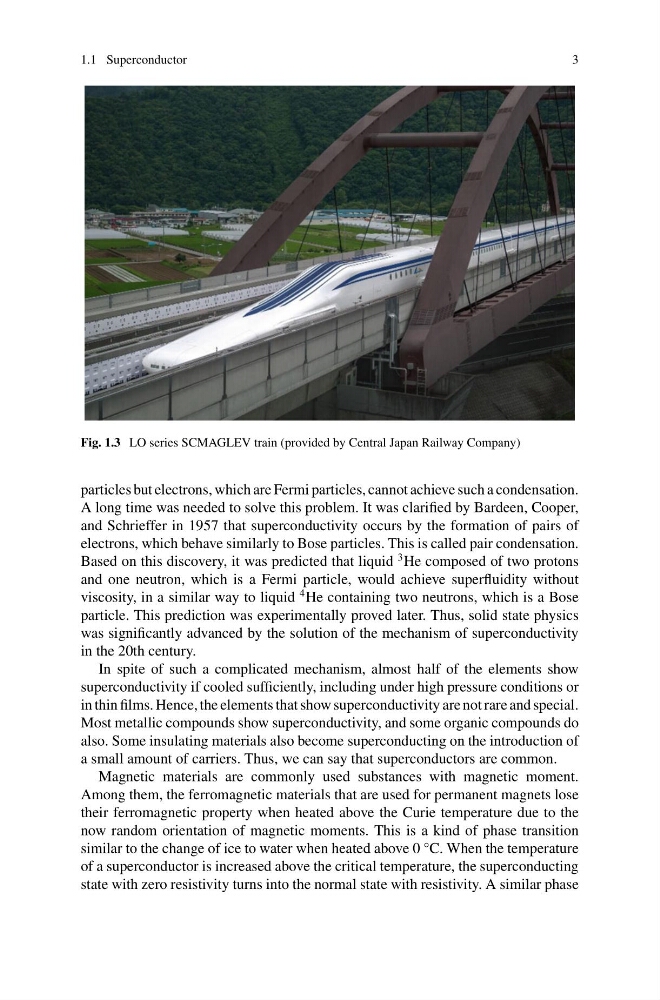
Fig. 1.3 LO series SCMAGLEV train (provided by Central Japan Railway Company)
particles but electrons, which are Fermi particles, cannot achieve such a condensation.
A long time was needed to solve this problem. It was clarified by Bardeen, Cooper,
and Schrieffer in 1957 that superconductivity occurs by the formation of pairs of
electrons, which behave similarly to Bose particles. This is called pair condensation.
Based on this discovery, it was predicted that liquid
3 He composed of two protons
and one neutron, which is a Fermi particle, would achieve superfluidity without
viscosity, in a similar way to liquid
4 He containing two neutrons, which is a Bose
particle. This prediction was experimentally proved later. Thus, solid state physics
was significantly advanced by the solution of the mechanism of superconductivity
in the 20th century.
In spite of such a complicated mechanism, almost half of the elements show
superconductivity if cooled sufficiently, including under high pressure conditions or
in thin films. Hence, the elements that show superconductivity are not rare and special.
Most metallic compounds show superconductivity, and some organic compounds do
also. Some insulating materials also become superconducting on the introduction of
a small amount of carriers. Thus, we can say that superconductors are common.
Magnetic materials are commonly used substances with magnetic moment.
Among them, the ferromagnetic materials that are used for permanent magnets lose
their ferromagnetic property when heated above the Curie temperature due to the
now random orientation of magnetic moments. This is a kind of phase transition
similar to the change of ice to water when heated above 0 °C. When the temperature
of a superconductor is increased above the critical temperature, the superconducting
state with zero resistivity turns into the normal state with resistivity. A similar phase
3
Fig. 1.3 LO series SCMAGLEV train (provided by Central Japan Railway Company)
particles but electrons, which are Fermi particles, cannot achieve such a condensation.
A long time was needed to solve this problem. It was clarified by Bardeen, Cooper,
and Schrieffer in 1957 that superconductivity occurs by the formation of pairs of
electrons, which behave similarly to Bose particles. This is called pair condensation.
Based on this discovery, it was predicted that liquid
3 He composed of two protons
and one neutron, which is a Fermi particle, would achieve superfluidity without
viscosity, in a similar way to liquid
4 He containing two neutrons, which is a Bose
particle. This prediction was experimentally proved later. Thus, solid state physics
was significantly advanced by the solution of the mechanism of superconductivity
in the 20th century.
In spite of such a complicated mechanism, almost half of the elements show
superconductivity if cooled sufficiently, including under high pressure conditions or
in thin films. Hence, the elements that show superconductivity are not rare and special.
Most metallic compounds show superconductivity, and some organic compounds do
also. Some insulating materials also become superconducting on the introduction of
a small amount of carriers. Thus, we can say that superconductors are common.
Magnetic materials are commonly used substances with magnetic moment.
Among them, the ferromagnetic materials that are used for permanent magnets lose
their ferromagnetic property when heated above the Curie temperature due to the
now random orientation of magnetic moments. This is a kind of phase transition
similar to the change of ice to water when heated above 0 °C. When the temperature
of a superconductor is increased above the critical temperature, the superconducting
state with zero resistivity turns into the normal state with resistivity. A similar phase