

108
5 Flux Pinning Phenomena
where C 11 is the elastic moduli of flux line lattice for uniaxial compression (see
Appendix A.5). The first and second terms correspond to the magnetic pressure
(Fig. 5.6) and the line tension (Fig. 5.7), respectively. Equation (A5.1) for elastic
moduli of the flux line in Appendix A.5 is derived from this equation.
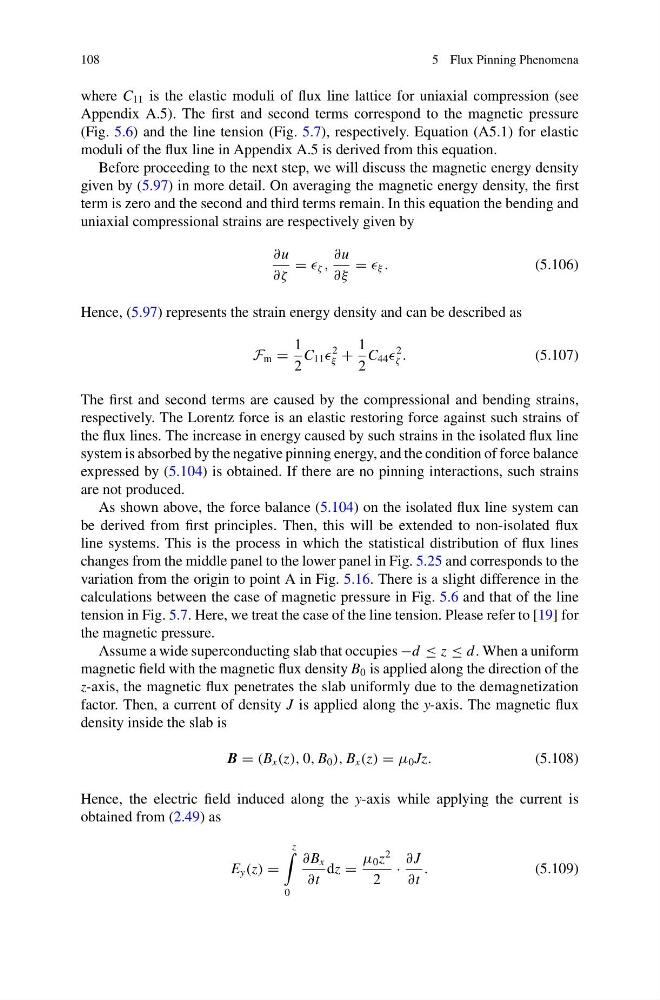
Before proceeding to the next step, we will discuss the magnetic energy density
given by (5.97) in more detail. On averaging the magnetic energy density, the first
term is zero and the second and third terms remain. In this equation the bending and
uniaxial compressional strains are respectively given by
∂u
∂ζ
= ζ ,
∂u
∂ξ
= ξ .
(5.106)
Hence, (5.97) represents the strain energy density and can be described as
F m =
1
2
C 11
2
ξ +
1
2
C 44
2
ζ .
(5.107)
The first and second terms are caused by the compressional and bending strains,
respectively. The Lorentz force is an elastic restoring force against such strains of
the flux lines. The increase in energy caused by such strains in the isolated flux line
system is absorbed by the negative pinning energy, and the condition of force balance
expressed by (5.104) is obtained. If there are no pinning interactions, such strains
are not produced.
As shown above, the force balance (5.104) on the isolated flux line system can
be derived from first principles. Then, this will be extended to non-isolated flux
line systems. This is the process in which the statistical distribution of flux lines
changes from the middle panel to the lower panel in Fig. 5.25 and corresponds to the
variation from the origin to point A in Fig. 5.16. There is a slight difference in the
calculations between the case of magnetic pressure in Fig. 5.6 and that of the line
tension in Fig. 5.7. Here, we treat the case of the line tension. Please refer to [19] for
the magnetic pressure.
Assume a wide superconducting slab that occupies −d ≤ z ≤ d . When a uniform
magnetic field with the magnetic flux density B 0 is applied along the direction of the
z-axis, the magnetic flux penetrates the slab uniformly due to the demagnetization
factor. Then, a current of density J is applied along the y-axis. The magnetic flux
density inside the slab is
B = (B x (z), 0, B 0 ), B x (z) = μ 0 Jz.
(5.108)
Hence, the electric field induced along the y-axis while applying the current is
obtained from (2.49) as
E y (z) =
z
0
∂B x
∂t
dz =
μ 0 z
2
2
·
∂J
∂t
.
(5.109)
5 Flux Pinning Phenomena
where C 11 is the elastic moduli of flux line lattice for uniaxial compression (see
Appendix A.5). The first and second terms correspond to the magnetic pressure
(Fig. 5.6) and the line tension (Fig. 5.7), respectively. Equation (A5.1) for elastic
moduli of the flux line in Appendix A.5 is derived from this equation.
Before proceeding to the next step, we will discuss the magnetic energy density
given by (5.97) in more detail. On averaging the magnetic energy density, the first
term is zero and the second and third terms remain. In this equation the bending and
uniaxial compressional strains are respectively given by
∂u
∂ζ
= ζ ,
∂u
∂ξ
= ξ .
(5.106)
Hence, (5.97) represents the strain energy density and can be described as
F m =
1
2
C 11
2
ξ +
1
2
C 44
2
ζ .
(5.107)
The first and second terms are caused by the compressional and bending strains,
respectively. The Lorentz force is an elastic restoring force against such strains of
the flux lines. The increase in energy caused by such strains in the isolated flux line
system is absorbed by the negative pinning energy, and the condition of force balance
expressed by (5.104) is obtained. If there are no pinning interactions, such strains
are not produced.
As shown above, the force balance (5.104) on the isolated flux line system can
be derived from first principles. Then, this will be extended to non-isolated flux
line systems. This is the process in which the statistical distribution of flux lines
changes from the middle panel to the lower panel in Fig. 5.25 and corresponds to the
variation from the origin to point A in Fig. 5.16. There is a slight difference in the
calculations between the case of magnetic pressure in Fig. 5.6 and that of the line
tension in Fig. 5.7. Here, we treat the case of the line tension. Please refer to [19] for
the magnetic pressure.
Assume a wide superconducting slab that occupies −d ≤ z ≤ d . When a uniform
magnetic field with the magnetic flux density B 0 is applied along the direction of the
z-axis, the magnetic flux penetrates the slab uniformly due to the demagnetization
factor. Then, a current of density J is applied along the y-axis. The magnetic flux
density inside the slab is
B = (B x (z), 0, B 0 ), B x (z) = μ 0 Jz.
(5.108)
Hence, the electric field induced along the y-axis while applying the current is
obtained from (2.49) as
E y (z) =
z
0
∂B x
∂t
dz =
μ 0 z
2
2
·
∂J
∂t
.
(5.109)