

106
5 Flux Pinning Phenomena
5.7 Critical State Theory
The irreversibility was derived using the statistical mean field approximation in
Sect. 5.4. On the other hand, individual elementary energetic interactions with defects
are reversible in nature, and this theoretical method also describes reversible behavior
in the flux pinning phenomena, which can be observed experimentally. It is expected,
therefore, that the flux pinning phenomena can be explained by first principles to
minimize the relevant free energy, similarly to superconductivity, which is explained
by minimizing the Ginzburg-Landau free energy.
In the critical state model, the balance between the Lorentz force and the pinning
force is essential, and the energies related to the force balance are only the magnetic
energy and the pinning energy. Practical superconductors to which the critical state
model is applicable are type II superconductors with high κ values, and the condensation energy and the kinetic energy are relatively small enough to disregard. Thus,
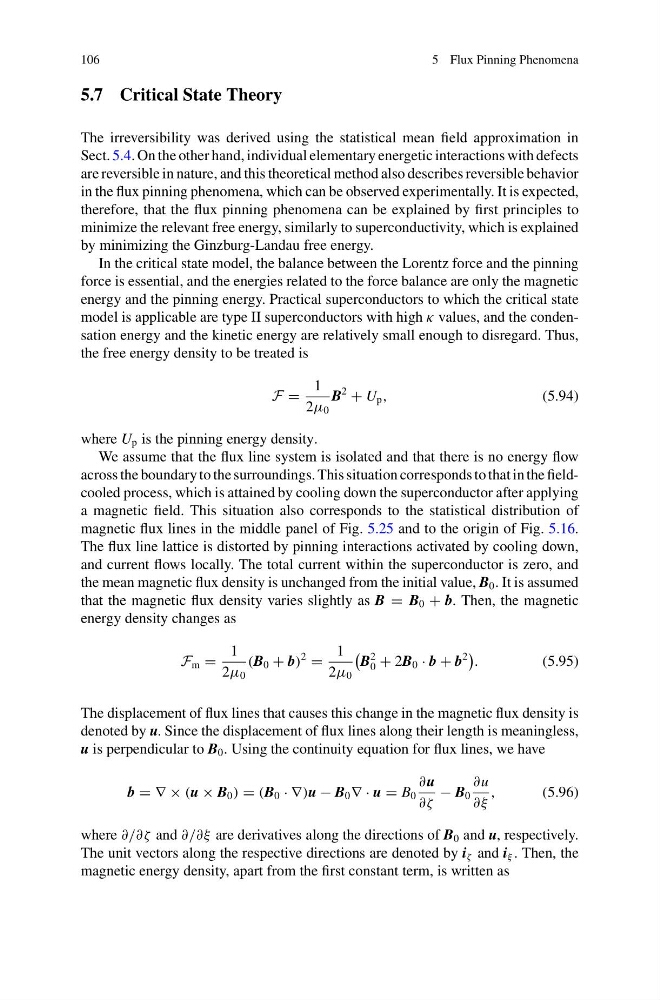
the free energy density to be treated is
F =
1
2μ 0
B
2
+ U p ,
(5.94)
where U p is the pinning energy density.
We assume that the flux line system is isolated and that there is no energy flow
across the boundary to the surroundings. This situation corresponds to that in the fieldcooled process, which is attained by cooling down the superconductor after applying
a magnetic field. This situation also corresponds to the statistical distribution of
magnetic flux lines in the middle panel of Fig. 5.25 and to the origin of Fig. 5.16.
The flux line lattice is distorted by pinning interactions activated by cooling down,
and current flows locally. The total current within the superconductor is zero, and
the mean magnetic flux density is unchanged from the initial value, B 0 . It is assumed
that the magnetic flux density varies slightly as B = B 0 + b. Then, the magnetic
energy density changes as
F m =
1
2μ 0
(B 0 + b)
2
=
1
2μ 0
B
2
0 + 2B 0 · b + b
2
.
(5.95)
The displacement of flux lines that causes this change in the magnetic flux density is
denoted by u. Since the displacement of flux lines along their length is meaningless,
u is perpendicular to B 0 . Using the continuity equation for flux lines, we have
b = ∇ × (u × B 0 ) = (B 0 · ∇)u − B 0 ∇ · u = B 0
∂u
∂ζ
− B 0
∂u
∂ξ
,
(5.96)
where ∂/∂ζ and ∂/∂ξ are derivatives along the directions of B 0 and u, respectively.
The unit vectors along the respective directions are denoted by i ζ and i ξ . Then, the
magnetic energy density, apart from the first constant term, is written as
5 Flux Pinning Phenomena
5.7 Critical State Theory
The irreversibility was derived using the statistical mean field approximation in
Sect. 5.4. On the other hand, individual elementary energetic interactions with defects
are reversible in nature, and this theoretical method also describes reversible behavior
in the flux pinning phenomena, which can be observed experimentally. It is expected,
therefore, that the flux pinning phenomena can be explained by first principles to
minimize the relevant free energy, similarly to superconductivity, which is explained
by minimizing the Ginzburg-Landau free energy.
In the critical state model, the balance between the Lorentz force and the pinning
force is essential, and the energies related to the force balance are only the magnetic
energy and the pinning energy. Practical superconductors to which the critical state
model is applicable are type II superconductors with high κ values, and the condensation energy and the kinetic energy are relatively small enough to disregard. Thus,
the free energy density to be treated is
F =
1
2μ 0
B
2
+ U p ,
(5.94)
where U p is the pinning energy density.
We assume that the flux line system is isolated and that there is no energy flow
across the boundary to the surroundings. This situation corresponds to that in the fieldcooled process, which is attained by cooling down the superconductor after applying
a magnetic field. This situation also corresponds to the statistical distribution of
magnetic flux lines in the middle panel of Fig. 5.25 and to the origin of Fig. 5.16.
The flux line lattice is distorted by pinning interactions activated by cooling down,
and current flows locally. The total current within the superconductor is zero, and
the mean magnetic flux density is unchanged from the initial value, B 0 . It is assumed
that the magnetic flux density varies slightly as B = B 0 + b. Then, the magnetic
energy density changes as
F m =
1
2μ 0
(B 0 + b)
2
=
1
2μ 0
B
2
0 + 2B 0 · b + b
2
.
(5.95)
The displacement of flux lines that causes this change in the magnetic flux density is
denoted by u. Since the displacement of flux lines along their length is meaningless,
u is perpendicular to B 0 . Using the continuity equation for flux lines, we have
b = ∇ × (u × B 0 ) = (B 0 · ∇)u − B 0 ∇ · u = B 0
∂u
∂ζ
− B 0
∂u
∂ξ
,
(5.96)
where ∂/∂ζ and ∂/∂ξ are derivatives along the directions of B 0 and u, respectively.
The unit vectors along the respective directions are denoted by i ζ and i ξ . Then, the
magnetic energy density, apart from the first constant term, is written as