

104
5 Flux Pinning Phenomena
F p = N p f p
f p − f pt
f p + f pt
= α L
a f
ζ
.
(5.84)
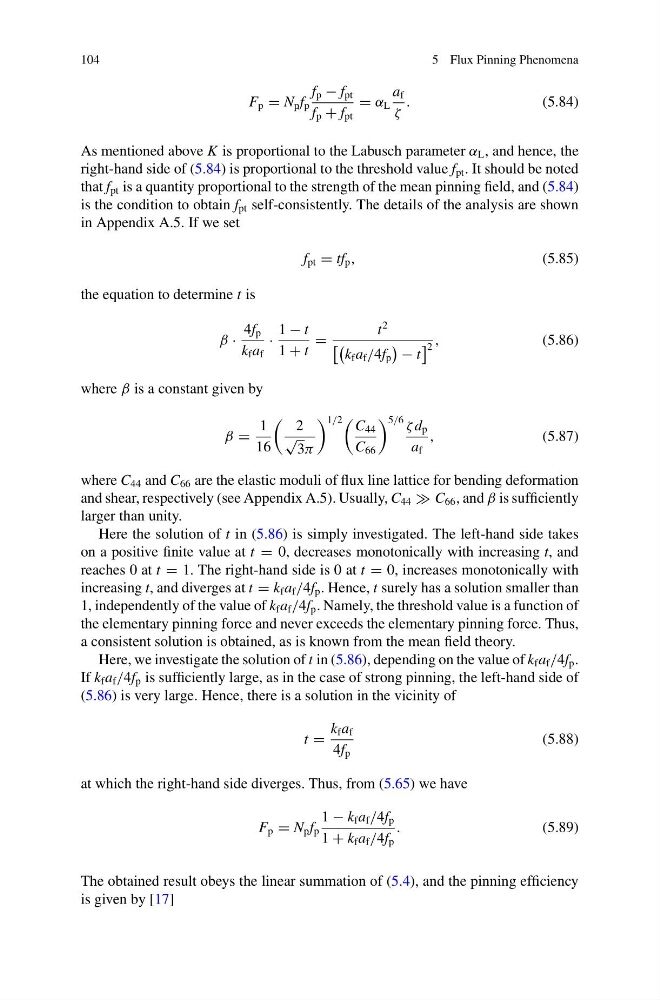
As mentioned above K is proportional to the Labusch parameter α L , and hence, the
right-hand side of (5.84) is proportional to the threshold value f pt . It should be noted
that f pt is a quantity proportional to the strength of the mean pinning field, and (5.84)
is the condition to obtain f pt self-consistently. The details of the analysis are shown
in Appendix A.5. If we set
f pt = tf p ,
(5.85)
the equation to determine t is
β ·
4f p
k f a f
·
1 − t
1 + t
=
t
2
k f a f /4f p
− t
2 ,
(5.86)
where β is a constant given by
β =
1
16
2
√
3π
1/2
C 44
C 66
5/6 ζ d p
a f
,
(5.87)
where C 44 and C 66 are the elastic moduli of flux line lattice for bending deformation
and shear, respectively (see Appendix A.5). Usually, C 44 C 66 , and β is sufficiently
larger than unity.
Here the solution of t in (5.86) is simply investigated. The left-hand side takes
on a positive finite value at t = 0, decreases monotonically with increasing t, and
reaches 0 at t = 1. The right-hand side is 0 at t = 0, increases monotonically with
increasing t, and diverges at t = k f a f /4f p . Hence, t surely has a solution smaller than
1, independently of the value of k f a f /4f p . Namely, the threshold value is a function of
the elementary pinning force and never exceeds the elementary pinning force. Thus,
a consistent solution is obtained, as is known from the mean field theory.
Here, we investigate the solution of t in (5.86), depending on the value of k f a f /4f p .
If k f a f /4f p is sufficiently large, as in the case of strong pinning, the left-hand side of
(5.86) is very large. Hence, there is a solution in the vicinity of
t =
k f a f
4f p
(5.88)
at which the right-hand side diverges. Thus, from (5.65) we have
F p = N p f p
1 − k f a f /4f p
1 + k f a f /4f p
.
(5.89)
The obtained result obeys the linear summation of (5.4), and the pinning efficiency
is given by [17]
5 Flux Pinning Phenomena
F p = N p f p
f p − f pt
f p + f pt
= α L
a f
ζ
.
(5.84)
As mentioned above K is proportional to the Labusch parameter α L , and hence, the
right-hand side of (5.84) is proportional to the threshold value f pt . It should be noted
that f pt is a quantity proportional to the strength of the mean pinning field, and (5.84)
is the condition to obtain f pt self-consistently. The details of the analysis are shown
in Appendix A.5. If we set
f pt = tf p ,
(5.85)
the equation to determine t is
β ·
4f p
k f a f
·
1 − t
1 + t
=
t
2
k f a f /4f p
− t
2 ,
(5.86)
where β is a constant given by
β =
1
16
2
√
3π
1/2
C 44
C 66
5/6 ζ d p
a f
,
(5.87)
where C 44 and C 66 are the elastic moduli of flux line lattice for bending deformation
and shear, respectively (see Appendix A.5). Usually, C 44 C 66 , and β is sufficiently
larger than unity.
Here the solution of t in (5.86) is simply investigated. The left-hand side takes
on a positive finite value at t = 0, decreases monotonically with increasing t, and
reaches 0 at t = 1. The right-hand side is 0 at t = 0, increases monotonically with
increasing t, and diverges at t = k f a f /4f p . Hence, t surely has a solution smaller than
1, independently of the value of k f a f /4f p . Namely, the threshold value is a function of
the elementary pinning force and never exceeds the elementary pinning force. Thus,
a consistent solution is obtained, as is known from the mean field theory.
Here, we investigate the solution of t in (5.86), depending on the value of k f a f /4f p .
If k f a f /4f p is sufficiently large, as in the case of strong pinning, the left-hand side of
(5.86) is very large. Hence, there is a solution in the vicinity of
t =
k f a f
4f p
(5.88)
at which the right-hand side diverges. Thus, from (5.65) we have
F p = N p f p
1 − k f a f /4f p
1 + k f a f /4f p
.
(5.89)
The obtained result obeys the linear summation of (5.4), and the pinning efficiency
is given by [17]