

72
S. B. Christensen et al.
6.2 Chemistry at Lactone C-12
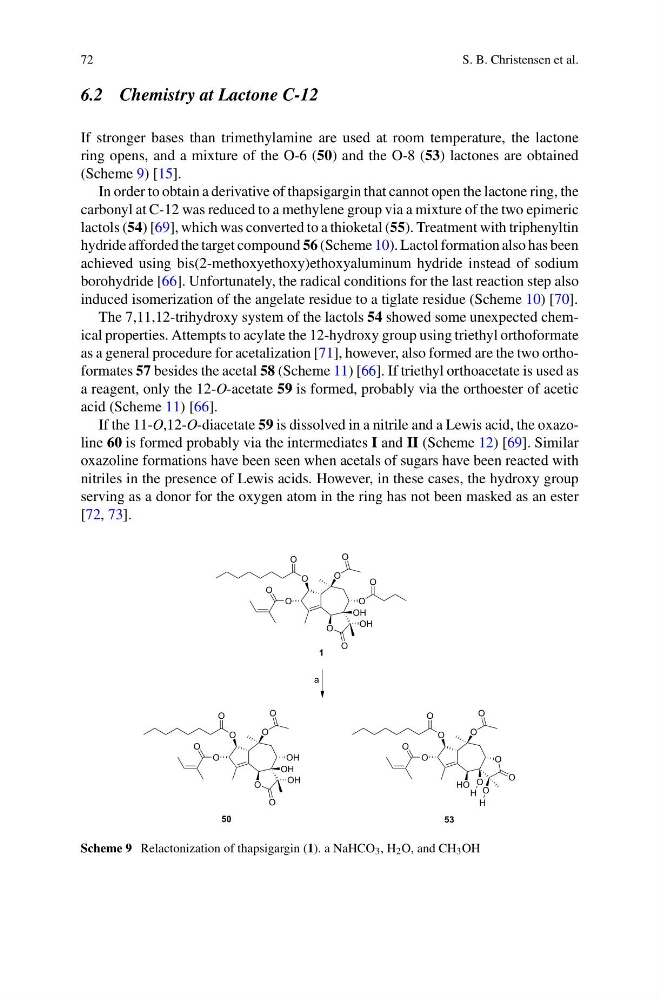
If stronger bases than trimethylamine are used at room temperature, the lactone
ring opens, and a mixture of the O-6 (50) and the O-8 (53) lactones are obtained
(Scheme 9) [15].
In order to obtain a derivative of thapsigargin that cannot open the lactone ring, the
carbonyl at C-12 was reduced to a methylene group via a mixture of the two epimeric
lactols (54) [69], which was converted to a thioketal (55). Treatment with triphenyltin
hydride afforded the target compound 56 (Scheme 10). Lactol formation also has been
achieved using bis(2-methoxyethoxy)ethoxyaluminum hydride instead of sodium
borohydride [66]. Unfortunately, the radical conditions for the last reaction step also
induced isomerization of the angelate residue to a tiglate residue (Scheme 10) [70].
The 7,11,12-trihydroxy system of the lactols 54 showed some unexpected chemical properties. Attempts to acylate the 12-hydroxy group using triethyl orthoformate
as a general procedure for acetalization [71], however, also formed are the two orthoformates 57 besides the acetal 58 (Scheme 11) [66]. If triethyl orthoacetate is used as
a reagent, only the 12-O-acetate 59 is formed, probably via the orthoester of acetic
acid (Scheme 11) [66].
If the 11-O,12-O-diacetate 59 is dissolved in a nitrile and a Lewis acid, the oxazoline 60 is formed probably via the intermediates I and II (Scheme 12) [69]. Similar
oxazoline formations have been seen when acetals of sugars have been reacted with
nitriles in the presence of Lewis acids. However, in these cases, the hydroxy group
serving as a donor for the oxygen atom in the ring has not been masked as an ester
[72, 73].
O
O
O
O
O
O
O
O
O
OH
OH
O
O
O
O
O
O
OH
O
O
OH
OH
O
HO
O
O
O
O
O
O
O
O
O
H O
H
50
53
1
a
Scheme 9 Relactonization of thapsigargin (1). a NaHCO 3 , H 2 O, and CH 3 OH
S. B. Christensen et al.
6.2 Chemistry at Lactone C-12
If stronger bases than trimethylamine are used at room temperature, the lactone
ring opens, and a mixture of the O-6 (50) and the O-8 (53) lactones are obtained
(Scheme 9) [15].
In order to obtain a derivative of thapsigargin that cannot open the lactone ring, the
carbonyl at C-12 was reduced to a methylene group via a mixture of the two epimeric
lactols (54) [69], which was converted to a thioketal (55). Treatment with triphenyltin
hydride afforded the target compound 56 (Scheme 10). Lactol formation also has been
achieved using bis(2-methoxyethoxy)ethoxyaluminum hydride instead of sodium
borohydride [66]. Unfortunately, the radical conditions for the last reaction step also
induced isomerization of the angelate residue to a tiglate residue (Scheme 10) [70].
The 7,11,12-trihydroxy system of the lactols 54 showed some unexpected chemical properties. Attempts to acylate the 12-hydroxy group using triethyl orthoformate
as a general procedure for acetalization [71], however, also formed are the two orthoformates 57 besides the acetal 58 (Scheme 11) [66]. If triethyl orthoacetate is used as
a reagent, only the 12-O-acetate 59 is formed, probably via the orthoester of acetic
acid (Scheme 11) [66].
If the 11-O,12-O-diacetate 59 is dissolved in a nitrile and a Lewis acid, the oxazoline 60 is formed probably via the intermediates I and II (Scheme 12) [69]. Similar
oxazoline formations have been seen when acetals of sugars have been reacted with
nitriles in the presence of Lewis acids. However, in these cases, the hydroxy group
serving as a donor for the oxygen atom in the ring has not been masked as an ester
[72, 73].
O
O
O
O
O
O
O
O
O
OH
OH
O
O
O
O
O
O
OH
O
O
OH
OH
O
HO
O
O
O
O
O
O
O
O
O
H O
H
50
53
1
a
Scheme 9 Relactonization of thapsigargin (1). a NaHCO 3 , H 2 O, and CH 3 OH