

68
S. B. Christensen et al.
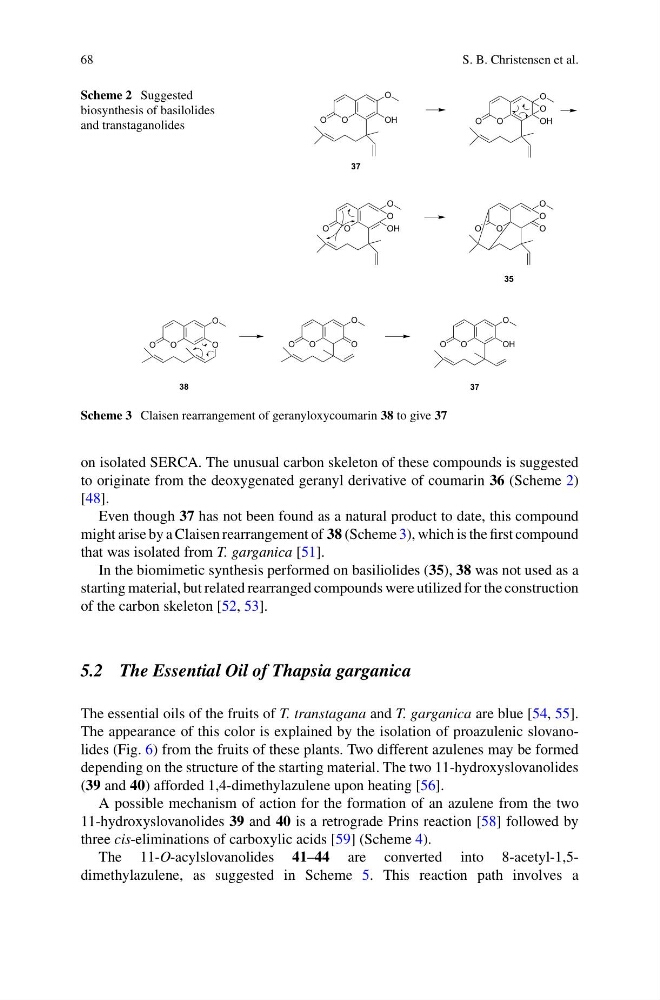
Scheme 2 Suggested
biosynthesis of basilolides
and transtaganolides
O
O
O
OH
O
O
O
OH
O
O
O
O
OH
O
O
O
O
O
O
37
35
O
O
O
OH
37
O
O
O
O
O
O
O
O
38
Scheme 3 Claisen rearrangement of geranyloxycoumarin 38 to give 37
on isolated SERCA. The unusual carbon skeleton of these compounds is suggested
to originate from the deoxygenated geranyl derivative of coumarin 36 (Scheme 2)
[48].
Even though 37 has not been found as a natural product to date, this compound
might arise by a Claisen rearrangement of 38 (Scheme 3), which is the first compound
that was isolated from T. garganica [51].
In the biomimetic synthesis performed on basiliolides (35), 38 was not used as a
starting material, but related rearranged compounds were utilized for the construction
of the carbon skeleton [52, 53].
5.2 The Essential Oil of Thapsia garganica
The essential oils of the fruits of T. transtagana and T. garganica are blue [54, 55].
The appearance of this color is explained by the isolation of proazulenic slovanolides (Fig. 6) from the fruits of these plants. Two different azulenes may be formed
depending on the structure of the starting material. The two 11-hydroxyslovanolides
(39 and 40) afforded 1,4-dimethylazulene upon heating [56].
A possible mechanism of action for the formation of an azulene from the two
11-hydroxyslovanolides 39 and 40 is a retrograde Prins reaction [58] followed by
three cis-eliminations of carboxylic acids [59] (Scheme 4).
The 11-O-acylslovanolides 41–44 are converted into 8-acetyl-1,5dimethylazulene, as suggested in Scheme 5. This reaction path involves a
S. B. Christensen et al.
Scheme 2 Suggested
biosynthesis of basilolides
and transtaganolides
O
O
O
OH
O
O
O
OH
O
O
O
O
OH
O
O
O
O
O
O
37
35
O
O
O
OH
37
O
O
O
O
O
O
O
O
38
Scheme 3 Claisen rearrangement of geranyloxycoumarin 38 to give 37
on isolated SERCA. The unusual carbon skeleton of these compounds is suggested
to originate from the deoxygenated geranyl derivative of coumarin 36 (Scheme 2)
[48].
Even though 37 has not been found as a natural product to date, this compound
might arise by a Claisen rearrangement of 38 (Scheme 3), which is the first compound
that was isolated from T. garganica [51].
In the biomimetic synthesis performed on basiliolides (35), 38 was not used as a
starting material, but related rearranged compounds were utilized for the construction
of the carbon skeleton [52, 53].
5.2 The Essential Oil of Thapsia garganica
The essential oils of the fruits of T. transtagana and T. garganica are blue [54, 55].
The appearance of this color is explained by the isolation of proazulenic slovanolides (Fig. 6) from the fruits of these plants. Two different azulenes may be formed
depending on the structure of the starting material. The two 11-hydroxyslovanolides
(39 and 40) afforded 1,4-dimethylazulene upon heating [56].
A possible mechanism of action for the formation of an azulene from the two
11-hydroxyslovanolides 39 and 40 is a retrograde Prins reaction [58] followed by
three cis-eliminations of carboxylic acids [59] (Scheme 4).
The 11-O-acylslovanolides 41–44 are converted into 8-acetyl-1,5dimethylazulene, as suggested in Scheme 5. This reaction path involves a