

The Role of Total Synthesis in Structure …
37
study, the originally assigned structure 114 for seimatopolide A was also confirmed
and a negative specific rotation, albeit with a significantly lower value, was recorded
[127] (Table 2, entry 2). A third synthesis (that was actually the first based on
the “received” and “published online” dates of the original publication) led to a
different conclusion with regard to the absolute configuration of seimatopolide A
[128] (Table 2, entry 3). The authors reported the synthesis of seimatopolide A with its
assigned structure 114, but they found a positive specific rotation for this compound,
which suggested that the (3R,6R,7R,9S)-configuration of the natural product was
erroneously assigned and should be revised to (3S,6S,7S,9R) (ent-114). In contrast
to the syntheses summarized above (Table 2, entries 1–2), this approach utilized a
starting material from the chiral pool with a reliably assigned absolute configuration,
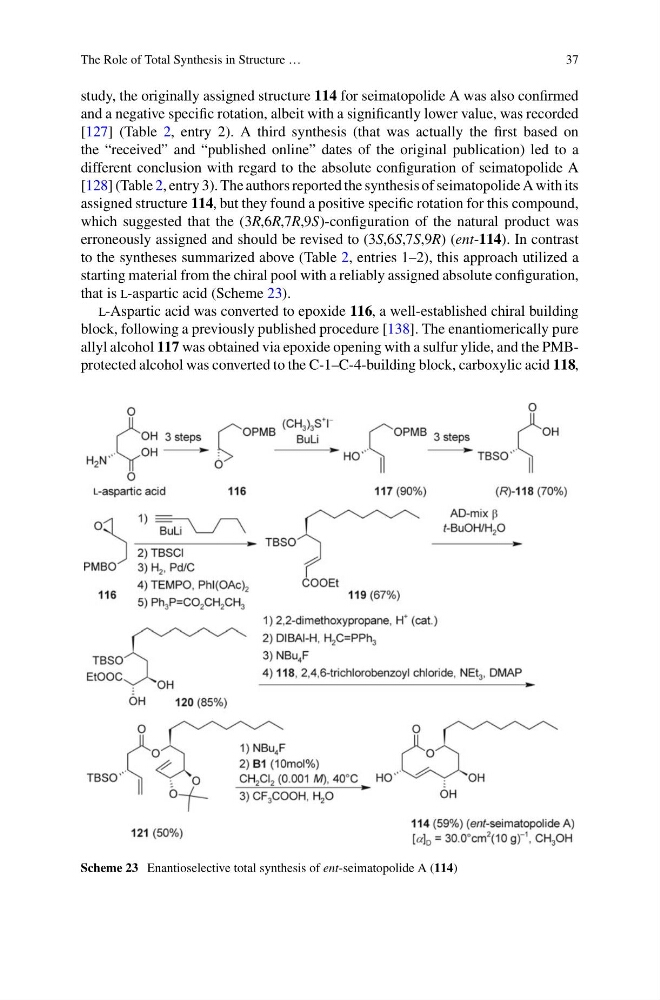
that is l-aspartic acid (Scheme 23).
l-Aspartic acid was converted to epoxide 116, a well-established chiral building
block, following a previously published procedure [138]. The enantiomerically pure
allyl alcohol 117 was obtained via epoxide opening with a sulfur ylide, and the PMBprotected alcohol was converted to the C-1–C-4-building block, carboxylic acid 118,
Scheme 23 Enantioselective total synthesis of ent-seimatopolide A (114)
37
study, the originally assigned structure 114 for seimatopolide A was also confirmed
and a negative specific rotation, albeit with a significantly lower value, was recorded
[127] (Table 2, entry 2). A third synthesis (that was actually the first based on
the “received” and “published online” dates of the original publication) led to a
different conclusion with regard to the absolute configuration of seimatopolide A
[128] (Table 2, entry 3). The authors reported the synthesis of seimatopolide A with its
assigned structure 114, but they found a positive specific rotation for this compound,
which suggested that the (3R,6R,7R,9S)-configuration of the natural product was
erroneously assigned and should be revised to (3S,6S,7S,9R) (ent-114). In contrast
to the syntheses summarized above (Table 2, entries 1–2), this approach utilized a
starting material from the chiral pool with a reliably assigned absolute configuration,
that is l-aspartic acid (Scheme 23).
l-Aspartic acid was converted to epoxide 116, a well-established chiral building
block, following a previously published procedure [138]. The enantiomerically pure
allyl alcohol 117 was obtained via epoxide opening with a sulfur ylide, and the PMBprotected alcohol was converted to the C-1–C-4-building block, carboxylic acid 118,
Scheme 23 Enantioselective total synthesis of ent-seimatopolide A (114)