

The Role of Total Synthesis in Structure …
35
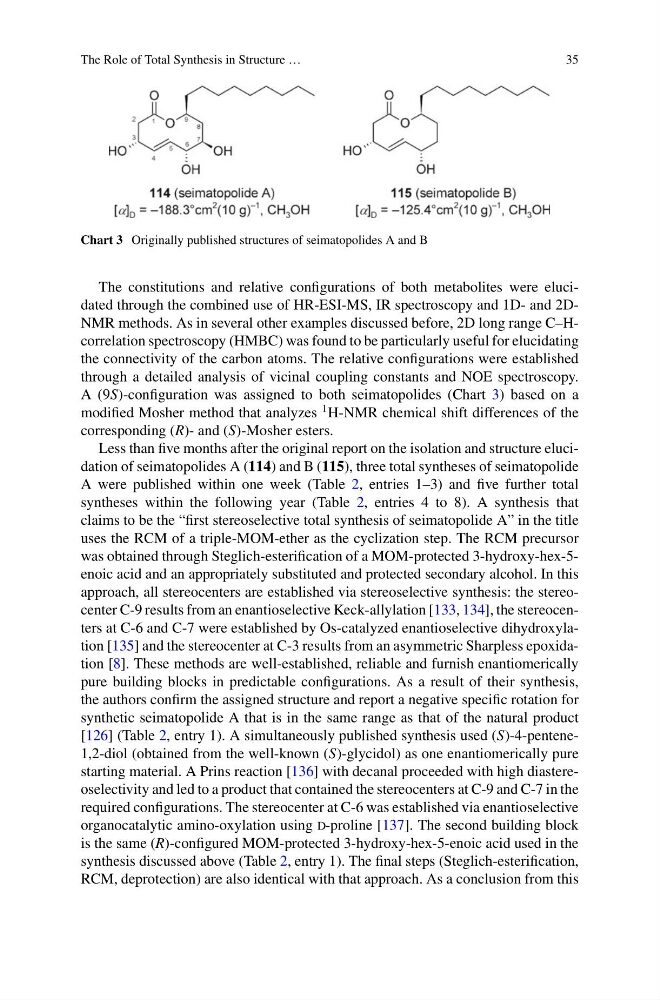
Chart 3 Originally published structures of seimatopolides A and B
The constitutions and relative configurations of both metabolites were elucidated through the combined use of HR-ESI-MS, IR spectroscopy and 1D- and 2DNMR methods. As in several other examples discussed before, 2D long range C–Hcorrelation spectroscopy (HMBC) was found to be particularly useful for elucidating
the connectivity of the carbon atoms. The relative configurations were established
through a detailed analysis of vicinal coupling constants and NOE spectroscopy.
A (9S)-configuration was assigned to both seimatopolides (Chart 3) based on a
modified Mosher method that analyzes
1 H-NMR chemical shift differences of the
corresponding (R)- and (S)-Mosher esters.
Less than five months after the original report on the isolation and structure elucidation of seimatopolides A (114) and B (115), three total syntheses of seimatopolide
A were published within one week (Table 2, entries 1–3) and five further total
syntheses within the following year (Table 2, entries 4 to 8). A synthesis that
claims to be the “first stereoselective total synthesis of seimatopolide A” in the title
uses the RCM of a triple-MOM-ether as the cyclization step. The RCM precursor
was obtained through Steglich-esterification of a MOM-protected 3-hydroxy-hex-5enoic acid and an appropriately substituted and protected secondary alcohol. In this
approach, all stereocenters are established via stereoselective synthesis: the stereocenter C-9 results from an enantioselective Keck-allylation [133, 134], the stereocenters at C-6 and C-7 were established by Os-catalyzed enantioselective dihydroxylation [135] and the stereocenter at C-3 results from an asymmetric Sharpless epoxidation [8]. These methods are well-established, reliable and furnish enantiomerically
pure building blocks in predictable configurations. As a result of their synthesis,
the authors confirm the assigned structure and report a negative specific rotation for
synthetic seimatopolide A that is in the same range as that of the natural product
[126] (Table 2, entry 1). A simultaneously published synthesis used (S)-4-pentene1,2-diol (obtained from the well-known (S)-glycidol) as one enantiomerically pure
starting material. A Prins reaction [136] with decanal proceeded with high diastereoselectivity and led to a product that contained the stereocenters at C-9 and C-7 in the
required configurations. The stereocenter at C-6 was established via enantioselective
organocatalytic amino-oxylation using d-proline [137]. The second building block
is the same (R)-configured MOM-protected 3-hydroxy-hex-5-enoic acid used in the
synthesis discussed above (Table 2, entry 1). The final steps (Steglich-esterification,
RCM, deprotection) are also identical with that approach. As a conclusion from this
35
Chart 3 Originally published structures of seimatopolides A and B
The constitutions and relative configurations of both metabolites were elucidated through the combined use of HR-ESI-MS, IR spectroscopy and 1D- and 2DNMR methods. As in several other examples discussed before, 2D long range C–Hcorrelation spectroscopy (HMBC) was found to be particularly useful for elucidating
the connectivity of the carbon atoms. The relative configurations were established
through a detailed analysis of vicinal coupling constants and NOE spectroscopy.
A (9S)-configuration was assigned to both seimatopolides (Chart 3) based on a
modified Mosher method that analyzes
1 H-NMR chemical shift differences of the
corresponding (R)- and (S)-Mosher esters.
Less than five months after the original report on the isolation and structure elucidation of seimatopolides A (114) and B (115), three total syntheses of seimatopolide
A were published within one week (Table 2, entries 1–3) and five further total
syntheses within the following year (Table 2, entries 4 to 8). A synthesis that
claims to be the “first stereoselective total synthesis of seimatopolide A” in the title
uses the RCM of a triple-MOM-ether as the cyclization step. The RCM precursor
was obtained through Steglich-esterification of a MOM-protected 3-hydroxy-hex-5enoic acid and an appropriately substituted and protected secondary alcohol. In this
approach, all stereocenters are established via stereoselective synthesis: the stereocenter C-9 results from an enantioselective Keck-allylation [133, 134], the stereocenters at C-6 and C-7 were established by Os-catalyzed enantioselective dihydroxylation [135] and the stereocenter at C-3 results from an asymmetric Sharpless epoxidation [8]. These methods are well-established, reliable and furnish enantiomerically
pure building blocks in predictable configurations. As a result of their synthesis,
the authors confirm the assigned structure and report a negative specific rotation for
synthetic seimatopolide A that is in the same range as that of the natural product
[126] (Table 2, entry 1). A simultaneously published synthesis used (S)-4-pentene1,2-diol (obtained from the well-known (S)-glycidol) as one enantiomerically pure
starting material. A Prins reaction [136] with decanal proceeded with high diastereoselectivity and led to a product that contained the stereocenters at C-9 and C-7 in the
required configurations. The stereocenter at C-6 was established via enantioselective
organocatalytic amino-oxylation using d-proline [137]. The second building block
is the same (R)-configured MOM-protected 3-hydroxy-hex-5-enoic acid used in the
synthesis discussed above (Table 2, entry 1). The final steps (Steglich-esterification,
RCM, deprotection) are also identical with that approach. As a conclusion from this