

The Role of Total Synthesis in Structure …
25
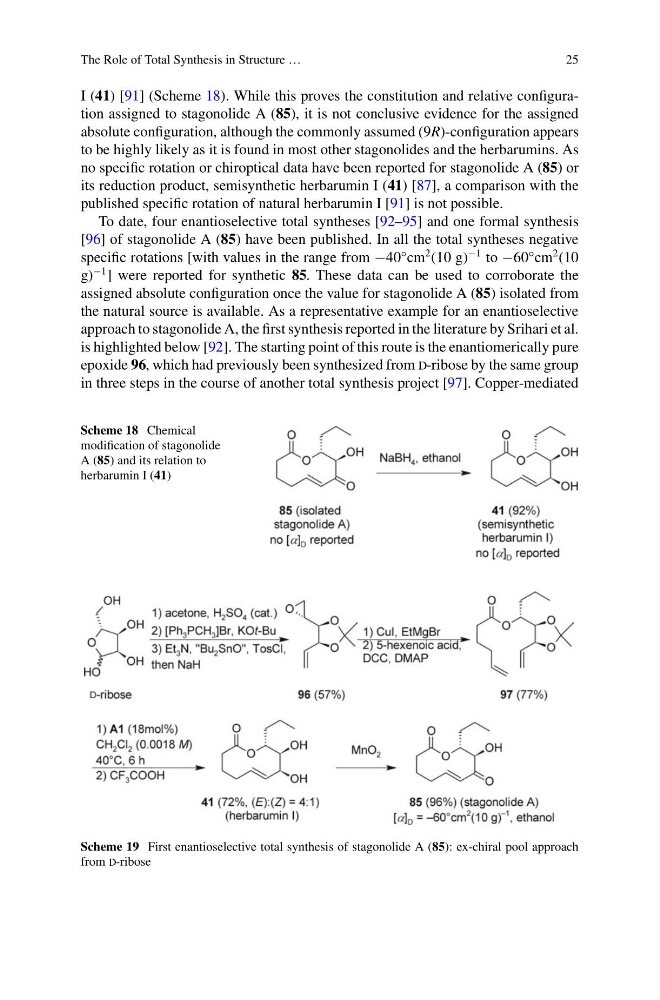
I (41) [91] (Scheme 18). While this proves the constitution and relative configuration assigned to stagonolide A (85), it is not conclusive evidence for the assigned
absolute configuration, although the commonly assumed (9R)-configuration appears
to be highly likely as it is found in most other stagonolides and the herbarumins. As
no specific rotation or chiroptical data have been reported for stagonolide A (85) or
its reduction product, semisynthetic herbarumin I (41) [87], a comparison with the
published specific rotation of natural herbarumin I [91] is not possible.
To date, four enantioselective total syntheses [92–95] and one formal synthesis
[96] of stagonolide A (85) have been published. In all the total syntheses negative
specific rotations [with values in the range from −40°cm
2 (10 g)
−1 to −60°cm
2 (10
g)
−1 ] were reported for synthetic 85. These data can be used to corroborate the
assigned absolute configuration once the value for stagonolide A (85) isolated from
the natural source is available. As a representative example for an enantioselective
approach to stagonolide A, the first synthesis reported in the literature by Srihari et al.
is highlighted below [92]. The starting point of this route is the enantiomerically pure
epoxide 96, which had previously been synthesized from d-ribose by the same group
in three steps in the course of another total synthesis project [97]. Copper-mediated
Scheme 18 Chemical
modification of stagonolide
A (85) and its relation to
herbarumin I (41)
Scheme 19 First enantioselective total synthesis of stagonolide A (85): ex-chiral pool approach
from d-ribose
25
I (41) [91] (Scheme 18). While this proves the constitution and relative configuration assigned to stagonolide A (85), it is not conclusive evidence for the assigned
absolute configuration, although the commonly assumed (9R)-configuration appears
to be highly likely as it is found in most other stagonolides and the herbarumins. As
no specific rotation or chiroptical data have been reported for stagonolide A (85) or
its reduction product, semisynthetic herbarumin I (41) [87], a comparison with the
published specific rotation of natural herbarumin I [91] is not possible.
To date, four enantioselective total syntheses [92–95] and one formal synthesis
[96] of stagonolide A (85) have been published. In all the total syntheses negative
specific rotations [with values in the range from −40°cm
2 (10 g)
−1 to −60°cm
2 (10
g)
−1 ] were reported for synthetic 85. These data can be used to corroborate the
assigned absolute configuration once the value for stagonolide A (85) isolated from
the natural source is available. As a representative example for an enantioselective
approach to stagonolide A, the first synthesis reported in the literature by Srihari et al.
is highlighted below [92]. The starting point of this route is the enantiomerically pure
epoxide 96, which had previously been synthesized from d-ribose by the same group
in three steps in the course of another total synthesis project [97]. Copper-mediated
Scheme 18 Chemical
modification of stagonolide
A (85) and its relation to
herbarumin I (41)
Scheme 19 First enantioselective total synthesis of stagonolide A (85): ex-chiral pool approach
from d-ribose