
Recent Advances in the Chemistry and Pharmacology of Cryptolepine
203
79. Koninti RK, Sappati S, Satpathi S, Gavvala K, Hazra P (2016) Spectroscopy and dynamics of
cryptolepine in the nanocavity of cucurbit[7]uril and DNA. ChemPhysChem 17:506
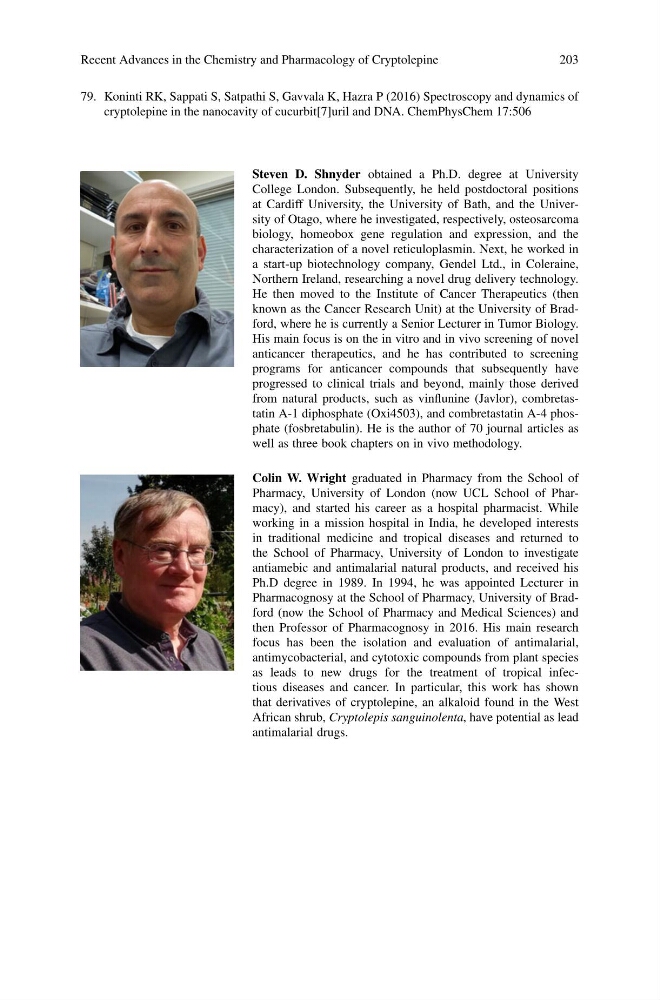
Steven D. Shnyder obtained a Ph.D. degree at University
College London. Subsequently, he held postdoctoral positions
at Cardiff University, the University of Bath, and the University of Otago, where he investigated, respectively, osteosarcoma
biology, homeobox gene regulation and expression, and the
characterization of a novel reticuloplasmin. Next, he worked in
a start-up biotechnology company, Gendel Ltd., in Coleraine,
Northern Ireland, researching a novel drug delivery technology.
He then moved to the Institute of Cancer Therapeutics (then
known as the Cancer Research Unit) at the University of Bradford, where he is currently a Senior Lecturer in Tumor Biology.
His main focus is on the in vitro and in vivo screening of novel
anticancer therapeutics, and he has contributed to screening
programs for anticancer compounds that subsequently have
progressed to clinical trials and beyond, mainly those derived
from natural products, such as vinflunine (Javlor), combretastatin A-1 diphosphate (Oxi4503), and combretastatin A-4 phosphate (fosbretabulin). He is the author of 70 journal articles as
well as three book chapters on in vivo methodology.
Colin W. Wright graduated in Pharmacy from the School of
Pharmacy, University of London (now UCL School of Pharmacy), and started his career as a hospital pharmacist. While
working in a mission hospital in India, he developed interests
in traditional medicine and tropical diseases and returned to
the School of Pharmacy, University of London to investigate
antiamebic and antimalarial natural products, and received his
Ph.D degree in 1989. In 1994, he was appointed Lecturer in
Pharmacognosy at the School of Pharmacy, University of Bradford (now the School of Pharmacy and Medical Sciences) and
then Professor of Pharmacognosy in 2016. His main research
focus has been the isolation and evaluation of antimalarial,
antimycobacterial, and cytotoxic compounds from plant species
as leads to new drugs for the treatment of tropical infectious diseases and cancer. In particular, this work has shown
that derivatives of cryptolepine, an alkaloid found in the West
African shrub, Cryptolepis sanguinolenta, have potential as lead
antimalarial drugs.
203
79. Koninti RK, Sappati S, Satpathi S, Gavvala K, Hazra P (2016) Spectroscopy and dynamics of
cryptolepine in the nanocavity of cucurbit[7]uril and DNA. ChemPhysChem 17:506
Steven D. Shnyder obtained a Ph.D. degree at University
College London. Subsequently, he held postdoctoral positions
at Cardiff University, the University of Bath, and the University of Otago, where he investigated, respectively, osteosarcoma
biology, homeobox gene regulation and expression, and the
characterization of a novel reticuloplasmin. Next, he worked in
a start-up biotechnology company, Gendel Ltd., in Coleraine,
Northern Ireland, researching a novel drug delivery technology.
He then moved to the Institute of Cancer Therapeutics (then
known as the Cancer Research Unit) at the University of Bradford, where he is currently a Senior Lecturer in Tumor Biology.
His main focus is on the in vitro and in vivo screening of novel
anticancer therapeutics, and he has contributed to screening
programs for anticancer compounds that subsequently have
progressed to clinical trials and beyond, mainly those derived
from natural products, such as vinflunine (Javlor), combretastatin A-1 diphosphate (Oxi4503), and combretastatin A-4 phosphate (fosbretabulin). He is the author of 70 journal articles as
well as three book chapters on in vivo methodology.
Colin W. Wright graduated in Pharmacy from the School of
Pharmacy, University of London (now UCL School of Pharmacy), and started his career as a hospital pharmacist. While
working in a mission hospital in India, he developed interests
in traditional medicine and tropical diseases and returned to
the School of Pharmacy, University of London to investigate
antiamebic and antimalarial natural products, and received his
Ph.D degree in 1989. In 1994, he was appointed Lecturer in
Pharmacognosy at the School of Pharmacy, University of Bradford (now the School of Pharmacy and Medical Sciences) and
then Professor of Pharmacognosy in 2016. His main research
focus has been the isolation and evaluation of antimalarial,
antimycobacterial, and cytotoxic compounds from plant species
as leads to new drugs for the treatment of tropical infectious diseases and cancer. In particular, this work has shown
that derivatives of cryptolepine, an alkaloid found in the West
African shrub, Cryptolepis sanguinolenta, have potential as lead
antimalarial drugs.
Précédent