

196
S. D. Shnyder and C. W. Wright
As a way of boosting the cytotoxic activity of Zn(II) complexes for anticancer
photodynamic therapy (PDT), recently Qin et al. have developed novel red Zn(II)
complex-based fluorescent probes featuring cryptolepine–curcumin derivatives [58].
One of these derivatives, 54, inhibited tumor growth with an inhibition rate of 43%
when administered to mice kept in the dark bearing subcutaneously implanted T-24
bladder cancer cell line xenografts at 2.0 mg/kg/dose administered every 2 days for
16 days. The tumor inhibition rate increased to 66% when mice were subjected to 470
nm LED light-irradiation, with negligible toxicity reported, suggesting the potential
for the use of such complexes in PDT.
10 Pharmacokinetics and Toxic Effects
10.1 Cryptolepine Pharmacokinetics
The pK a of cryptolepine (1) has been determined spectrophotometrically to be 10.99
at 20°C [70], comparable to that previously published using similar methodology
(11.8) [40], and it was found to be relatively stable in neutral and acidic conditions but
less so in basic media and susceptible to oxidation. The partitioning of cryptolepine
into red blood cells has been investigated and compared to that of quinine [71].
This was found to be irreversible for cryptolepine but reversible for quinine; plasma
protein binding was found to be moderate for both.
As a number of quinolinium compounds are known to be metabolized by the
molybdenum-containing enzyme liver aldehyde oxidase, the in vitro metabolism of
1 and several analogs was investigated [72]. Cryptolepine was readily oxidized by a
partially purified rabbit liver preparation of aldehyde oxidase (K m = 7 μM), similar
to that for other quinolinium compounds but the rate of oxidation was 40-fold slower
than the oxidation of the standard substrate, 4-(dimethylamino)cinnamaldehyde.
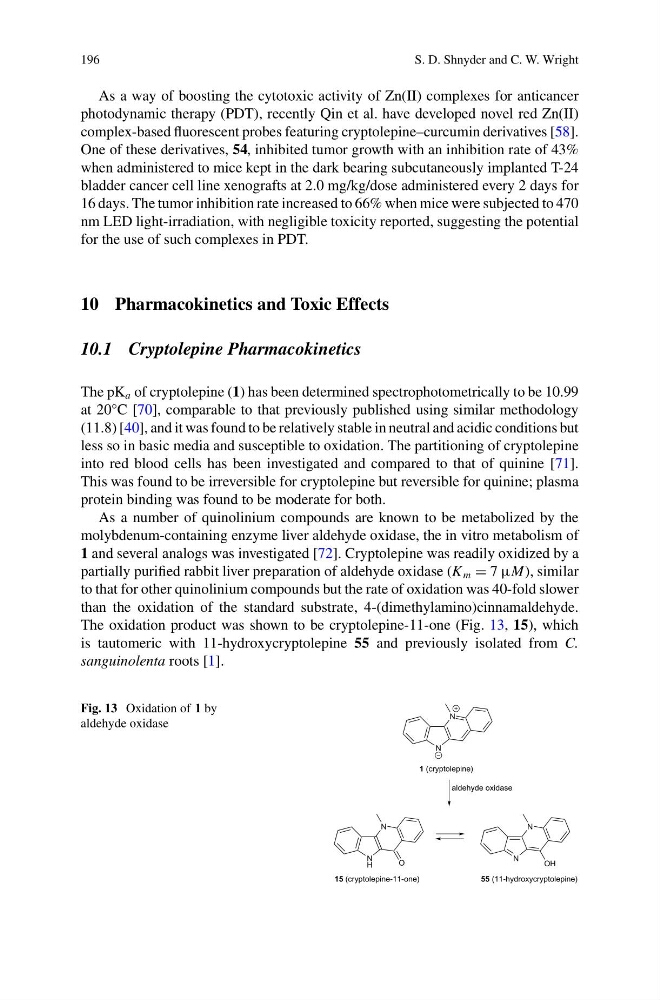
The oxidation product was shown to be cryptolepine-11-one (Fig. 13, 15), which
is tautomeric with 11-hydroxycryptolepine 55 and previously isolated from C.
sanguinolenta roots [1].
Fig. 13 Oxidation of 1 by
aldehyde oxidase
N
N
1 (cryptolepine)
aldehyde oxidase
N
H
N
15 (cryptolepine-11-one)
O
N
N
55 (11-hydroxycryptolepine)
OH
S. D. Shnyder and C. W. Wright
As a way of boosting the cytotoxic activity of Zn(II) complexes for anticancer
photodynamic therapy (PDT), recently Qin et al. have developed novel red Zn(II)
complex-based fluorescent probes featuring cryptolepine–curcumin derivatives [58].
One of these derivatives, 54, inhibited tumor growth with an inhibition rate of 43%
when administered to mice kept in the dark bearing subcutaneously implanted T-24
bladder cancer cell line xenografts at 2.0 mg/kg/dose administered every 2 days for
16 days. The tumor inhibition rate increased to 66% when mice were subjected to 470
nm LED light-irradiation, with negligible toxicity reported, suggesting the potential
for the use of such complexes in PDT.
10 Pharmacokinetics and Toxic Effects
10.1 Cryptolepine Pharmacokinetics
The pK a of cryptolepine (1) has been determined spectrophotometrically to be 10.99
at 20°C [70], comparable to that previously published using similar methodology
(11.8) [40], and it was found to be relatively stable in neutral and acidic conditions but
less so in basic media and susceptible to oxidation. The partitioning of cryptolepine
into red blood cells has been investigated and compared to that of quinine [71].
This was found to be irreversible for cryptolepine but reversible for quinine; plasma
protein binding was found to be moderate for both.
As a number of quinolinium compounds are known to be metabolized by the
molybdenum-containing enzyme liver aldehyde oxidase, the in vitro metabolism of
1 and several analogs was investigated [72]. Cryptolepine was readily oxidized by a
partially purified rabbit liver preparation of aldehyde oxidase (K m = 7 μM), similar
to that for other quinolinium compounds but the rate of oxidation was 40-fold slower
than the oxidation of the standard substrate, 4-(dimethylamino)cinnamaldehyde.
The oxidation product was shown to be cryptolepine-11-one (Fig. 13, 15), which
is tautomeric with 11-hydroxycryptolepine 55 and previously isolated from C.
sanguinolenta roots [1].
Fig. 13 Oxidation of 1 by
aldehyde oxidase
N
N
1 (cryptolepine)
aldehyde oxidase
N
H
N
15 (cryptolepine-11-one)
O
N
N
55 (11-hydroxycryptolepine)
OH