

Antileishmanial Activity of Lignans, Neolignans …
133
Fig. 7 The biological activity of resveratrol related to muscle, liver, adipose and pancreatic tissue,
and its cardiovascular preventive actions
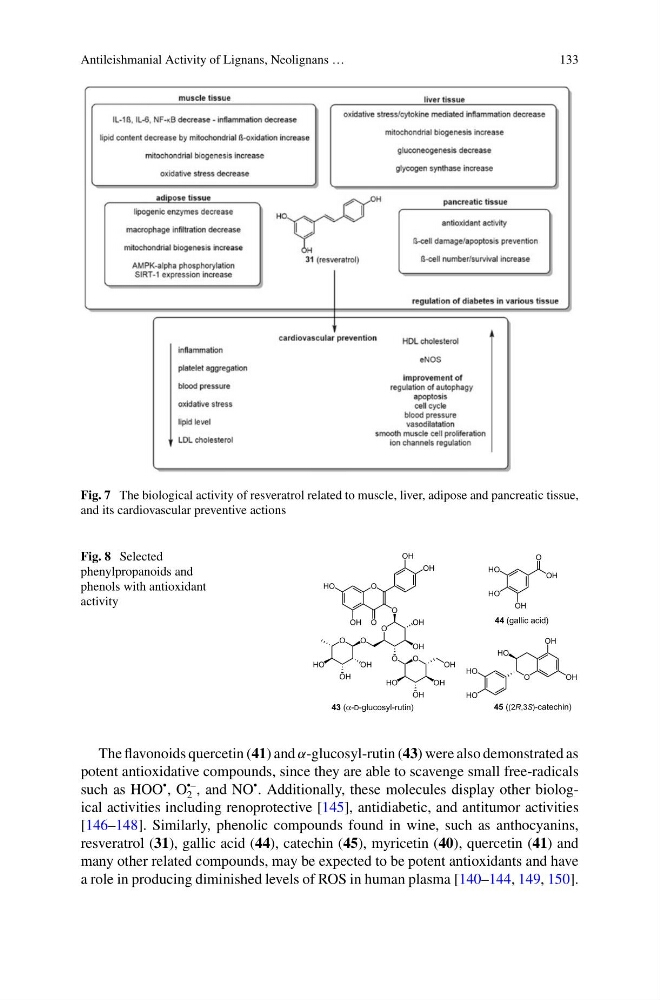
Fig. 8 Selected
phenylpropanoids and
phenols with antioxidant
activity
O
HO
OH O
O
OH
OH
O
O
O
HO
OH
OH
OH
OH
O
O
OH
HO
HO
OH
44 (gallic acid)
O
HO
HO
HO
OH
OH
45 ((2R,3S)-catechin)
43 (α-D-glucosyl-rutin)
O
OH
HO
OH
OH
The flavonoids quercetin (41) and α-glucosyl-rutin (43) were also demonstrated as
potent antioxidative compounds, since they are able to scavenge small free-radicals
such as HOO
• , O
•–
2 , and NO
• . Additionally, these molecules display other biological activities including renoprotective [145], antidiabetic, and antitumor activities
[146–148]. Similarly, phenolic compounds found in wine, such as anthocyanins,
resveratrol (31), gallic acid (44), catechin (45), myricetin (40), quercetin (41) and
many other related compounds, may be expected to be potent antioxidants and have
a role in producing diminished levels of ROS in human plasma [140–144, 149, 150].
133
Fig. 7 The biological activity of resveratrol related to muscle, liver, adipose and pancreatic tissue,
and its cardiovascular preventive actions
Fig. 8 Selected
phenylpropanoids and
phenols with antioxidant
activity
O
HO
OH O
O
OH
OH
O
O
O
HO
OH
OH
OH
OH
O
O
OH
HO
HO
OH
44 (gallic acid)
O
HO
HO
HO
OH
OH
45 ((2R,3S)-catechin)
43 (α-D-glucosyl-rutin)
O
OH
HO
OH
OH
The flavonoids quercetin (41) and α-glucosyl-rutin (43) were also demonstrated as
potent antioxidative compounds, since they are able to scavenge small free-radicals
such as HOO
• , O
•–
2 , and NO
• . Additionally, these molecules display other biological activities including renoprotective [145], antidiabetic, and antitumor activities
[146–148]. Similarly, phenolic compounds found in wine, such as anthocyanins,
resveratrol (31), gallic acid (44), catechin (45), myricetin (40), quercetin (41) and
many other related compounds, may be expected to be potent antioxidants and have
a role in producing diminished levels of ROS in human plasma [140–144, 149, 150].