

Antileishmanial Activity of Lignans, Neolignans …
131
3.3.1 Neuroprotective activities
Neurodegenerative diseases affect many aspects of human life. Memory, cognition,
the ability to speak and to understand, and/or the unique personality of patients may
be affected. The neurodegenerative impact on the central nervous system (CNS) is
a result of a gradual and progressive loss of neuronal cells, or is a consequence of
intra- or extracellular protein aggregate accumulation. To date, more than 600 neurological disorders have been described and recognized, but the CNS-related “prominent” disorders are Alzheimer’s disease (AD), Parkinson’s disease (PD), cerebrovascular disease, multiple sclerosis (MS), and epilepsy [109, 110]. Concerning their
pathophysiological mechanisms, oxidative stress and mitochondrial dysfunction or
neuroinflammation have been suggested as the causes of these neurodegenerative
diseases [109, 110].
Phenylpropanoids and phenylpropanoid dimers have neuroprotective properties,
and therefore might play a crucial role in neurological disease prevention. Moreover, it has been observed that some of these compounds may have a positive impact
in the treatment of such diseases by removing or alleviating certain of their symptoms [111, 112]. Previously, it was demonstrated experimentally that the flavonoids
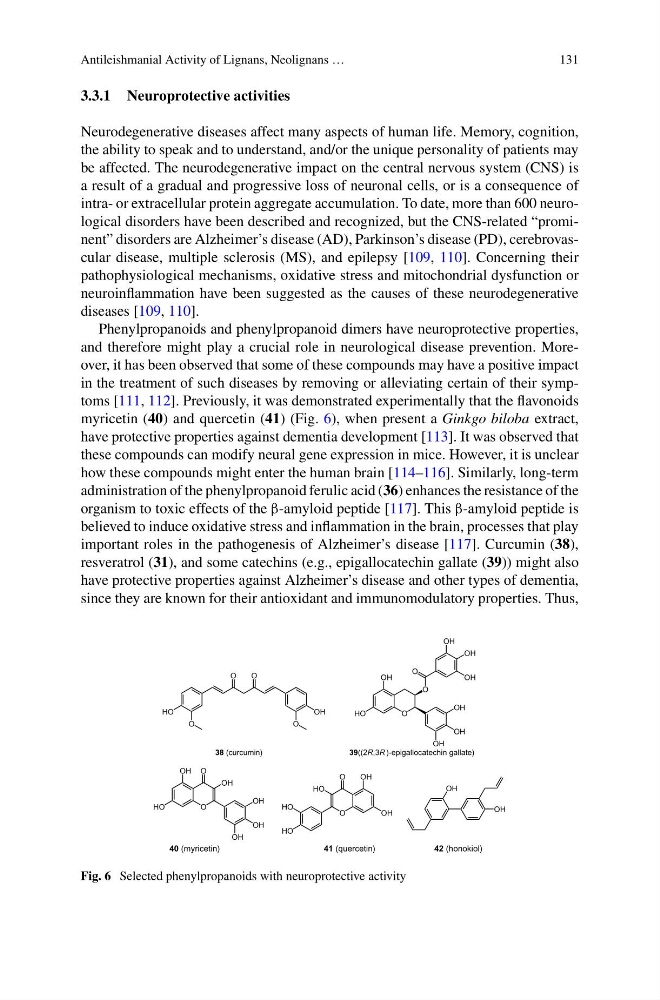
myricetin (40) and quercetin (41) (Fig. 6), when present a Ginkgo biloba extract,
have protective properties against dementia development [113]. It was observed that
these compounds can modify neural gene expression in mice. However, it is unclear
how these compounds might enter the human brain [114–116]. Similarly, long-term
administration of the phenylpropanoid ferulic acid (36) enhances the resistance of the
organism to toxic effects of the β-amyloid peptide [117]. This β-amyloid peptide is
believed to induce oxidative stress and inflammation in the brain, processes that play
important roles in the pathogenesis of Alzheimer’s disease [117]. Curcumin (38),
resveratrol (31), and some catechins (e.g., epigallocatechin gallate (39)) might also
have protective properties against Alzheimer’s disease and other types of dementia,
since they are known for their antioxidant and immunomodulatory properties. Thus,
OH
HO
O
O
OH
OH
OH
OH
OH
OH
O
O
HO
HO
HO
OH
OH
40 (myricetin)
41 (quercetin)
42 (honokiol)
O
HO
O
O
OH
O
38 (curcumin)
39 ((2R,3R )-epigallocatechin gallate)
OH
HO
O
O
OH
OH
OH
O
OH
OH
OH
Fig. 6 Selected phenylpropanoids with neuroprotective activity
131
3.3.1 Neuroprotective activities
Neurodegenerative diseases affect many aspects of human life. Memory, cognition,
the ability to speak and to understand, and/or the unique personality of patients may
be affected. The neurodegenerative impact on the central nervous system (CNS) is
a result of a gradual and progressive loss of neuronal cells, or is a consequence of
intra- or extracellular protein aggregate accumulation. To date, more than 600 neurological disorders have been described and recognized, but the CNS-related “prominent” disorders are Alzheimer’s disease (AD), Parkinson’s disease (PD), cerebrovascular disease, multiple sclerosis (MS), and epilepsy [109, 110]. Concerning their
pathophysiological mechanisms, oxidative stress and mitochondrial dysfunction or
neuroinflammation have been suggested as the causes of these neurodegenerative
diseases [109, 110].
Phenylpropanoids and phenylpropanoid dimers have neuroprotective properties,
and therefore might play a crucial role in neurological disease prevention. Moreover, it has been observed that some of these compounds may have a positive impact
in the treatment of such diseases by removing or alleviating certain of their symptoms [111, 112]. Previously, it was demonstrated experimentally that the flavonoids
myricetin (40) and quercetin (41) (Fig. 6), when present a Ginkgo biloba extract,
have protective properties against dementia development [113]. It was observed that
these compounds can modify neural gene expression in mice. However, it is unclear
how these compounds might enter the human brain [114–116]. Similarly, long-term
administration of the phenylpropanoid ferulic acid (36) enhances the resistance of the
organism to toxic effects of the β-amyloid peptide [117]. This β-amyloid peptide is
believed to induce oxidative stress and inflammation in the brain, processes that play
important roles in the pathogenesis of Alzheimer’s disease [117]. Curcumin (38),
resveratrol (31), and some catechins (e.g., epigallocatechin gallate (39)) might also
have protective properties against Alzheimer’s disease and other types of dementia,
since they are known for their antioxidant and immunomodulatory properties. Thus,
OH
HO
O
O
OH
OH
OH
OH
OH
OH
O
O
HO
HO
HO
OH
OH
40 (myricetin)
41 (quercetin)
42 (honokiol)
O
HO
O
O
OH
O
38 (curcumin)
39 ((2R,3R )-epigallocatechin gallate)
OH
HO
O
O
OH
OH
OH
O
OH
OH
OH
Fig. 6 Selected phenylpropanoids with neuroprotective activity