

Antileishmanial Activity of Lignans, Neolignans …
123
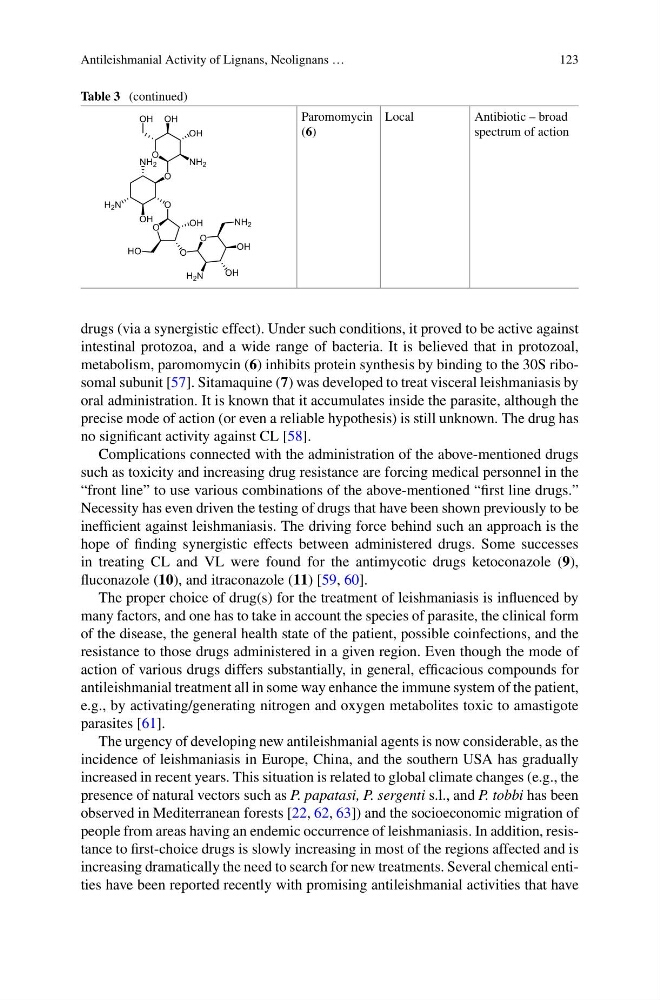
Table 3 (continued)
Paromomycin
(6)
Local
Antibiotic – broad
spectrum of action
drugs (via a synergistic effect). Under such conditions, it proved to be active against
intestinal protozoa, and a wide range of bacteria. It is believed that in protozoal,
metabolism, paromomycin (6) inhibits protein synthesis by binding to the 30S ribosomal subunit [57]. Sitamaquine (7) was developed to treat visceral leishmaniasis by
oral administration. It is known that it accumulates inside the parasite, although the
precise mode of action (or even a reliable hypothesis) is still unknown. The drug has
no significant activity against CL [58].
Complications connected with the administration of the above-mentioned drugs
such as toxicity and increasing drug resistance are forcing medical personnel in the
“front line” to use various combinations of the above-mentioned “first line drugs.”
Necessity has even driven the testing of drugs that have been shown previously to be
inefficient against leishmaniasis. The driving force behind such an approach is the
hope of finding synergistic effects between administered drugs. Some successes
in treating CL and VL were found for the antimycotic drugs ketoconazole (9),
fluconazole (10), and itraconazole (11) [59, 60].
The proper choice of drug(s) for the treatment of leishmaniasis is influenced by
many factors, and one has to take in account the species of parasite, the clinical form
of the disease, the general health state of the patient, possible coinfections, and the
resistance to those drugs administered in a given region. Even though the mode of
action of various drugs differs substantially, in general, efficacious compounds for
antileishmanial treatment all in some way enhance the immune system of the patient,
e.g., by activating/generating nitrogen and oxygen metabolites toxic to amastigote
parasites [61].
The urgency of developing new antileishmanial agents is now considerable, as the
incidence of leishmaniasis in Europe, China, and the southern USA has gradually
increased in recent years. This situation is related to global climate changes (e.g., the
presence of natural vectors such as P. papatasi, P. sergenti s.l., and P. tobbi has been
observed in Mediterranean forests [22, 62, 63]) and the socioeconomic migration of
people from areas having an endemic occurrence of leishmaniasis. In addition, resistance to first-choice drugs is slowly increasing in most of the regions affected and is
increasing dramatically the need to search for new treatments. Several chemical entities have been reported recently with promising antileishmanial activities that have
123
Table 3 (continued)
Paromomycin
(6)
Local
Antibiotic – broad
spectrum of action
drugs (via a synergistic effect). Under such conditions, it proved to be active against
intestinal protozoa, and a wide range of bacteria. It is believed that in protozoal,
metabolism, paromomycin (6) inhibits protein synthesis by binding to the 30S ribosomal subunit [57]. Sitamaquine (7) was developed to treat visceral leishmaniasis by
oral administration. It is known that it accumulates inside the parasite, although the
precise mode of action (or even a reliable hypothesis) is still unknown. The drug has
no significant activity against CL [58].
Complications connected with the administration of the above-mentioned drugs
such as toxicity and increasing drug resistance are forcing medical personnel in the
“front line” to use various combinations of the above-mentioned “first line drugs.”
Necessity has even driven the testing of drugs that have been shown previously to be
inefficient against leishmaniasis. The driving force behind such an approach is the
hope of finding synergistic effects between administered drugs. Some successes
in treating CL and VL were found for the antimycotic drugs ketoconazole (9),
fluconazole (10), and itraconazole (11) [59, 60].
The proper choice of drug(s) for the treatment of leishmaniasis is influenced by
many factors, and one has to take in account the species of parasite, the clinical form
of the disease, the general health state of the patient, possible coinfections, and the
resistance to those drugs administered in a given region. Even though the mode of
action of various drugs differs substantially, in general, efficacious compounds for
antileishmanial treatment all in some way enhance the immune system of the patient,
e.g., by activating/generating nitrogen and oxygen metabolites toxic to amastigote
parasites [61].
The urgency of developing new antileishmanial agents is now considerable, as the
incidence of leishmaniasis in Europe, China, and the southern USA has gradually
increased in recent years. This situation is related to global climate changes (e.g., the
presence of natural vectors such as P. papatasi, P. sergenti s.l., and P. tobbi has been
observed in Mediterranean forests [22, 62, 63]) and the socioeconomic migration of
people from areas having an endemic occurrence of leishmaniasis. In addition, resistance to first-choice drugs is slowly increasing in most of the regions affected and is
increasing dramatically the need to search for new treatments. Several chemical entities have been reported recently with promising antileishmanial activities that have