

112
S. B. Christensen et al.
Thapsia garganica and the chemical and pharmacological properties were investigated leading to the intellectual properties of
right behind the biotechnical company GenSpera Ltd. In addition, a number of other natural products have been investigated.
He is co-author of over 185 publications in international scientific journals and has been named as co-inventor of more than
10 patents. From 2010 to 2015, he managed the project, “A
New Sustainable Platform for Production of Natural Products as
Illustrated by Production of Thapsigargin in Moss”, supported
by the Danish Research Council for Strategic Research.
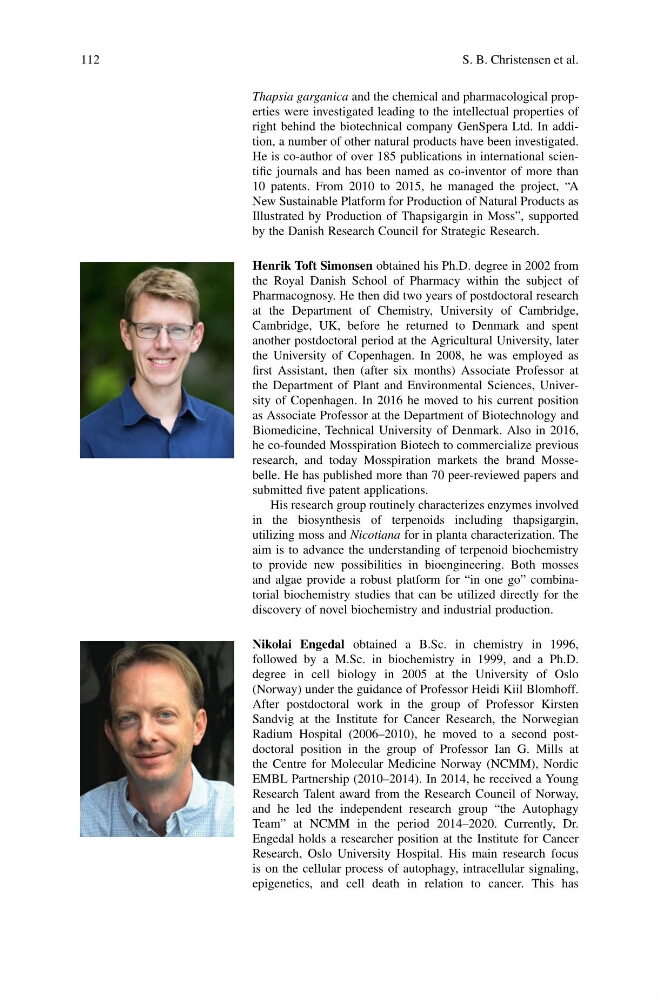
Henrik Toft Simonsen obtained his Ph.D. degree in 2002 from
the Royal Danish School of Pharmacy within the subject of
Pharmacognosy. He then did two years of postdoctoral research
at the Department of Chemistry, University of Cambridge,
Cambridge, UK, before he returned to Denmark and spent
another postdoctoral period at the Agricultural University, later
the University of Copenhagen. In 2008, he was employed as
first Assistant, then (after six months) Associate Professor at
the Department of Plant and Environmental Sciences, University of Copenhagen. In 2016 he moved to his current position
as Associate Professor at the Department of Biotechnology and
Biomedicine, Technical University of Denmark. Also in 2016,
he co-founded Mosspiration Biotech to commercialize previous
research, and today Mosspiration markets the brand Mossebelle. He has published more than 70 peer-reviewed papers and
submitted five patent applications.
His research group routinely characterizes enzymes involved
in the biosynthesis of terpenoids including thapsigargin,
utilizing moss and Nicotiana for in planta characterization. The
aim is to advance the understanding of terpenoid biochemistry
to provide new possibilities in bioengineering. Both mosses
and algae provide a robust platform for “in one go” combinatorial biochemistry studies that can be utilized directly for the
discovery of novel biochemistry and industrial production.
Nikolai Engedal obtained a B.Sc. in chemistry in 1996,
followed by a M.Sc. in biochemistry in 1999, and a Ph.D.
degree in cell biology in 2005 at the University of Oslo
(Norway) under the guidance of Professor Heidi Kiil Blomhoff.
After postdoctoral work in the group of Professor Kirsten
Sandvig at the Institute for Cancer Research, the Norwegian
Radium Hospital (2006–2010), he moved to a second postdoctoral position in the group of Professor Ian G. Mills at
the Centre for Molecular Medicine Norway (NCMM), Nordic
EMBL Partnership (2010–2014). In 2014, he received a Young
Research Talent award from the Research Council of Norway,
and he led the independent research group “the Autophagy
Team” at NCMM in the period 2014–2020. Currently, Dr.
Engedal holds a researcher position at the Institute for Cancer
Research, Oslo University Hospital. His main research focus
is on the cellular process of autophagy, intracellular signaling,
epigenetics, and cell death in relation to cancer. This has
S. B. Christensen et al.
Thapsia garganica and the chemical and pharmacological properties were investigated leading to the intellectual properties of
right behind the biotechnical company GenSpera Ltd. In addition, a number of other natural products have been investigated.
He is co-author of over 185 publications in international scientific journals and has been named as co-inventor of more than
10 patents. From 2010 to 2015, he managed the project, “A
New Sustainable Platform for Production of Natural Products as
Illustrated by Production of Thapsigargin in Moss”, supported
by the Danish Research Council for Strategic Research.
Henrik Toft Simonsen obtained his Ph.D. degree in 2002 from
the Royal Danish School of Pharmacy within the subject of
Pharmacognosy. He then did two years of postdoctoral research
at the Department of Chemistry, University of Cambridge,
Cambridge, UK, before he returned to Denmark and spent
another postdoctoral period at the Agricultural University, later
the University of Copenhagen. In 2008, he was employed as
first Assistant, then (after six months) Associate Professor at
the Department of Plant and Environmental Sciences, University of Copenhagen. In 2016 he moved to his current position
as Associate Professor at the Department of Biotechnology and
Biomedicine, Technical University of Denmark. Also in 2016,
he co-founded Mosspiration Biotech to commercialize previous
research, and today Mosspiration markets the brand Mossebelle. He has published more than 70 peer-reviewed papers and
submitted five patent applications.
His research group routinely characterizes enzymes involved
in the biosynthesis of terpenoids including thapsigargin,
utilizing moss and Nicotiana for in planta characterization. The
aim is to advance the understanding of terpenoid biochemistry
to provide new possibilities in bioengineering. Both mosses
and algae provide a robust platform for “in one go” combinatorial biochemistry studies that can be utilized directly for the
discovery of novel biochemistry and industrial production.
Nikolai Engedal obtained a B.Sc. in chemistry in 1996,
followed by a M.Sc. in biochemistry in 1999, and a Ph.D.
degree in cell biology in 2005 at the University of Oslo
(Norway) under the guidance of Professor Heidi Kiil Blomhoff.
After postdoctoral work in the group of Professor Kirsten
Sandvig at the Institute for Cancer Research, the Norwegian
Radium Hospital (2006–2010), he moved to a second postdoctoral position in the group of Professor Ian G. Mills at
the Centre for Molecular Medicine Norway (NCMM), Nordic
EMBL Partnership (2010–2014). In 2014, he received a Young
Research Talent award from the Research Council of Norway,
and he led the independent research group “the Autophagy
Team” at NCMM in the period 2014–2020. Currently, Dr.
Engedal holds a researcher position at the Institute for Cancer
Research, Oslo University Hospital. His main research focus
is on the cellular process of autophagy, intracellular signaling,
epigenetics, and cell death in relation to cancer. This has