

94
S. B. Christensen et al.
12.3 Sarco-Endoplasmic Reticulum ATPase (SERCA)
The SERCA protein family consists of at least ten isoforms, SERCA 1a and 1b,
SERCA 2a–2c, and SERCA 3a–3f [182]. The affinity between the different SERCA
isoforms and thapsigargin (1) varies with K i values of 0.21 nM towards SERCA1b,
1.3 nM towards SERCA2b, and 12 nM towards SERCA3a [108, 130, 133, 183–185].
By complexing to the binding site (Fig. 10), 1 makes movements of the transmembrane segment impossible. The immobility of the enzyme prevents Ca
2+ transportation. The pump is locked in an E2 conformation without Ca
2+ ions [186]. Accordingly,
cells incubated with 1 in a sub- or low μM concentrations quickly undergo apoptosis. Being a P-type ATPase, the pump transports two ions of calcium against the
concentration gradient into the ER by the energy released by phosphorylation of an
aspartate residue [187]. Two to three hydrogen ions are counter-transported, meaning
that the pump creates an electrochemical voltage over the membrane [187, 188]. The
pumping cycle is well understood, even though some details still are missing [189].
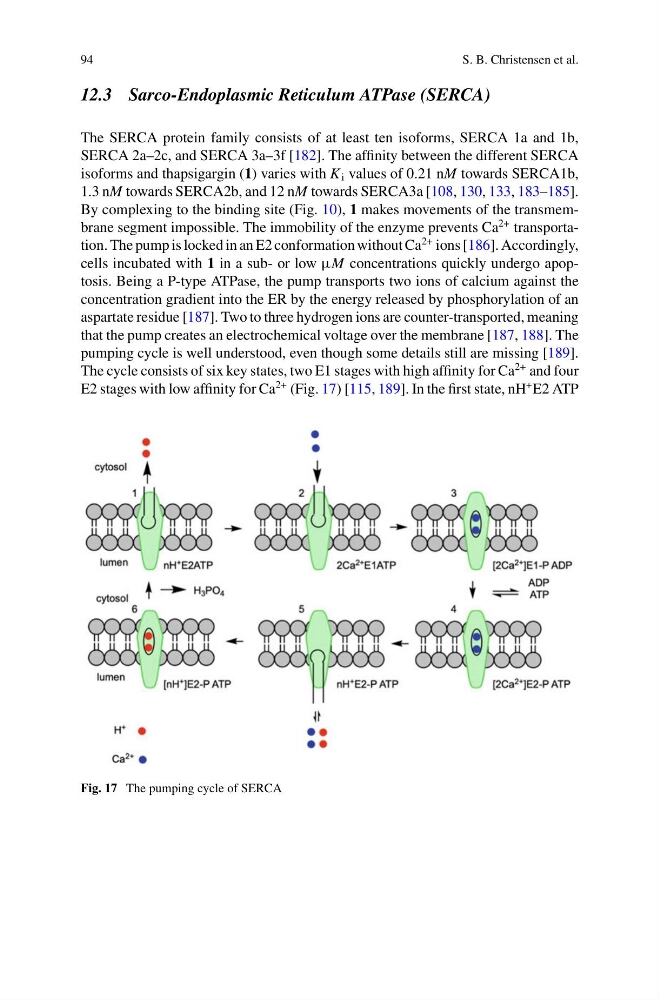
The cycle consists of six key states, two E1 stages with high affinity for Ca
2+ and four
E2 stages with low affinity for Ca
2+ (Fig. 17) [115, 189]. In the first state, nH
+ E2 ATP
Fig. 17 The pumping cycle of SERCA
S. B. Christensen et al.
12.3 Sarco-Endoplasmic Reticulum ATPase (SERCA)
The SERCA protein family consists of at least ten isoforms, SERCA 1a and 1b,
SERCA 2a–2c, and SERCA 3a–3f [182]. The affinity between the different SERCA
isoforms and thapsigargin (1) varies with K i values of 0.21 nM towards SERCA1b,
1.3 nM towards SERCA2b, and 12 nM towards SERCA3a [108, 130, 133, 183–185].
By complexing to the binding site (Fig. 10), 1 makes movements of the transmembrane segment impossible. The immobility of the enzyme prevents Ca
2+ transportation. The pump is locked in an E2 conformation without Ca
2+ ions [186]. Accordingly,
cells incubated with 1 in a sub- or low μM concentrations quickly undergo apoptosis. Being a P-type ATPase, the pump transports two ions of calcium against the
concentration gradient into the ER by the energy released by phosphorylation of an
aspartate residue [187]. Two to three hydrogen ions are counter-transported, meaning
that the pump creates an electrochemical voltage over the membrane [187, 188]. The
pumping cycle is well understood, even though some details still are missing [189].
The cycle consists of six key states, two E1 stages with high affinity for Ca
2+ and four
E2 stages with low affinity for Ca
2+ (Fig. 17) [115, 189]. In the first state, nH
+ E2 ATP
Fig. 17 The pumping cycle of SERCA