

5.1 Basic Considerations 85
forces. An exception are layered silicates, mica, which are based on electrostatic
attraction between the layers and alkaline ions positioned in-between the layers.
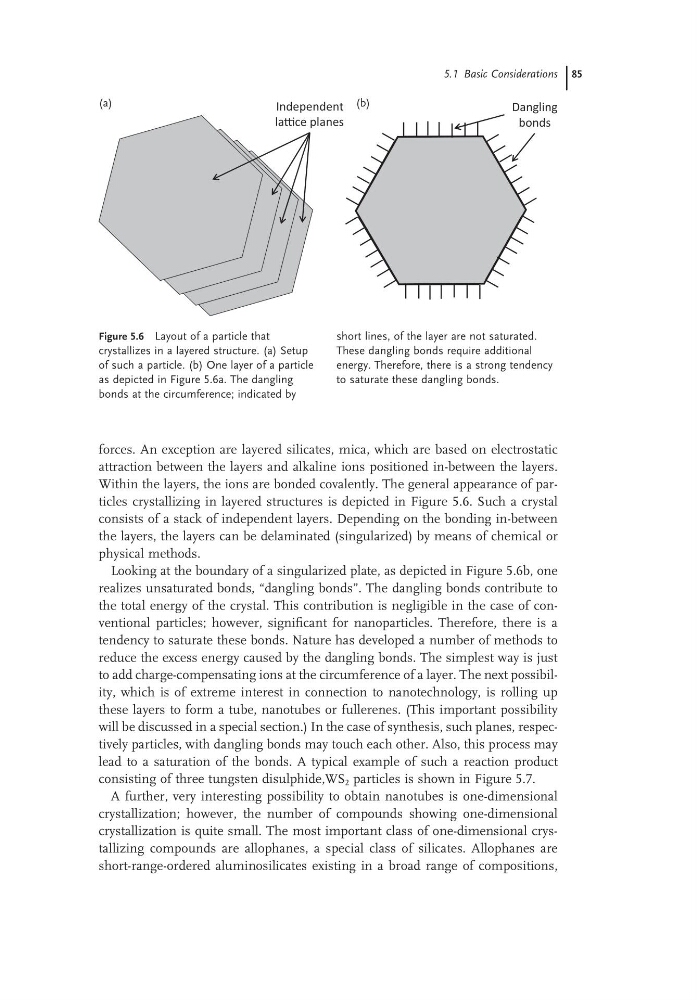
Within the layers, the ions are bonded covalently. The general appearance of particles crystallizing in layered structures is depicted in Figure 5.6. Such a crystal
consists of a stack of independent layers. Depending on the bonding in-between
the layers, the layers can be delaminated (singularized) by means of chemical or
physical methods.
Looking at the boundary of a singularized plate, as depicted in Figure 5.6b, one
realizes unsaturated bonds, “dangling bonds”. The dangling bonds contribute to
the total energy of the crystal. This contribution is negligible in the case of conventional particles; however, significant for nanoparticles. Therefore, there is a
tendency to saturate these bonds. Nature has developed a number of methods to
reduce the excess energy caused by the dangling bonds. The simplest way is just
to add charge-compensating ions at the circumference of a layer. The next possibility, which is of extreme interest in connection to nanotechnology, is rolling up
these layers to form a tube, nanotubes or fullerenes. (This important possibility
will be discussed in a special section.) In the case of synthesis, such planes, respectively particles, with dangling bonds may touch each other. Also, this process may
lead to a saturation of the bonds. A typical example of such a reaction product
consisting of three tungsten disulphide,WS 2 particles is shown in Figure 5.7.
A further, very interesting possibility to obtain nanotubes is one-dimensional
crystallization; however, the number of compounds showing one-dimensional
crystallization is quite small. The most important class of one-dimensional crystallizing compounds are allophanes, a special class of silicates. Allophanes are
short-range-ordered aluminosilicates existing in a broad range of compositions,
Figure 5.6 Layout of a particle that
crystallizes in a layered structure. (a) Setup
of such a particle. (b) One layer of a particle
as depicted in Figure 5.6a. The dangling
bonds at the circumference; indicated by
short lines, of the layer are not saturated.
These dangling bonds require additional
energy. Therefore, there is a strong tendency
to saturate these dangling bonds.
Independent
laƫce planes
Dangling
bonds
(a)
(b)
forces. An exception are layered silicates, mica, which are based on electrostatic
attraction between the layers and alkaline ions positioned in-between the layers.
Within the layers, the ions are bonded covalently. The general appearance of particles crystallizing in layered structures is depicted in Figure 5.6. Such a crystal
consists of a stack of independent layers. Depending on the bonding in-between
the layers, the layers can be delaminated (singularized) by means of chemical or
physical methods.
Looking at the boundary of a singularized plate, as depicted in Figure 5.6b, one
realizes unsaturated bonds, “dangling bonds”. The dangling bonds contribute to
the total energy of the crystal. This contribution is negligible in the case of conventional particles; however, significant for nanoparticles. Therefore, there is a
tendency to saturate these bonds. Nature has developed a number of methods to
reduce the excess energy caused by the dangling bonds. The simplest way is just
to add charge-compensating ions at the circumference of a layer. The next possibility, which is of extreme interest in connection to nanotechnology, is rolling up
these layers to form a tube, nanotubes or fullerenes. (This important possibility
will be discussed in a special section.) In the case of synthesis, such planes, respectively particles, with dangling bonds may touch each other. Also, this process may
lead to a saturation of the bonds. A typical example of such a reaction product
consisting of three tungsten disulphide,WS 2 particles is shown in Figure 5.7.
A further, very interesting possibility to obtain nanotubes is one-dimensional
crystallization; however, the number of compounds showing one-dimensional
crystallization is quite small. The most important class of one-dimensional crystallizing compounds are allophanes, a special class of silicates. Allophanes are
short-range-ordered aluminosilicates existing in a broad range of compositions,
Figure 5.6 Layout of a particle that
crystallizes in a layered structure. (a) Setup
of such a particle. (b) One layer of a particle
as depicted in Figure 5.6a. The dangling
bonds at the circumference; indicated by
short lines, of the layer are not saturated.
These dangling bonds require additional
energy. Therefore, there is a strong tendency
to saturate these dangling bonds.
Independent
laƫce planes
Dangling
bonds
(a)
(b)