

80 5 One- and Two-Dimensional Nanoparticles
The same mechanism is valid on combining two prisms. Two rod-like prisms
will combine in a way to extend the length, the second prism will not attach at the
side. In the other case, it is just the opposite: The second platelet will attach at
the side. This is depicted in Figure 5.1. Combinations leading to a minimum of
surface energy are those indicated as (a) and (d). The combinations (b) and (c) are
energetically not favorable, and they will be avoided. One can establish the rule:
Agglomerates of nanorods reduce their surface energy by increasing their aspect
ratio and in the case of nanoplates, surface energy is reduced by decreasing the
aspect ratio. In both cases, the tendency of formng a rod or a plate is enhanced.
It is important to mention that the mechanism described above is valid for
“clean” surfaces only, these are surfaces that are not modified by contaminants or
functionalization. By proper selection of surface-active molecules, it is possible to
grow rods or even plates from isotropic materials. In this context it must be mentioned that even from gold, a cubic material, nanorods and nanoplates are well
known. The interest on these specially shaped nanoparticles is promoted by many
interesting physical properties connected to these structures.
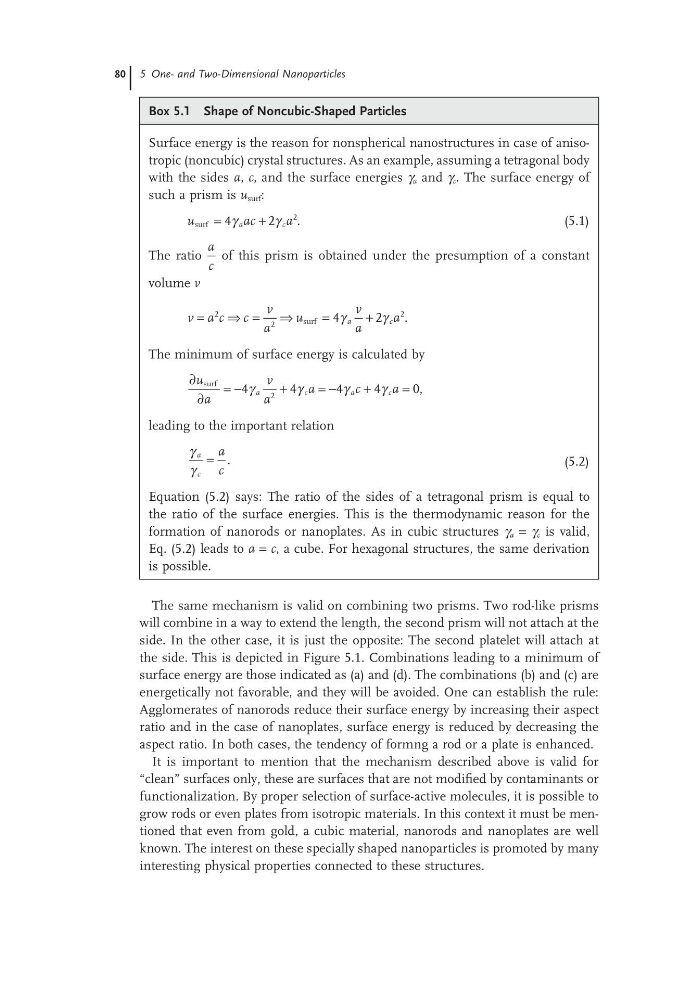
Box 5.1 Shape of Noncubic-Shaped Particles
Surface energy is the reason for nonspherical nanostructures in case of anisotropic (noncubic) crystal structures. As an example, assuming a tetragonal body
with the sides a, c, and the surface energies γ a and γ c . The surface energy of
such a prism is u surf :
u
ac
a
a
c
surf =
+
4
2
2
γ
γ .
(5.1)
The ratio
a
c
of this prism is obtained under the presumption of a constant
volume v
v a c c
v
a
u
v
a
a
a
c
=
⇒ =
⇒
=
+
2
2
2
4
2
surf
γ
γ .
The minimum of surface energy is calculated by
∂
∂
= −
+
= −
+
=
u
a
v
a
a
c
a
a
c
a
c
surf
4
4
4
4
0
2
γ
γ
γ
γ
,
leading to the important relation
γ
γ
a
c
a
c
= .
(5.2)
Equation (5.2) says: The ratio of the sides of a tetragonal prism is equal to
the ratio of the surface energies. This is the thermodynamic reason for the
formation of nanorods or nanoplates. As in cubic structures γ a = γ c is valid,
Eq. (5.2) leads to a = c, a cube. For hexagonal structures, the same derivation
is possible.
The same mechanism is valid on combining two prisms. Two rod-like prisms
will combine in a way to extend the length, the second prism will not attach at the
side. In the other case, it is just the opposite: The second platelet will attach at
the side. This is depicted in Figure 5.1. Combinations leading to a minimum of
surface energy are those indicated as (a) and (d). The combinations (b) and (c) are
energetically not favorable, and they will be avoided. One can establish the rule:
Agglomerates of nanorods reduce their surface energy by increasing their aspect
ratio and in the case of nanoplates, surface energy is reduced by decreasing the
aspect ratio. In both cases, the tendency of formng a rod or a plate is enhanced.
It is important to mention that the mechanism described above is valid for
“clean” surfaces only, these are surfaces that are not modified by contaminants or
functionalization. By proper selection of surface-active molecules, it is possible to
grow rods or even plates from isotropic materials. In this context it must be mentioned that even from gold, a cubic material, nanorods and nanoplates are well
known. The interest on these specially shaped nanoparticles is promoted by many
interesting physical properties connected to these structures.
Box 5.1 Shape of Noncubic-Shaped Particles
Surface energy is the reason for nonspherical nanostructures in case of anisotropic (noncubic) crystal structures. As an example, assuming a tetragonal body
with the sides a, c, and the surface energies γ a and γ c . The surface energy of
such a prism is u surf :
u
ac
a
a
c
surf =
+
4
2
2
γ
γ .
(5.1)
The ratio
a
c
of this prism is obtained under the presumption of a constant
volume v
v a c c
v
a
u
v
a
a
a
c
=
⇒ =
⇒
=
+
2
2
2
4
2
surf
γ
γ .
The minimum of surface energy is calculated by
∂
∂
= −
+
= −
+
=
u
a
v
a
a
c
a
a
c
a
c
surf
4
4
4
4
0
2
γ
γ
γ
γ
,
leading to the important relation
γ
γ
a
c
a
c
= .
(5.2)
Equation (5.2) says: The ratio of the sides of a tetragonal prism is equal to
the ratio of the surface energies. This is the thermodynamic reason for the
formation of nanorods or nanoplates. As in cubic structures γ a = γ c is valid,
Eq. (5.2) leads to a = c, a cube. For hexagonal structures, the same derivation
is possible.