

4.6 Flame Processes 71
in-between two plate electrodes. The field strength was 2 kV cm
–1 . One sees that
both electrodes are covered with particles. This indicates that the particles carry,
as assumed, electrical charges of both sign.
In the arrangement using plate electrodes (Figures 4.30a and 4.31), due to their
electrical charges, the particles are pulled out of the flame. Therefore, the time for
growing and, most importantly, for agglomeration is reduced. This improves the
chance to obtain unagglomerated products with small particles. A different mechanism, however, also with encouraging results is observed in the experimental
setup depicted in Figure 4.30b. At the tips of the needle electrodes, one observes
corona discharge. These electrons move across the flame. Because of their high
energy, these electrons ionize the particles, now all of them carry negative electrical
charges. These negatively charged particles, repelling each other, move to the
positive electrode and are collected. As result, one may expect that the particle
size of the product decreases with increasing field strength between the needle
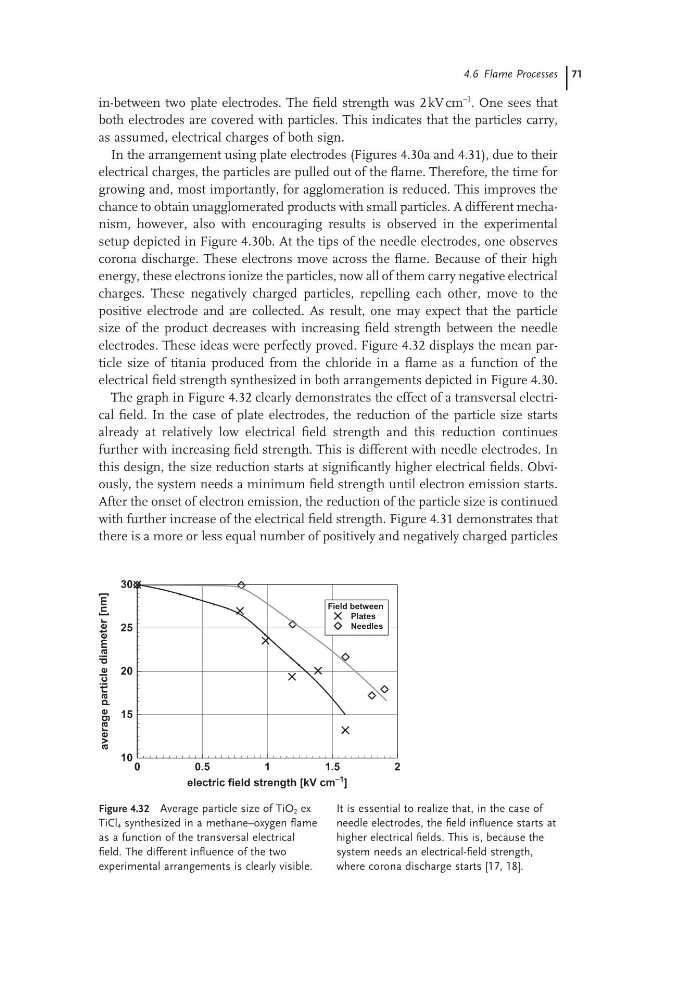
electrodes. These ideas were perfectly proved. Figure 4.32 displays the mean particle size of titania produced from the chloride in a flame as a function of the
electrical field strength synthesized in both arrangements depicted in Figure 4.30.
The graph in Figure 4.32 clearly demonstrates the effect of a transversal electrical field. In the case of plate electrodes, the reduction of the particle size starts
already at relatively low electrical field strength and this reduction continues
further with increasing field strength. This is different with needle electrodes. In
this design, the size reduction starts at significantly higher electrical fields. Obviously, the system needs a minimum field strength until electron emission starts.
After the onset of electron emission, the reduction of the particle size is continued
with further increase of the electrical field strength. Figure 4.31 demonstrates that
there is a more or less equal number of positively and negatively charged particles
Figure 4.32 Average particle size of TiO 2 ex
TiCl 4 synthesized in a methane–oxygen flame
as a function of the transversal electrical
field. The different influence of the two
experimental arrangements is clearly visible.
It is essential to realize that, in the case of
needle electrodes, the field influence starts at
higher electrical fields. This is, because the
system needs an electrical-field strength,
where corona discharge starts [17, 18].
0
0.5
1
1.5
2
electric field strength [kV cm
–1 ]
10
15
20
25
30
average
particle
diameter
[nm]
Field between
Plates
Needles
in-between two plate electrodes. The field strength was 2 kV cm
–1 . One sees that
both electrodes are covered with particles. This indicates that the particles carry,
as assumed, electrical charges of both sign.
In the arrangement using plate electrodes (Figures 4.30a and 4.31), due to their
electrical charges, the particles are pulled out of the flame. Therefore, the time for
growing and, most importantly, for agglomeration is reduced. This improves the
chance to obtain unagglomerated products with small particles. A different mechanism, however, also with encouraging results is observed in the experimental
setup depicted in Figure 4.30b. At the tips of the needle electrodes, one observes
corona discharge. These electrons move across the flame. Because of their high
energy, these electrons ionize the particles, now all of them carry negative electrical
charges. These negatively charged particles, repelling each other, move to the
positive electrode and are collected. As result, one may expect that the particle
size of the product decreases with increasing field strength between the needle
electrodes. These ideas were perfectly proved. Figure 4.32 displays the mean particle size of titania produced from the chloride in a flame as a function of the
electrical field strength synthesized in both arrangements depicted in Figure 4.30.
The graph in Figure 4.32 clearly demonstrates the effect of a transversal electrical field. In the case of plate electrodes, the reduction of the particle size starts
already at relatively low electrical field strength and this reduction continues
further with increasing field strength. This is different with needle electrodes. In
this design, the size reduction starts at significantly higher electrical fields. Obviously, the system needs a minimum field strength until electron emission starts.
After the onset of electron emission, the reduction of the particle size is continued
with further increase of the electrical field strength. Figure 4.31 demonstrates that
there is a more or less equal number of positively and negatively charged particles
Figure 4.32 Average particle size of TiO 2 ex
TiCl 4 synthesized in a methane–oxygen flame
as a function of the transversal electrical
field. The different influence of the two
experimental arrangements is clearly visible.
It is essential to realize that, in the case of
needle electrodes, the field influence starts at
higher electrical fields. This is, because the
system needs an electrical-field strength,
where corona discharge starts [17, 18].
0
0.5
1
1.5
2
electric field strength [kV cm
–1 ]
10
15
20
25
30
average
particle
diameter
[nm]
Field between
Plates
Needles