

4.6 Flame Processes 69
In Figure 4.28 the oxygen content in the flame increased from Figure 4.28a to
4.28b. At low oxygen flow rates, the flame is instable and fluctuating. With increasing oxygen addition the flame is more stable and hotter. The oxygen content in
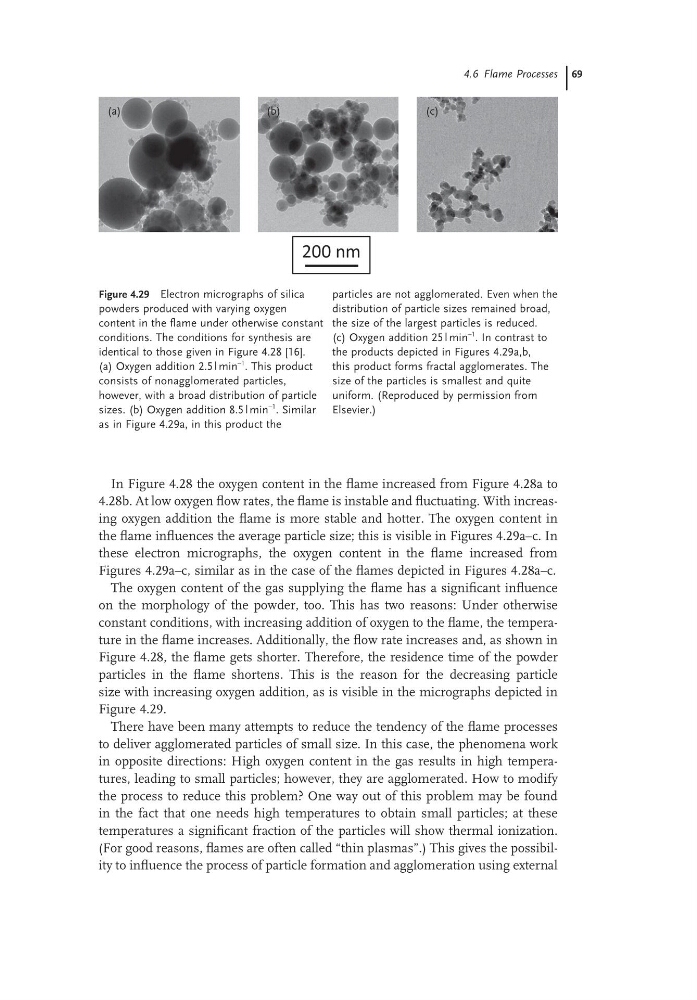
the flame influences the average particle size; this is visible in Figures 4.29a–c. In
these electron micrographs, the oxygen content in the flame increased from
Figures 4.29a–c, similar as in the case of the flames depicted in Figures 4.28a–c.
The oxygen content of the gas supplying the flame has a significant influence
on the morphology of the powder, too. This has two reasons: Under otherwise
constant conditions, with increasing addition of oxygen to the flame, the temperature in the flame increases. Additionally, the flow rate increases and, as shown in
Figure 4.28, the flame gets shorter. Therefore, the residence time of the powder
particles in the flame shortens. This is the reason for the decreasing particle
size with increasing oxygen addition, as is visible in the micrographs depicted in
Figure 4.29.
There have been many attempts to reduce the tendency of the flame processes
to deliver agglomerated particles of small size. In this case, the phenomena work
in opposite directions: High oxygen content in the gas results in high temperatures, leading to small particles; however, they are agglomerated. How to modify
the process to reduce this problem? One way out of this problem may be found
in the fact that one needs high temperatures to obtain small particles; at these
temperatures a significant fraction of the particles will show thermal ionization.
(For good reasons, flames are often called “thin plasmas”.) This gives the possibility to influence the process of particle formation and agglomeration using external
Figure 4.29 Electron micrographs of silica
powders produced with varying oxygen
content in the flame under otherwise constant
conditions. The conditions for synthesis are
identical to those given in Figure 4.28 [16].
(a) Oxygen addition 2.5 l min
−1
. This product
consists of nonagglomerated particles,
however, with a broad distribution of particle
sizes. (b) Oxygen addition 8.5 l min
−1 . Similar
as in Figure 4.29a, in this product the
particles are not agglomerated. Even when the
distribution of particle sizes remained broad,
the size of the largest particles is reduced.
(c) Oxygen addition 25 l min
−1
. In contrast to
the products depicted in Figures 4.29a,b,
this product forms fractal agglomerates. The
size of the particles is smallest and quite
uniform. (Reproduced by permission from
Elsevier.)
200 nm
200 nm
(a)
(b)
(c)
In Figure 4.28 the oxygen content in the flame increased from Figure 4.28a to
4.28b. At low oxygen flow rates, the flame is instable and fluctuating. With increasing oxygen addition the flame is more stable and hotter. The oxygen content in
the flame influences the average particle size; this is visible in Figures 4.29a–c. In
these electron micrographs, the oxygen content in the flame increased from
Figures 4.29a–c, similar as in the case of the flames depicted in Figures 4.28a–c.
The oxygen content of the gas supplying the flame has a significant influence
on the morphology of the powder, too. This has two reasons: Under otherwise
constant conditions, with increasing addition of oxygen to the flame, the temperature in the flame increases. Additionally, the flow rate increases and, as shown in
Figure 4.28, the flame gets shorter. Therefore, the residence time of the powder
particles in the flame shortens. This is the reason for the decreasing particle
size with increasing oxygen addition, as is visible in the micrographs depicted in
Figure 4.29.
There have been many attempts to reduce the tendency of the flame processes
to deliver agglomerated particles of small size. In this case, the phenomena work
in opposite directions: High oxygen content in the gas results in high temperatures, leading to small particles; however, they are agglomerated. How to modify
the process to reduce this problem? One way out of this problem may be found
in the fact that one needs high temperatures to obtain small particles; at these
temperatures a significant fraction of the particles will show thermal ionization.
(For good reasons, flames are often called “thin plasmas”.) This gives the possibility to influence the process of particle formation and agglomeration using external
Figure 4.29 Electron micrographs of silica
powders produced with varying oxygen
content in the flame under otherwise constant
conditions. The conditions for synthesis are
identical to those given in Figure 4.28 [16].
(a) Oxygen addition 2.5 l min
−1
. This product
consists of nonagglomerated particles,
however, with a broad distribution of particle
sizes. (b) Oxygen addition 8.5 l min
−1 . Similar
as in Figure 4.29a, in this product the
particles are not agglomerated. Even when the
distribution of particle sizes remained broad,
the size of the largest particles is reduced.
(c) Oxygen addition 25 l min
−1
. In contrast to
the products depicted in Figures 4.29a,b,
this product forms fractal agglomerates. The
size of the particles is smallest and quite
uniform. (Reproduced by permission from
Elsevier.)
200 nm
200 nm
(a)
(b)
(c)