

4.5 Plasma Processes 63
charges, the resulting products excel with quite a narrow particle-size distribution.
An essential advantage of this design is the ability to adjust the particle size by the
pulse length of the RF. Figure 4.21 displays the dependency of the particle size as
a function of the RF pulse length.
Figure 4.22 shows an electron micrograph of a typical product, in this case hard
magnetic FePt particles. The particles were placed on a holey carbon film. As
expected, the particles depicted in Figure 4.22 are very uniform in size.
4.5.2
RF and DC Plasma Processes
Plasma processes working with direct current, DC, or radio-frequency, RF sources
for the energy supply are high-temperature processes. Therefore, the quenching
step, directly following the plasma synthesis is of essential importance. Additionally, in most cases, argon is used as carrier gas. As argon is, looking at industrial
scales, quite expensive, process gas recycling is of economic importance. Furthermore, one has to distinguish two basic design varieties: Processes using electrodes,
in most cases powered with direct current, DC, or alternating current, AC, and
electrodeless designs powered with radio-frequency, RF, generators. In general,
independent of the power supply, these considerations lead to a process design,
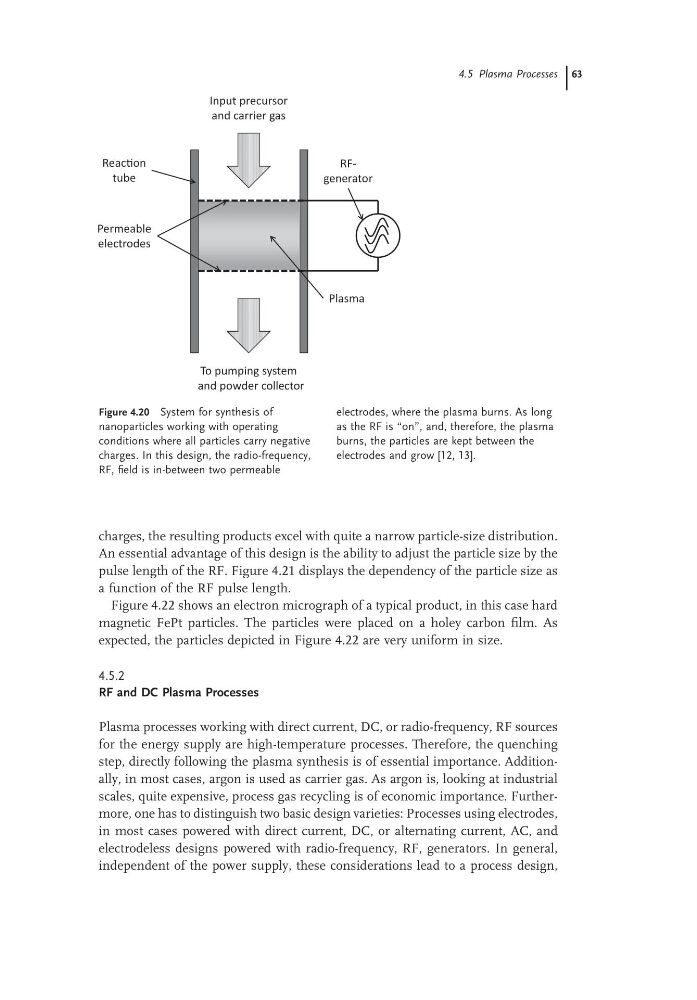
Figure 4.20 System for synthesis of
nanoparticles working with operating
conditions where all particles carry negative
charges. In this design, the radio-frequency,
RF, field is in-between two permeable
electrodes, where the plasma burns. As long
as the RF is “on”, and, therefore, the plasma
burns, the particles are kept between the
electrodes and grow [12, 13].
Input precursor
and carrier gas
ReacƟon
tube
Permeable
electrodes
To pumping system
and powder collector
Plasma
RFgenerator
charges, the resulting products excel with quite a narrow particle-size distribution.
An essential advantage of this design is the ability to adjust the particle size by the
pulse length of the RF. Figure 4.21 displays the dependency of the particle size as
a function of the RF pulse length.
Figure 4.22 shows an electron micrograph of a typical product, in this case hard
magnetic FePt particles. The particles were placed on a holey carbon film. As
expected, the particles depicted in Figure 4.22 are very uniform in size.
4.5.2
RF and DC Plasma Processes
Plasma processes working with direct current, DC, or radio-frequency, RF sources
for the energy supply are high-temperature processes. Therefore, the quenching
step, directly following the plasma synthesis is of essential importance. Additionally, in most cases, argon is used as carrier gas. As argon is, looking at industrial
scales, quite expensive, process gas recycling is of economic importance. Furthermore, one has to distinguish two basic design varieties: Processes using electrodes,
in most cases powered with direct current, DC, or alternating current, AC, and
electrodeless designs powered with radio-frequency, RF, generators. In general,
independent of the power supply, these considerations lead to a process design,
Figure 4.20 System for synthesis of
nanoparticles working with operating
conditions where all particles carry negative
charges. In this design, the radio-frequency,
RF, field is in-between two permeable
electrodes, where the plasma burns. As long
as the RF is “on”, and, therefore, the plasma
burns, the particles are kept between the
electrodes and grow [12, 13].
Input precursor
and carrier gas
ReacƟon
tube
Permeable
electrodes
To pumping system
and powder collector
Plasma
RFgenerator