

4.5 Plasma Processes 61
This leads to the following side reactions:
Side reaction I:
MeCl
OH
H
MeO
HClO
HCl
H
n
m
m x
m x
x
n x
m x
n
+ +
+ +
⇒
+
+ −
+
+ −
−
+
(
)(
) (
)
(
)
2
2 2
Side condition: x
n
<< .
(4.23)
Assuming positively charged particles, one observes
Side reaction II:
H O H
OH particle
OH
particle
OH
2
+
+
neutral
⇒
+
+
⇒
+
+
−
−
−
(
)
(
)
(
(
) )
.
n
n
n
n
(4.24)
This side reaction leads to a neutralization of the particles, which now carry a
hydroxide layer at the surface. As a result, the repulsion mechanism is no
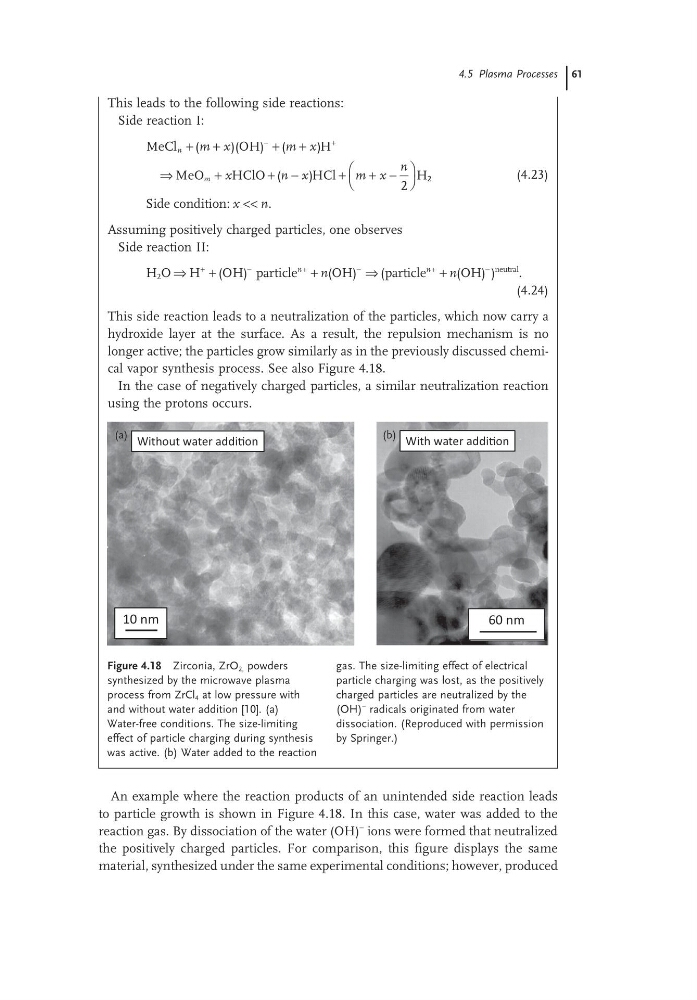
longer active; the particles grow similarly as in the previously discussed chemical vapor synthesis process. See also Figure 4.18.
In the case of negatively charged particles, a similar neutralization reaction
using the protons occurs.
Figure 4.18 Zirconia, ZrO 2, powders
synthesized by the microwave plasma
process from ZrCl 4 at low pressure with
and without water addition [10]. (a)
Water-free conditions. The size-limiting
effect of particle charging during synthesis
was active. (b) Water added to the reaction
gas. The size-limiting effect of electrical
particle charging was lost, as the positively
charged particles are neutralized by the
(OH)
− radicals originated from water
dissociation. (Reproduced with permission
by Springer.)
Without water addiƟon
With water addiƟon
10 nm
60 nm
(a)
(b)
An example where the reaction products of an unintended side reaction leads
to particle growth is shown in Figure 4.18. In this case, water was added to the
reaction gas. By dissociation of the water (OH)
− ions were formed that neutralized
the positively charged particles. For comparison, this figure displays the same
material, synthesized under the same experimental conditions; however, produced
This leads to the following side reactions:
Side reaction I:
MeCl
OH
H
MeO
HClO
HCl
H
n
m
m x
m x
x
n x
m x
n
+ +
+ +
⇒
+
+ −
+
+ −
−
+
(
)(
) (
)
(
)
2
2 2
Side condition: x
n
<< .
(4.23)
Assuming positively charged particles, one observes
Side reaction II:
H O H
OH particle
OH
particle
OH
2
+
+
neutral
⇒
+
+
⇒
+
+
−
−
−
(
)
(
)
(
(
) )
.
n
n
n
n
(4.24)
This side reaction leads to a neutralization of the particles, which now carry a
hydroxide layer at the surface. As a result, the repulsion mechanism is no
longer active; the particles grow similarly as in the previously discussed chemical vapor synthesis process. See also Figure 4.18.
In the case of negatively charged particles, a similar neutralization reaction
using the protons occurs.
Figure 4.18 Zirconia, ZrO 2, powders
synthesized by the microwave plasma
process from ZrCl 4 at low pressure with
and without water addition [10]. (a)
Water-free conditions. The size-limiting
effect of particle charging during synthesis
was active. (b) Water added to the reaction
gas. The size-limiting effect of electrical
particle charging was lost, as the positively
charged particles are neutralized by the
(OH)
− radicals originated from water
dissociation. (Reproduced with permission
by Springer.)
Without water addiƟon
With water addiƟon
10 nm
60 nm
(a)
(b)
An example where the reaction products of an unintended side reaction leads
to particle growth is shown in Figure 4.18. In this case, water was added to the
reaction gas. By dissociation of the water (OH)
− ions were formed that neutralized
the positively charged particles. For comparison, this figure displays the same
material, synthesized under the same experimental conditions; however, produced