

4.3 Physical and Chemical Vapor Synthesis Processes 51
problematic, chlorine-containing compounds in the off-gas and saves energy.
However, there are also a series of severe disadvantages. Problematic may be
not only the high price but also the difficult handling. Handling is difficult,
because most of the carbonyls are highly toxic and of limited stability in open
air. This is valid also for some of the organic precursors, which are quite often
self-igniting. As organic precursor compounds one preferably applies metal
alkoxides and acetyl acetonates. Particularly for metals of the groups II, IIa, and
the rare-earth elements, these are the most important precursors. The application
of precursors, reacting at relatively low temperatures, gives freedom in the
intended powder morphology, as the selected temperature influences the powder
morphology. Low temperatures lead to extreme fine fluffy, often glassy powders,
whereas the products crystallize with higher probability at increased reaction
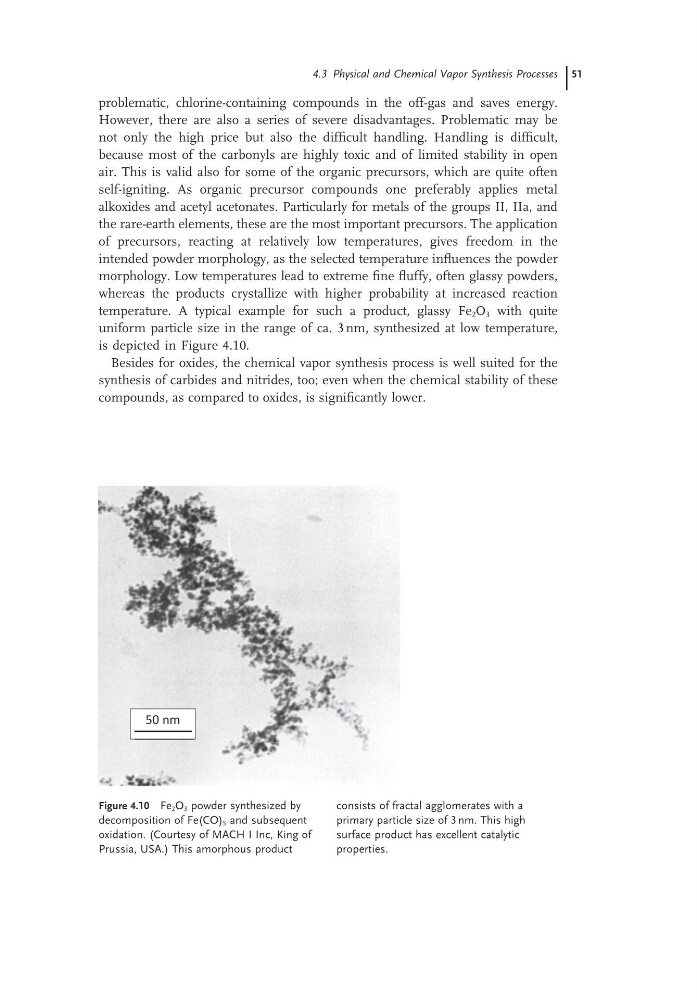
temperature. A typical example for such a product, glassy Fe 2 O 3 with quite
uniform particle size in the range of ca. 3 nm, synthesized at low temperature,
is depicted in Figure 4.10.
Besides for oxides, the chemical vapor synthesis process is well suited for the
synthesis of carbides and nitrides, too; even when the chemical stability of these
compounds, as compared to oxides, is significantly lower.
Figure 4.10 Fe 2 O 3 powder synthesized by
decomposition of Fe(CO) 5 and subsequent
oxidation. (Courtesy of MACH I Inc, King of
Prussia, USA.) This amorphous product
consists of fractal agglomerates with a
primary particle size of 3 nm. This high
surface product has excellent catalytic
properties.
50 nm
problematic, chlorine-containing compounds in the off-gas and saves energy.
However, there are also a series of severe disadvantages. Problematic may be
not only the high price but also the difficult handling. Handling is difficult,
because most of the carbonyls are highly toxic and of limited stability in open
air. This is valid also for some of the organic precursors, which are quite often
self-igniting. As organic precursor compounds one preferably applies metal
alkoxides and acetyl acetonates. Particularly for metals of the groups II, IIa, and
the rare-earth elements, these are the most important precursors. The application
of precursors, reacting at relatively low temperatures, gives freedom in the
intended powder morphology, as the selected temperature influences the powder
morphology. Low temperatures lead to extreme fine fluffy, often glassy powders,
whereas the products crystallize with higher probability at increased reaction
temperature. A typical example for such a product, glassy Fe 2 O 3 with quite
uniform particle size in the range of ca. 3 nm, synthesized at low temperature,
is depicted in Figure 4.10.
Besides for oxides, the chemical vapor synthesis process is well suited for the
synthesis of carbides and nitrides, too; even when the chemical stability of these
compounds, as compared to oxides, is significantly lower.
Figure 4.10 Fe 2 O 3 powder synthesized by
decomposition of Fe(CO) 5 and subsequent
oxidation. (Courtesy of MACH I Inc, King of
Prussia, USA.) This amorphous product
consists of fractal agglomerates with a
primary particle size of 3 nm. This high
surface product has excellent catalytic
properties.
50 nm