

4.1 Fundamental Considerations 43
As mentioned above, having estimated the probability to find one particle in a
certain volume element of an experimental device, the probability to find two
particles in the same volume element is the product of these two probabilities.
Based on this combined probability, it is possible to derive a “collision parameter”
that gives information on the tendency of the collision probability as a function of
the two particle diameters. The probability for the collision of two particles is
linearly proportional to the temperature and the collision parameter, based on the
geometry of the particles, which is proportional to the square root of the product
of the diameters of the collision partners. With respect to optimizing the process
of gas-phase synthesis, the collision probability of two particles gives important
hints on how to obtain small particles: (i) The temperature has to be kept as low
as possible and (ii) the growth of particles by coagulation must be avoided as far
as possible. This conclusion supports the use of a quenching step.
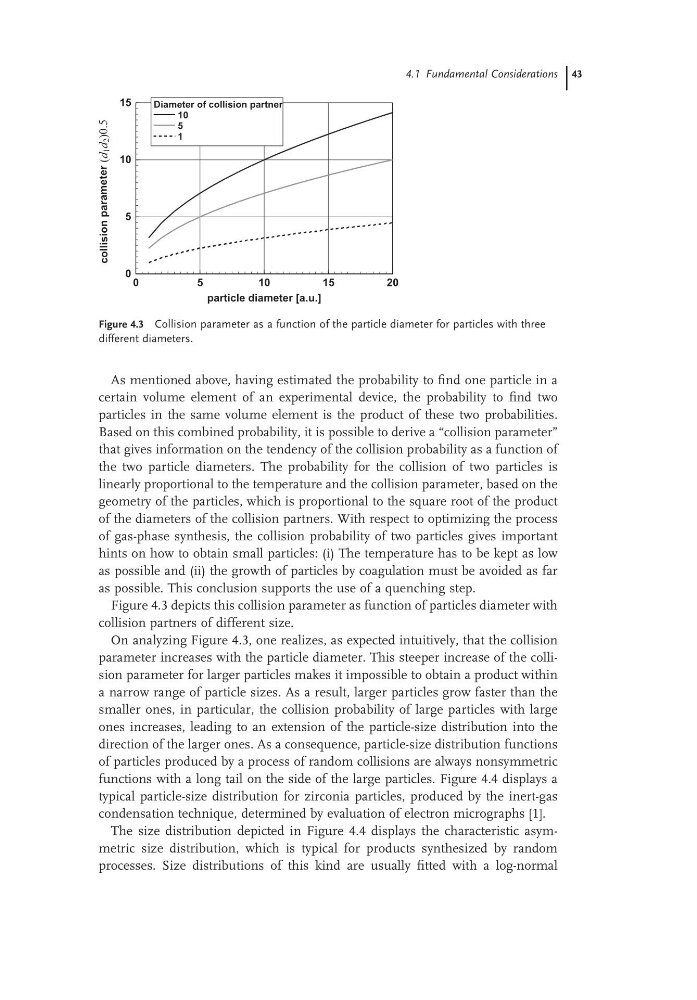
Figure 4.3 depicts this collision parameter as function of particles diameter with
collision partners of different size.
On analyzing Figure 4.3, one realizes, as expected intuitively, that the collision
parameter increases with the particle diameter. This steeper increase of the collision parameter for larger particles makes it impossible to obtain a product within
a narrow range of particle sizes. As a result, larger particles grow faster than the
smaller ones, in particular, the collision probability of large particles with large
ones increases, leading to an extension of the particle-size distribution into the
direction of the larger ones. As a consequence, particle-size distribution functions
of particles produced by a process of random collisions are always nonsymmetric
functions with a long tail on the side of the large particles. Figure 4.4 displays a
typical particle-size distribution for zirconia particles, produced by the inert-gas
condensation technique, determined by evaluation of electron micrographs [1].
The size distribution depicted in Figure 4.4 displays the characteristic asymmetric size distribution, which is typical for products synthesized by random
processes. Size distributions of this kind are usually fitted with a log-normal
Figure 4.3 Collision parameter as a function of the particle diameter for particles with three
different diameters.
0
5
10
15
20
particle diameter [a.u.]
0
5
10
15
collision
parameter
(d 1
d 2
)0.5
Diameter of collision partner
10
5
1
As mentioned above, having estimated the probability to find one particle in a
certain volume element of an experimental device, the probability to find two
particles in the same volume element is the product of these two probabilities.
Based on this combined probability, it is possible to derive a “collision parameter”
that gives information on the tendency of the collision probability as a function of
the two particle diameters. The probability for the collision of two particles is
linearly proportional to the temperature and the collision parameter, based on the
geometry of the particles, which is proportional to the square root of the product
of the diameters of the collision partners. With respect to optimizing the process
of gas-phase synthesis, the collision probability of two particles gives important
hints on how to obtain small particles: (i) The temperature has to be kept as low
as possible and (ii) the growth of particles by coagulation must be avoided as far
as possible. This conclusion supports the use of a quenching step.
Figure 4.3 depicts this collision parameter as function of particles diameter with
collision partners of different size.
On analyzing Figure 4.3, one realizes, as expected intuitively, that the collision
parameter increases with the particle diameter. This steeper increase of the collision parameter for larger particles makes it impossible to obtain a product within
a narrow range of particle sizes. As a result, larger particles grow faster than the
smaller ones, in particular, the collision probability of large particles with large
ones increases, leading to an extension of the particle-size distribution into the
direction of the larger ones. As a consequence, particle-size distribution functions
of particles produced by a process of random collisions are always nonsymmetric
functions with a long tail on the side of the large particles. Figure 4.4 displays a
typical particle-size distribution for zirconia particles, produced by the inert-gas
condensation technique, determined by evaluation of electron micrographs [1].
The size distribution depicted in Figure 4.4 displays the characteristic asymmetric size distribution, which is typical for products synthesized by random
processes. Size distributions of this kind are usually fitted with a log-normal
Figure 4.3 Collision parameter as a function of the particle diameter for particles with three
different diameters.
0
5
10
15
20
particle diameter [a.u.]
0
5
10
15
collision
parameter
(d 1
d 2
)0.5
Diameter of collision partner
10
5
1