

3.4 Hypothetical Nanomotors Driven by Surface Energy 37
in the series of electron micrographs from Figure 3.16a–c. Figure 3.17d depicts
the arrangement after coagulation; now, the process may start again. The time for
complete coagulation was estimated to be in the range of 200 ps.
A further nanomotor, presented by the same group applies the difference of the
surface energy of a material crystallizing in an anisotropic structure. As the metal
to be transported, again indium, crystallizing in a tetragonal structure, was
selected. As in the previous example, the indium atoms are transported at the
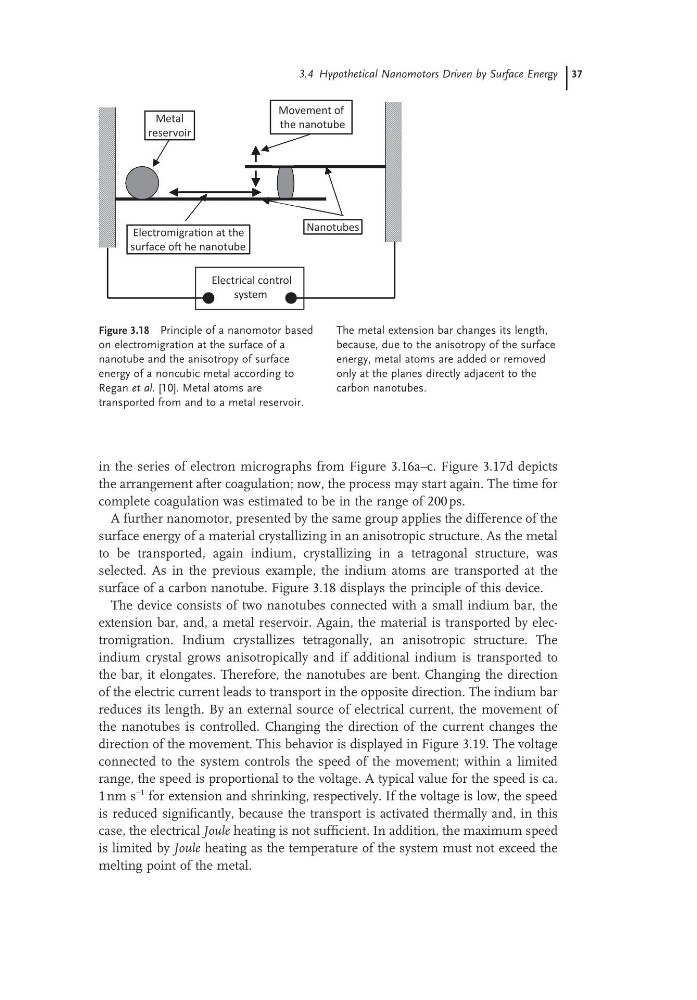
surface of a carbon nanotube. Figure 3.18 displays the principle of this device.
The device consists of two nanotubes connected with a small indium bar, the
extension bar, and, a metal reservoir. Again, the material is transported by electromigration. Indium crystallizes tetragonally, an anisotropic structure. The
indium crystal grows anisotropically and if additional indium is transported to
the bar, it elongates. Therefore, the nanotubes are bent. Changing the direction
of the electric current leads to transport in the opposite direction. The indium bar
reduces its length. By an external source of electrical current, the movement of
the nanotubes is controlled. Changing the direction of the current changes the
direction of the movement. This behavior is displayed in Figure 3.19. The voltage
connected to the system controls the speed of the movement; within a limited
range, the speed is proportional to the voltage. A typical value for the speed is ca.
1 nm s
−1 for extension and shrinking, respectively. If the voltage is low, the speed
is reduced significantly, because the transport is activated thermally and, in this
case, the electrical Joule heating is not sufficient. In addition, the maximum speed
is limited by Joule heating as the temperature of the system must not exceed the
melting point of the metal.
Figure 3.18 Principle of a nanomotor based
on electromigration at the surface of a
nanotube and the anisotropy of surface
energy of a noncubic metal according to
Regan et al. [10]. Metal atoms are
transported from and to a metal reservoir.
The metal extension bar changes its length,
because, due to the anisotropy of the surface
energy, metal atoms are added or removed
only at the planes directly adjacent to the
carbon nanotubes.
Nanotubes
ElectromigraƟon at the
surface oŌ he nanotube
Electrical control
system
Metal
reservoir
Movement of
the nanotube
in the series of electron micrographs from Figure 3.16a–c. Figure 3.17d depicts
the arrangement after coagulation; now, the process may start again. The time for
complete coagulation was estimated to be in the range of 200 ps.
A further nanomotor, presented by the same group applies the difference of the
surface energy of a material crystallizing in an anisotropic structure. As the metal
to be transported, again indium, crystallizing in a tetragonal structure, was
selected. As in the previous example, the indium atoms are transported at the
surface of a carbon nanotube. Figure 3.18 displays the principle of this device.
The device consists of two nanotubes connected with a small indium bar, the
extension bar, and, a metal reservoir. Again, the material is transported by electromigration. Indium crystallizes tetragonally, an anisotropic structure. The
indium crystal grows anisotropically and if additional indium is transported to
the bar, it elongates. Therefore, the nanotubes are bent. Changing the direction
of the electric current leads to transport in the opposite direction. The indium bar
reduces its length. By an external source of electrical current, the movement of
the nanotubes is controlled. Changing the direction of the current changes the
direction of the movement. This behavior is displayed in Figure 3.19. The voltage
connected to the system controls the speed of the movement; within a limited
range, the speed is proportional to the voltage. A typical value for the speed is ca.
1 nm s
−1 for extension and shrinking, respectively. If the voltage is low, the speed
is reduced significantly, because the transport is activated thermally and, in this
case, the electrical Joule heating is not sufficient. In addition, the maximum speed
is limited by Joule heating as the temperature of the system must not exceed the
melting point of the metal.
Figure 3.18 Principle of a nanomotor based
on electromigration at the surface of a
nanotube and the anisotropy of surface
energy of a noncubic metal according to
Regan et al. [10]. Metal atoms are
transported from and to a metal reservoir.
The metal extension bar changes its length,
because, due to the anisotropy of the surface
energy, metal atoms are added or removed
only at the planes directly adjacent to the
carbon nanotubes.
Nanotubes
ElectromigraƟon at the
surface oŌ he nanotube
Electrical control
system
Metal
reservoir
Movement of
the nanotube