

3.4 Hypothetical Nanomotors Driven by Surface Energy 35
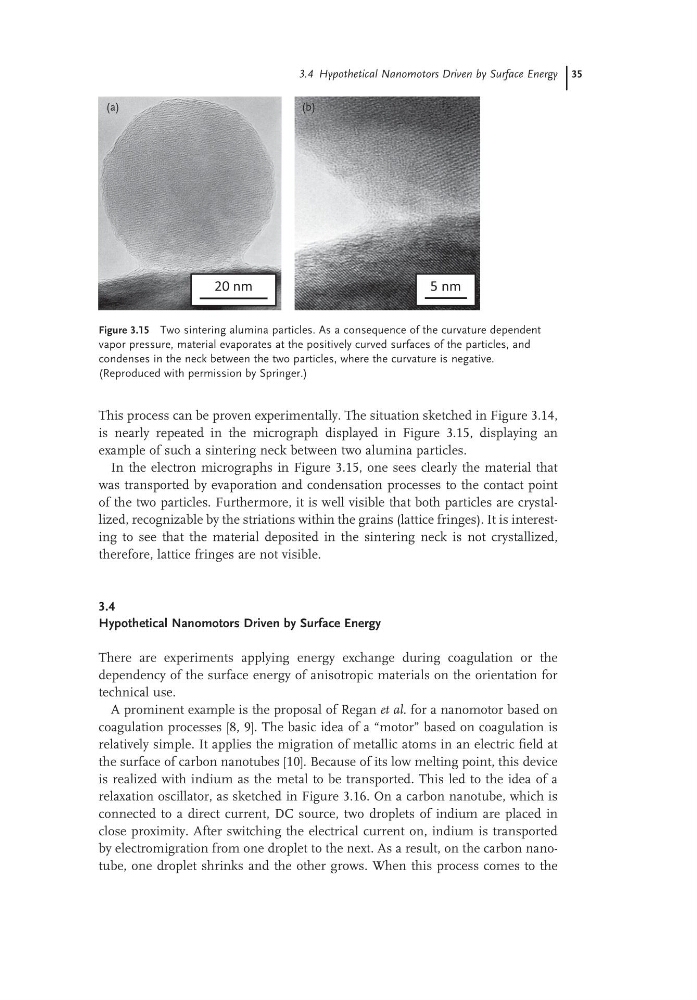
This process can be proven experimentally. The situation sketched in Figure 3.14,
is nearly repeated in the micrograph displayed in Figure 3.15, displaying an
example of such a sintering neck between two alumina particles.
In the electron micrographs in Figure 3.15, one sees clearly the material that
was transported by evaporation and condensation processes to the contact point
of the two particles. Furthermore, it is well visible that both particles are crystallized, recognizable by the striations within the grains (lattice fringes). It is interesting to see that the material deposited in the sintering neck is not crystallized,
therefore, lattice fringes are not visible.
3.4
Hypothetical Nanomotors Driven by Surface Energy
There are experiments applying energy exchange during coagulation or the
dependency of the surface energy of anisotropic materials on the orientation for
technical use.
A prominent example is the proposal of Regan et al. for a nanomotor based on
coagulation processes [8, 9]. The basic idea of a “motor” based on coagulation is
relatively simple. It applies the migration of metallic atoms in an electric field at
the surface of carbon nanotubes [10]. Because of its low melting point, this device
is realized with indium as the metal to be transported. This led to the idea of a
relaxation oscillator, as sketched in Figure 3.16. On a carbon nanotube, which is
connected to a direct current, DC source, two droplets of indium are placed in
close proximity. After switching the electrical current on, indium is transported
by electromigration from one droplet to the next. As a result, on the carbon nanotube, one droplet shrinks and the other grows. When this process comes to the
Figure 3.15 Two sintering alumina particles. As a consequence of the curvature dependent
vapor pressure, material evaporates at the positively curved surfaces of the particles, and
condenses in the neck between the two particles, where the curvature is negative.
(Reproduced with permission by Springer.)
5 nm
20 nm
(a)
(b)
This process can be proven experimentally. The situation sketched in Figure 3.14,
is nearly repeated in the micrograph displayed in Figure 3.15, displaying an
example of such a sintering neck between two alumina particles.
In the electron micrographs in Figure 3.15, one sees clearly the material that
was transported by evaporation and condensation processes to the contact point
of the two particles. Furthermore, it is well visible that both particles are crystallized, recognizable by the striations within the grains (lattice fringes). It is interesting to see that the material deposited in the sintering neck is not crystallized,
therefore, lattice fringes are not visible.
3.4
Hypothetical Nanomotors Driven by Surface Energy
There are experiments applying energy exchange during coagulation or the
dependency of the surface energy of anisotropic materials on the orientation for
technical use.
A prominent example is the proposal of Regan et al. for a nanomotor based on
coagulation processes [8, 9]. The basic idea of a “motor” based on coagulation is
relatively simple. It applies the migration of metallic atoms in an electric field at
the surface of carbon nanotubes [10]. Because of its low melting point, this device
is realized with indium as the metal to be transported. This led to the idea of a
relaxation oscillator, as sketched in Figure 3.16. On a carbon nanotube, which is
connected to a direct current, DC source, two droplets of indium are placed in
close proximity. After switching the electrical current on, indium is transported
by electromigration from one droplet to the next. As a result, on the carbon nanotube, one droplet shrinks and the other grows. When this process comes to the
Figure 3.15 Two sintering alumina particles. As a consequence of the curvature dependent
vapor pressure, material evaporates at the positively curved surfaces of the particles, and
condenses in the neck between the two particles, where the curvature is negative.
(Reproduced with permission by Springer.)
5 nm
20 nm
(a)
(b)