

3.2 Surface Energy 23
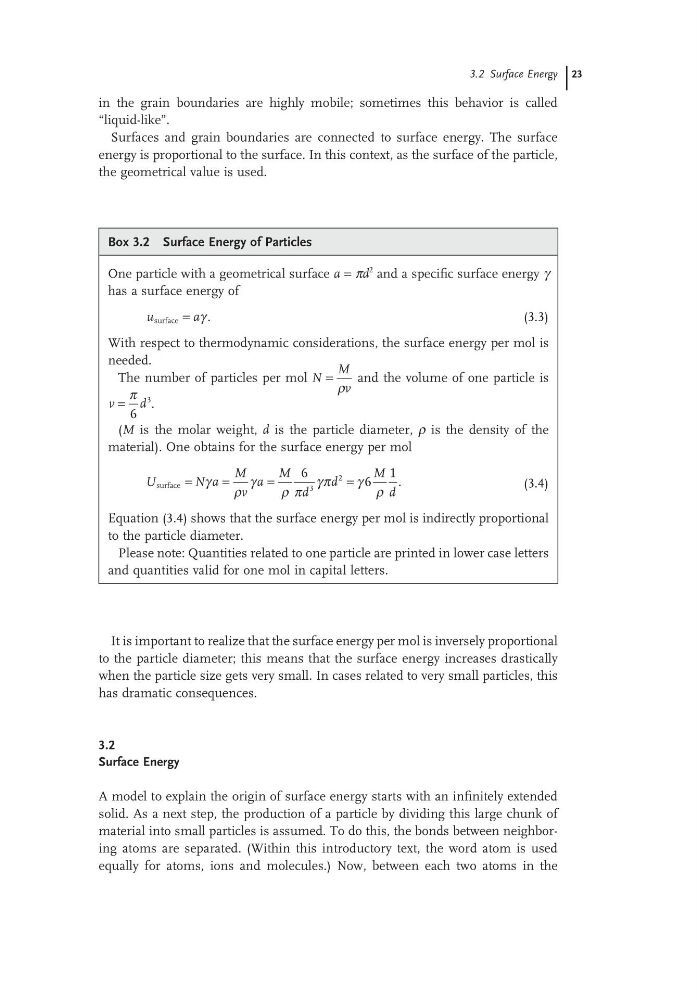
Box 3.2 Surface Energy of Particles
One particle with a geometrical surface a = πd
2 and a specific surface energy γ
has a surface energy of
u
a
surface = γ .
(3.3)
With respect to thermodynamic considerations, the surface energy per mol is
needed.
The number of particles per mol N
M
v
= ρ
and the volume of one particle is
v
d
=
π
6
3 .
(M is the molar weight, d is the particle diameter, ρ is the density of the
material). One obtains for the surface energy per mol
U
N a
M
v
a
M
d
d
M
d
surface =
=
=
=
γ
ρ
γ
ρ π
γπ
γ ρ
6
6
1
3
2
.
(3.4)
Equation (3.4) shows that the surface energy per mol is indirectly proportional
to the particle diameter.
Please note: Quantities related to one particle are printed in lower case letters
and quantities valid for one mol in capital letters.
in the grain boundaries are highly mobile; sometimes this behavior is called
“liquid-like”.
Surfaces and grain boundaries are connected to surface energy. The surface
energy is proportional to the surface. In this context, as the surface of the particle,
the geometrical value is used.
It is important to realize that the surface energy per mol is inversely proportional
to the particle diameter; this means that the surface energy increases drastically
when the particle size gets very small. In cases related to very small particles, this
has dramatic consequences.
3.2
Surface Energy
A model to explain the origin of surface energy starts with an infinitely extended
solid. As a next step, the production of a particle by dividing this large chunk of
material into small particles is assumed. To do this, the bonds between neighboring atoms are separated. (Within this introductory text, the word atom is used
equally for atoms, ions and molecules.) Now, between each two atoms in the
Box 3.2 Surface Energy of Particles
One particle with a geometrical surface a = πd
2 and a specific surface energy γ
has a surface energy of
u
a
surface = γ .
(3.3)
With respect to thermodynamic considerations, the surface energy per mol is
needed.
The number of particles per mol N
M
v
= ρ
and the volume of one particle is
v
d
=
π
6
3 .
(M is the molar weight, d is the particle diameter, ρ is the density of the
material). One obtains for the surface energy per mol
U
N a
M
v
a
M
d
d
M
d
surface =
=
=
=
γ
ρ
γ
ρ π
γπ
γ ρ
6
6
1
3
2
.
(3.4)
Equation (3.4) shows that the surface energy per mol is indirectly proportional
to the particle diameter.
Please note: Quantities related to one particle are printed in lower case letters
and quantities valid for one mol in capital letters.
in the grain boundaries are highly mobile; sometimes this behavior is called
“liquid-like”.
Surfaces and grain boundaries are connected to surface energy. The surface
energy is proportional to the surface. In this context, as the surface of the particle,
the geometrical value is used.
It is important to realize that the surface energy per mol is inversely proportional
to the particle diameter; this means that the surface energy increases drastically
when the particle size gets very small. In cases related to very small particles, this
has dramatic consequences.
3.2
Surface Energy
A model to explain the origin of surface energy starts with an infinitely extended
solid. As a next step, the production of a particle by dividing this large chunk of
material into small particles is assumed. To do this, the bonds between neighboring atoms are separated. (Within this introductory text, the word atom is used
equally for atoms, ions and molecules.) Now, between each two atoms in the