

250 11 Mechanical Properties
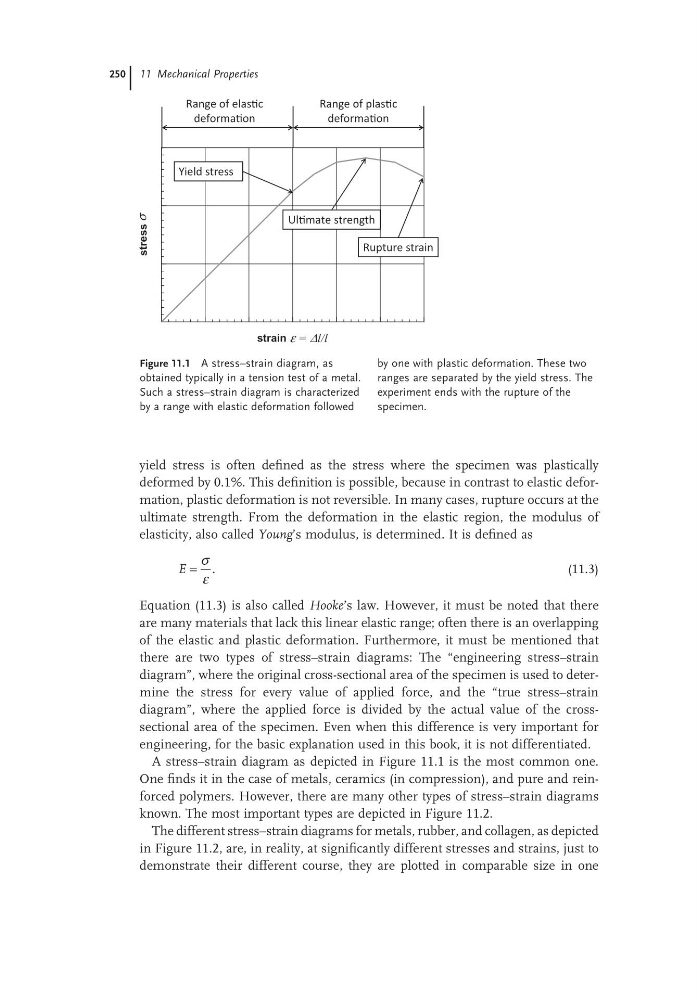
yield stress is often defined as the stress where the specimen was plastically
deformed by 0.1%. This definition is possible, because in contrast to elastic deformation, plastic deformation is not reversible. In many cases, rupture occurs at the
ultimate strength. From the deformation in the elastic region, the modulus of
elasticity, also called Young’s modulus, is determined. It is defined as
E =
σ
ε
.
(11.3)
Equation (11.3) is also called Hooke’s law. However, it must be noted that there
are many materials that lack this linear elastic range; often there is an overlapping
of the elastic and plastic deformation. Furthermore, it must be mentioned that
there are two types of stress–strain diagrams: The “engineering stress–strain
diagram”, where the original cross-sectional area of the specimen is used to determine the stress for every value of applied force, and the “true stress–strain
diagram”, where the applied force is divided by the actual value of the crosssectional area of the specimen. Even when this difference is very important for
engineering, for the basic explanation used in this book, it is not differentiated.
A stress–strain diagram as depicted in Figure 11.1 is the most common one.
One finds it in the case of metals, ceramics (in compression), and pure and reinforced polymers. However, there are many other types of stress–strain diagrams
known. The most important types are depicted in Figure 11.2.
The different stress–strain diagrams for metals, rubber, and collagen, as depicted
in Figure 11.2, are, in reality, at significantly different stresses and strains, just to
demonstrate their different course, they are plotted in comparable size in one
Figure 11.1 A stress–strain diagram, as
obtained typically in a tension test of a metal.
Such a stress–strain diagram is characterized
by a range with elastic deformation followed
by one with plastic deformation. These two
ranges are separated by the yield stress. The
experiment ends with the rupture of the
specimen.
0
3
6
9
12
15
18
strain ε = ∆l/l
0
4
8
12
stress
σ
Range of plasƟc
deformaƟon
Range of elasƟc
deformaƟon
Yield stress
UlƟmate strength
Rupture strain
yield stress is often defined as the stress where the specimen was plastically
deformed by 0.1%. This definition is possible, because in contrast to elastic deformation, plastic deformation is not reversible. In many cases, rupture occurs at the
ultimate strength. From the deformation in the elastic region, the modulus of
elasticity, also called Young’s modulus, is determined. It is defined as
E =
σ
ε
.
(11.3)
Equation (11.3) is also called Hooke’s law. However, it must be noted that there
are many materials that lack this linear elastic range; often there is an overlapping
of the elastic and plastic deformation. Furthermore, it must be mentioned that
there are two types of stress–strain diagrams: The “engineering stress–strain
diagram”, where the original cross-sectional area of the specimen is used to determine the stress for every value of applied force, and the “true stress–strain
diagram”, where the applied force is divided by the actual value of the crosssectional area of the specimen. Even when this difference is very important for
engineering, for the basic explanation used in this book, it is not differentiated.
A stress–strain diagram as depicted in Figure 11.1 is the most common one.
One finds it in the case of metals, ceramics (in compression), and pure and reinforced polymers. However, there are many other types of stress–strain diagrams
known. The most important types are depicted in Figure 11.2.
The different stress–strain diagrams for metals, rubber, and collagen, as depicted
in Figure 11.2, are, in reality, at significantly different stresses and strains, just to
demonstrate their different course, they are plotted in comparable size in one
Figure 11.1 A stress–strain diagram, as
obtained typically in a tension test of a metal.
Such a stress–strain diagram is characterized
by a range with elastic deformation followed
by one with plastic deformation. These two
ranges are separated by the yield stress. The
experiment ends with the rupture of the
specimen.
0
3
6
9
12
15
18
strain ε = ∆l/l
0
4
8
12
stress
σ
Range of plasƟc
deformaƟon
Range of elasƟc
deformaƟon
Yield stress
UlƟmate strength
Rupture strain