

14 2 Nanoparticles – Nanocomposites
variable of nanoparticles, the surface over volume ratio is discussed. Simple
calculations show that the ratio surface / volume is inversely proportional to
the diameter of the particle. Similar to the surface over volume ratio for one
particle, in molar quantities, this ratio is inversely proportional to the particle
diameter, too.
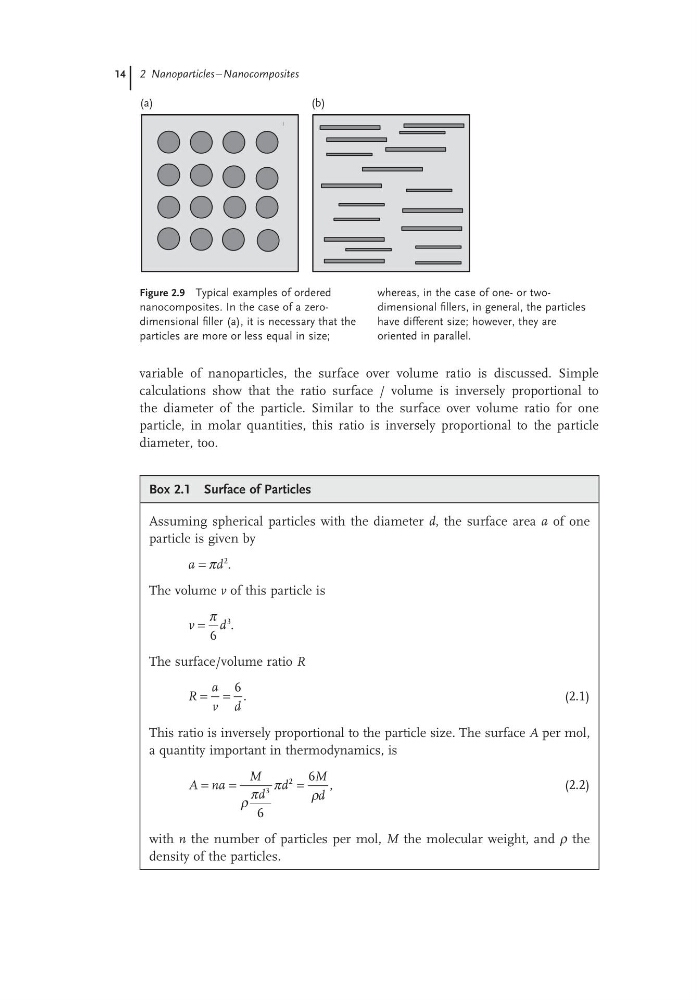
Figure 2.9 Typical examples of ordered
nanocomposites. In the case of a zerodimensional filler (a), it is necessary that the
particles are more or less equal in size;
whereas, in the case of one- or twodimensional fillers, in general, the particles
have different size; however, they are
oriented in parallel.
(a)
(b)
Box 2.1 Surface of Particles
Assuming spherical particles with the diameter d, the surface area a of one
particle is given by
a
d
= π
2
.
The volume v of this particle is
v
d
=
π
6
3
.
The surface/volume ratio R
R
a
v d
= =
6 .
(2.1)
This ratio is inversely proportional to the particle size. The surface A per mol,
a quantity important in thermodynamics, is
A na
M
d
d
M
d
=
=
=
ρ
π
π
ρ
3
2
6
6 ,
(2.2)
with n the number of particles per mol, M the molecular weight, and ρ the
density of the particles.
variable of nanoparticles, the surface over volume ratio is discussed. Simple
calculations show that the ratio surface / volume is inversely proportional to
the diameter of the particle. Similar to the surface over volume ratio for one
particle, in molar quantities, this ratio is inversely proportional to the particle
diameter, too.
Figure 2.9 Typical examples of ordered
nanocomposites. In the case of a zerodimensional filler (a), it is necessary that the
particles are more or less equal in size;
whereas, in the case of one- or twodimensional fillers, in general, the particles
have different size; however, they are
oriented in parallel.
(a)
(b)
Box 2.1 Surface of Particles
Assuming spherical particles with the diameter d, the surface area a of one
particle is given by
a
d
= π
2
.
The volume v of this particle is
v
d
=
π
6
3
.
The surface/volume ratio R
R
a
v d
= =
6 .
(2.1)
This ratio is inversely proportional to the particle size. The surface A per mol,
a quantity important in thermodynamics, is
A na
M
d
d
M
d
=
=
=
ρ
π
π
ρ
3
2
6
6 ,
(2.2)
with n the number of particles per mol, M the molecular weight, and ρ the
density of the particles.