

230 10 Electrical Properties
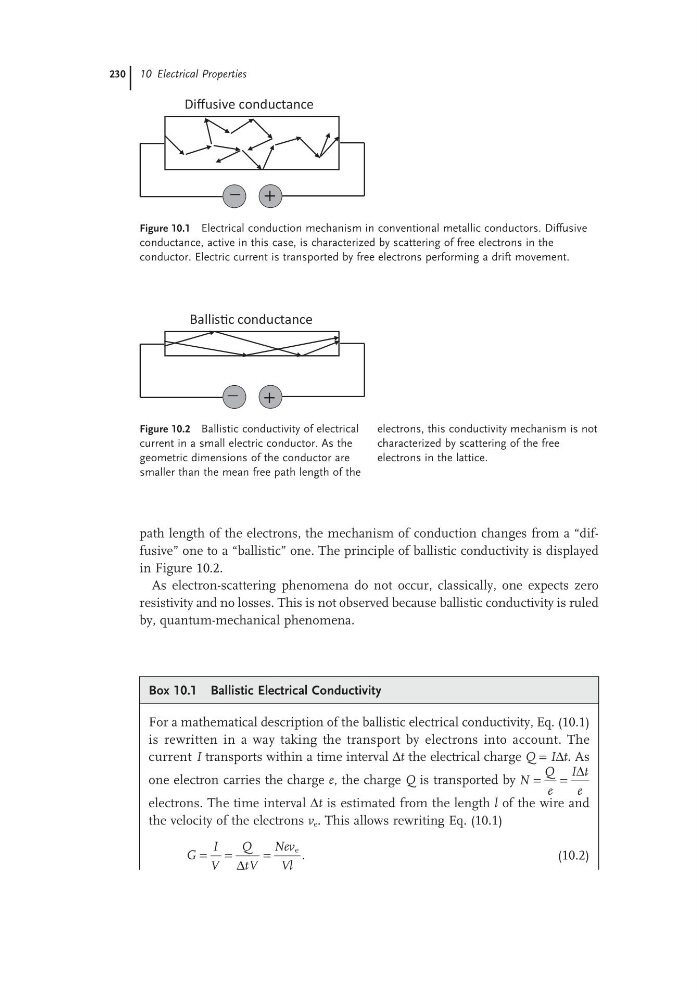
path length of the electrons, the mechanism of conduction changes from a “diffusive” one to a “ballistic” one. The principle of ballistic conductivity is displayed
in Figure 10.2.
As electron-scattering phenomena do not occur, classically, one expects zero
resistivity and no losses. This is not observed because ballistic conductivity is ruled
by, quantum-mechanical phenomena.
Figure 10.1 Electrical conduction mechanism in conventional metallic conductors. Diffusive
conductance, active in this case, is characterized by scattering of free electrons in the
conductor. Electric current is transported by free electrons performing a drift movement.
+
_
Diffusive conductance
Figure 10.2 Ballistic conductivity of electrical
current in a small electric conductor. As the
geometric dimensions of the conductor are
smaller than the mean free path length of the
electrons, this conductivity mechanism is not
characterized by scattering of the free
electrons in the lattice.
+
_
BallisƟc conductance
Box 10.1 Ballistic Electrical Conductivity
For a mathematical description of the ballistic electrical conductivity, Eq. (10.1)
is rewritten in a way taking the transport by electrons into account. The
cur rent I transports within a time interval Δt the electrical charge Q = IΔt. As
one electron carries the charge e, the charge Q is transported by N
Q
e
I t
e
= =
∆
electrons. The time interval Δt is estimated from the length l of the wire and
the velocity of the electrons v e . This allows rewriting Eq. (10.1)
G
I
V
Q
tV
Nev
Vl
= =
=
∆
e .
(10.2)
path length of the electrons, the mechanism of conduction changes from a “diffusive” one to a “ballistic” one. The principle of ballistic conductivity is displayed
in Figure 10.2.
As electron-scattering phenomena do not occur, classically, one expects zero
resistivity and no losses. This is not observed because ballistic conductivity is ruled
by, quantum-mechanical phenomena.
Figure 10.1 Electrical conduction mechanism in conventional metallic conductors. Diffusive
conductance, active in this case, is characterized by scattering of free electrons in the
conductor. Electric current is transported by free electrons performing a drift movement.
+
_
Diffusive conductance
Figure 10.2 Ballistic conductivity of electrical
current in a small electric conductor. As the
geometric dimensions of the conductor are
smaller than the mean free path length of the
electrons, this conductivity mechanism is not
characterized by scattering of the free
electrons in the lattice.
+
_
BallisƟc conductance
Box 10.1 Ballistic Electrical Conductivity
For a mathematical description of the ballistic electrical conductivity, Eq. (10.1)
is rewritten in a way taking the transport by electrons into account. The
cur rent I transports within a time interval Δt the electrical charge Q = IΔt. As
one electron carries the charge e, the charge Q is transported by N
Q
e
I t
e
= =
∆
electrons. The time interval Δt is estimated from the length l of the wire and
the velocity of the electrons v e . This allows rewriting Eq. (10.1)
G
I
V
Q
tV
Nev
Vl
= =
=
∆
e .
(10.2)