

182 9 Optical Properties
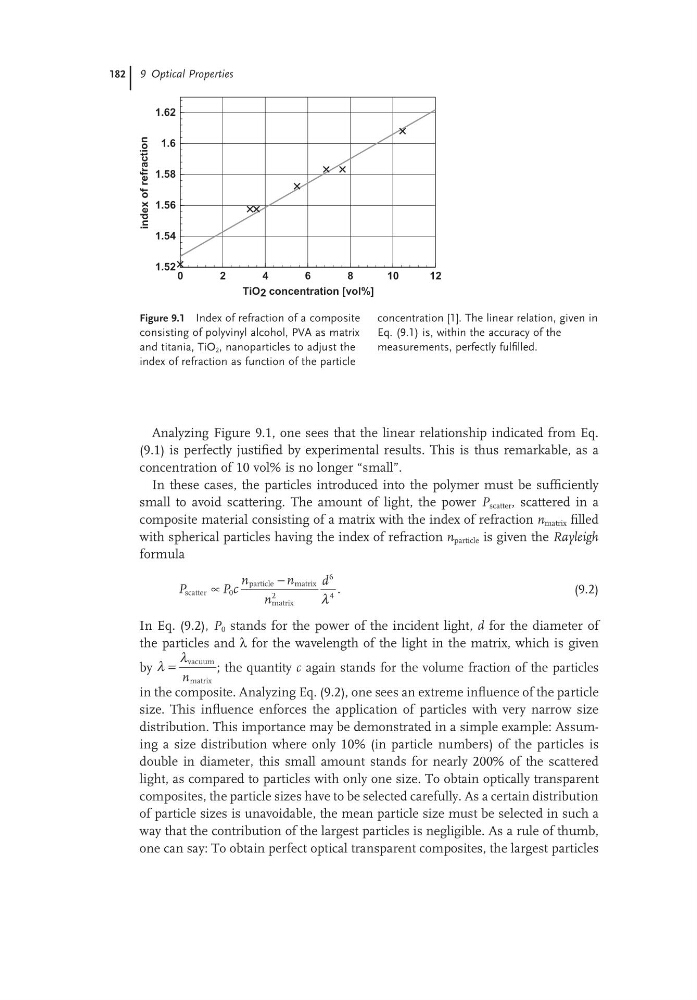
Analyzing Figure 9.1, one sees that the linear relationship indicated from Eq.
(9.1) is perfectly justified by experimental results. This is thus remarkable, as a
concentration of 10 vol% is no longer “small”.
In these cases, the particles introduced into the polymer must be sufficiently
small to avoid scattering. The amount of light, the power P scatter , scattered in a
composite material consisting of a matrix with the index of refraction n matrix filled
with spherical particles having the index of refraction n particle is given the Rayleigh
formula
P
P c
n
n
n
d
scatter
particle
matrix
matrix
∝
−
0
2
6
4
λ
.
(9.2)
In Eq. (9.2), P 0 stands for the power of the incident light, d for the diameter of
the particles and λ for the wavelength of the light in the matrix, which is given
by λ
λ
=
vacuum
matrix
n
; the quantity c again stands for the volume fraction of the particles
in the composite. Analyzing Eq. (9.2), one sees an extreme influence of the particle
size. This influence enforces the application of particles with very narrow size
distribution. This importance may be demonstrated in a simple example: Assuming a size distribution where only 10% (in particle numbers) of the particles is
double in diameter, this small amount stands for nearly 200% of the scattered
light, as compared to particles with only one size. To obtain optically transparent
composites, the particle sizes have to be selected carefully. As a certain distribution
of particle sizes is unavoidable, the mean particle size must be selected in such a
way that the contribution of the largest particles is negligible. As a rule of thumb,
one can say: To obtain perfect optical transparent composites, the largest particles
Figure 9.1 Index of refraction of a composite
consisting of polyvinyl alcohol, PVA as matrix
and titania, TiO 2 , nanoparticles to adjust the
index of refraction as function of the particle
concentration [1]. The linear relation, given in
Eq. (9.1) is, within the accuracy of the
measurements, perfectly fulfilled.
0
2
4
6
8
10
12
TiO 2 concentration [vol%]
1.52
1.54
1.56
1.58
1.6
1.62
index
of
refraction
Analyzing Figure 9.1, one sees that the linear relationship indicated from Eq.
(9.1) is perfectly justified by experimental results. This is thus remarkable, as a
concentration of 10 vol% is no longer “small”.
In these cases, the particles introduced into the polymer must be sufficiently
small to avoid scattering. The amount of light, the power P scatter , scattered in a
composite material consisting of a matrix with the index of refraction n matrix filled
with spherical particles having the index of refraction n particle is given the Rayleigh
formula
P
P c
n
n
n
d
scatter
particle
matrix
matrix
∝
−
0
2
6
4
λ
.
(9.2)
In Eq. (9.2), P 0 stands for the power of the incident light, d for the diameter of
the particles and λ for the wavelength of the light in the matrix, which is given
by λ
λ
=
vacuum
matrix
n
; the quantity c again stands for the volume fraction of the particles
in the composite. Analyzing Eq. (9.2), one sees an extreme influence of the particle
size. This influence enforces the application of particles with very narrow size
distribution. This importance may be demonstrated in a simple example: Assuming a size distribution where only 10% (in particle numbers) of the particles is
double in diameter, this small amount stands for nearly 200% of the scattered
light, as compared to particles with only one size. To obtain optically transparent
composites, the particle sizes have to be selected carefully. As a certain distribution
of particle sizes is unavoidable, the mean particle size must be selected in such a
way that the contribution of the largest particles is negligible. As a rule of thumb,
one can say: To obtain perfect optical transparent composites, the largest particles
Figure 9.1 Index of refraction of a composite
consisting of polyvinyl alcohol, PVA as matrix
and titania, TiO 2 , nanoparticles to adjust the
index of refraction as function of the particle
concentration [1]. The linear relation, given in
Eq. (9.1) is, within the accuracy of the
measurements, perfectly fulfilled.
0
2
4
6
8
10
12
TiO 2 concentration [vol%]
1.52
1.54
1.56
1.58
1.6
1.62
index
of
refraction