

170 8 Magnetic Nanomaterials, Superparamagnetism
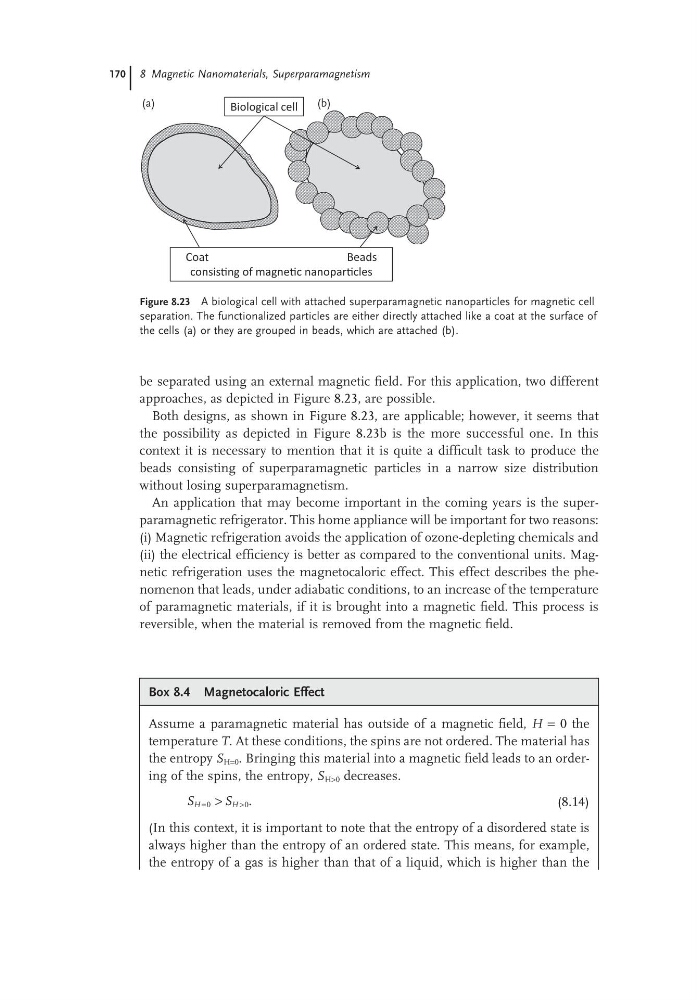
be separated using an external magnetic field. For this application, two different
approaches, as depicted in Figure 8.23, are possible.
Both designs, as shown in Figure 8.23, are applicable; however, it seems that
the possibility as depicted in Figure 8.23b is the more successful one. In this
context it is necessary to mention that it is quite a difficult task to produce the
beads consisting of superparamagnetic particles in a narrow size distribution
without losing superparamagnetism.
An application that may become important in the coming years is the superparamagnetic refrigerator. This home appliance will be important for two reasons:
(i) Magnetic refrigeration avoids the application of ozonedepleting chemicals and
(ii) the electrical efficiency is better as compared to the conventional units. Magnetic refrigeration uses the magnetocaloric effect. This effect describes the phenomenon that leads, under adiabatic conditions, to an increase of the temperature
of paramagnetic materials, if it is brought into a magnetic field. This process is
reversible, when the material is removed from the magnetic field.
Figure 8.23 A biological cell with attached superparamagnetic nanoparticles for magnetic cell
separation. The functionalized particles are either directly attached like a coat at the surface of
the cells (a) or they are grouped in beads, which are attached (b).
Biological cell
s
d
a
e
B
t
a
o
C
consisƟng of magneƟc nanoparƟcles
(a)
(b)
Box 8.4 Magnetocaloric Effect
Assume a paramagnetic material has outside of a magnetic field, H = 0 the
temperature T. At these conditions, the spins are not ordered. The material has
the entropy S H=0 . Bringing this material into a magnetic field leads to an ordering of the spins, the entropy, S H>0 decreases.
S
S
H
H
=
>
>
0
0 .
(8.14)
(In this context, it is important to note that the entropy of a disordered state is
always higher than the entropy of an ordered state. This means, for example,
the entropy of a gas is higher than that of a liquid, which is higher than the
be separated using an external magnetic field. For this application, two different
approaches, as depicted in Figure 8.23, are possible.
Both designs, as shown in Figure 8.23, are applicable; however, it seems that
the possibility as depicted in Figure 8.23b is the more successful one. In this
context it is necessary to mention that it is quite a difficult task to produce the
beads consisting of superparamagnetic particles in a narrow size distribution
without losing superparamagnetism.
An application that may become important in the coming years is the superparamagnetic refrigerator. This home appliance will be important for two reasons:
(i) Magnetic refrigeration avoids the application of ozonedepleting chemicals and
(ii) the electrical efficiency is better as compared to the conventional units. Magnetic refrigeration uses the magnetocaloric effect. This effect describes the phenomenon that leads, under adiabatic conditions, to an increase of the temperature
of paramagnetic materials, if it is brought into a magnetic field. This process is
reversible, when the material is removed from the magnetic field.
Figure 8.23 A biological cell with attached superparamagnetic nanoparticles for magnetic cell
separation. The functionalized particles are either directly attached like a coat at the surface of
the cells (a) or they are grouped in beads, which are attached (b).
Biological cell
s
d
a
e
B
t
a
o
C
consisƟng of magneƟc nanoparƟcles
(a)
(b)
Box 8.4 Magnetocaloric Effect
Assume a paramagnetic material has outside of a magnetic field, H = 0 the
temperature T. At these conditions, the spins are not ordered. The material has
the entropy S H=0 . Bringing this material into a magnetic field leads to an ordering of the spins, the entropy, S H>0 decreases.
S
S
H
H
=
>
>
0
0 .
(8.14)
(In this context, it is important to note that the entropy of a disordered state is
always higher than the entropy of an ordered state. This means, for example,
the entropy of a gas is higher than that of a liquid, which is higher than the